Stainless Steel Worm Gear for CNC | ANSI/DIN, Module 1–3, Hardness 55–60 HRC

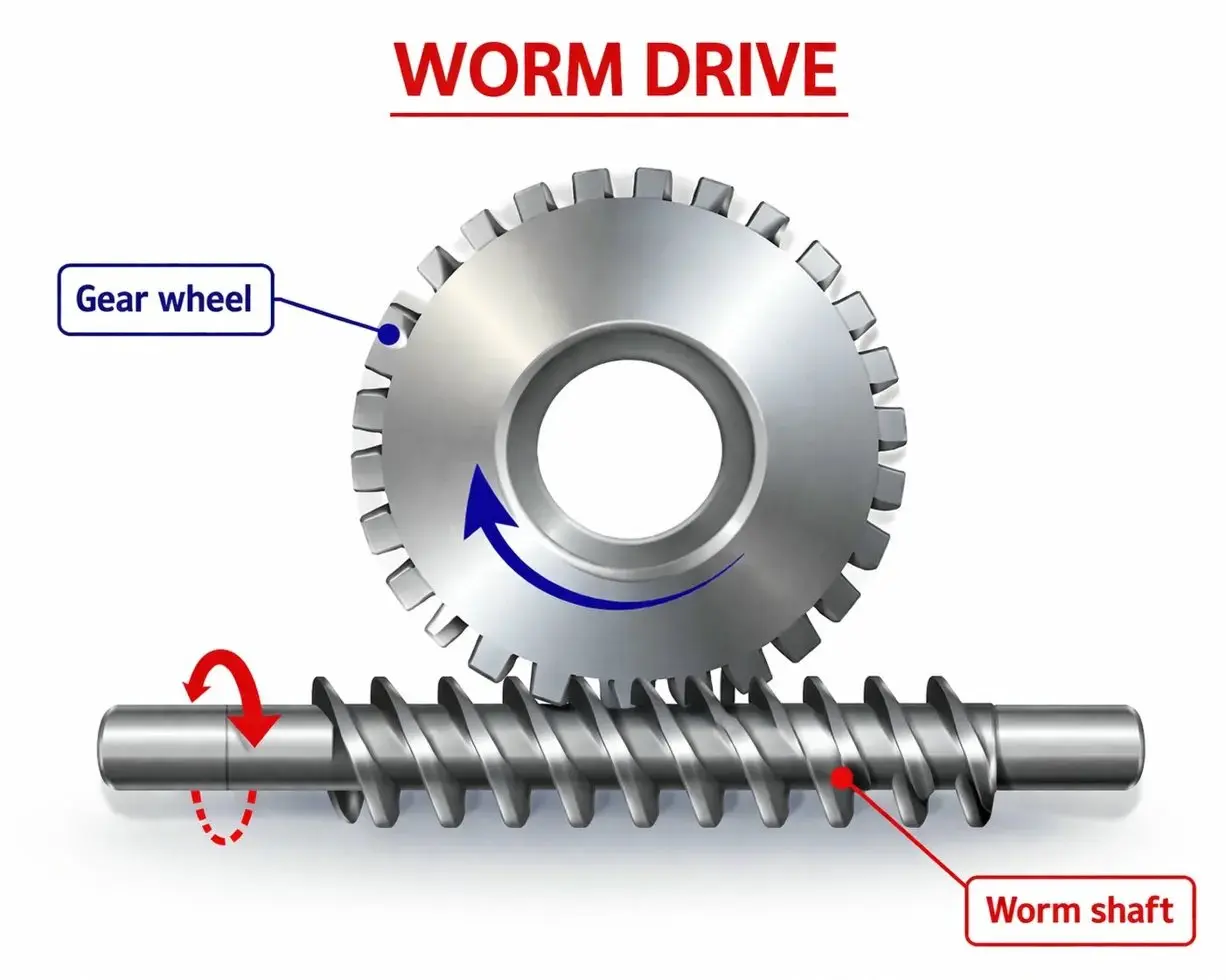
Worm gear produced strictly to ANSI or DIN standard dimensions. Module 1–3, finished bore (straight / straight+tap / keyway+tap), pressure angle 20°, tooth hardness 55–60 HRC. Tooth count Z15–Z70. Materials: 1045 carbon steel (standard), SCM415 alloy steel (DIN5–DIN7 precision), stainless steel SS304/SS316. Left and right twist directions. Full specification table across five module series (M1.0–M3.0) with bore ranges and B/C/D/E/F/G dimensions. ISO 9001:2008 certified.
Product Overview
In CNC machine tool applications, dimensional interchangeability is not a convenience — it is a service and maintenance requirement. When a worm gear fails on a production machine, the replacement part must fit the existing housing bore, shaft, and keyway without any additional machining. If the replacement gear has a slightly different OD, face width, or bore position that is off by even 0.3 mm, the machine is down while a toolmaker reworks the housing or shaft — an expensive consequence of a non-standard part. Korea Ever-Power Worm Gear Co., Ltd manufactures these CNC worm gears strictly following ANSI or DIN standard dimensions across module 1 through 3, so that the part fits the first time. Finished bore, standard pressure angle of 20°, and tooth hardness 55–60 HRC are maintained across the full specification table. For facilities running under ISO or quality certification, the manufacturing ISO 9001:2008 certificate is provided on request.
Main Features
- ✦Produced strictly following ANSI or DIN standard dimensions — direct replacement compatibility with existing standard installations
- ✦Standard material: 1045 Carbon Steel with induction hardening to 55–60 HRC
- ✦Bore: Finished bore — straight bore, straight bore with tap, or keyway with tap; ready to mount without secondary machining
- ✦Module: 1 through 3 (standard catalog); module 1 through 4 available in SCM415 alloy steel grade
Product Parameters
| Product Name | Worm Gear and Worm Wheel |
| Materials Available | Stainless Steel, Carbon Steel, Brass, Bronze, Iron, Aluminum Alloy, Copper, Plastic, Nylon, PA66, MC, PEER, MSM, POM, Derlin etc. |
| Heat Treatment | Quenching & Tempering, Carburizing & Quenching, High-frequency Hardening, Carbonitriding... |
| Surface Treatment | Carburizing and Quenching, Tempering, Tooth surface high quenching Hardening, Tempering |
| BORE | Finished bore, Pilot Bore, Special request |
| Processing Method | Molding, Shaving, Hobbing, Drilling, Tapping, Reaming, Manual Chamfering, Grinding, etc. |
| Pressure Angle | 20 Degree |
| Hardness | 55–60 HRC |
| Size | Customer Drawings & ISO standard |
| Package | Wooden Case/Container and pallet, or made-to-order |
| Certificate | ISO 9001:2008 |
| Applications | Electric machinery, metallurgical machinery, environmental protection machinery, electronic and electrical appliances, road construction machinery, chemical machinery, food machinery, light industrial machinery, mining machinery, transportation machinery, construction machinery, building materials machinery, cement machinery, rubber machinery, water conservancy machinery and petroleum machinery |
| Machining Process | Material preparation → normalizing → rough turning → quenching and tempering → semi-fine turning outer circle → rough turning spiral surface → fine turning / fine grinding inner hole end face, keyway → semi-fine turning spiral surface → pliers (rest incomplete teeth) → semi-fine grinding outer circle → semi-fine grinding spiral surface → grinding center hole → fine grinding outer ring → fine scratching helical surface → finished product inspection |
Key Advantages — SCM415 Grade
The SCM415 alloy steel grade represents the highest precision tier in this product series, combining carburizing heat treatment with ground tooth surfaces to achieve DIN5–DIN7 class accuracy. These advantages apply to the SCM415 version; the 1045 carbon steel grade shares items 1, 3, and 5.
- ✦Produced strictly following ANSI or DIN standard dimensions — interchangeable with existing standard installations
- ✦Material: SCM415 alloy steel — chromium-molybdenum low-carbon steel specifically designed for carburizing applications
- ✦Bore: Finished bore — ready to mount on the specified shaft diameter without any secondary machining operations
- ✦Precision grade: DIN 5 to DIN 7 — suitable for CNC servo axes, precision indexing, and positioning applications requiring angular repeatability below ±30 arc-seconds
- ✦Surface treatment: Carburizing and Quenching — case depth 0.5–1.0 mm of 58–62 HRC surface hardness over a tough core at 30–40 HRC, providing wear resistance on the tooth face and impact resistance at the root
- ✦Module: From 1 to 4 — covers the full range from fine-pitch servo drives to moderate-pitch industrial auxiliary axes
- ✦Tooth count: From Z15 to Z70 — covering ratios from 15:1 (single-start) to over 70:1 depending on the worm design
Steel Grade Selection — 1045 vs SCM415 vs SS304 vs SS316
Four steel grades cover virtually all CNC and process industry applications in this module range. The selection decision is not about one grade being universally superior — it is about matching the material properties to the specific operating environment, load level, and precision requirement. Getting this decision wrong produces either premature failure (undersized material) or unnecessary cost (over-specified material).
1045 Carbon Steel — Standard Grade
Medium carbon steel with carbon content approximately 0.43–0.50%. Induction hardening of the tooth surface achieves 55–60 HRC surface hardness over a soft core, providing good wear resistance with reasonable impact tolerance. This is the most widely used grade for general industrial worm gears operating in clean indoor environments where corrosion is not a concern. Manufacturing cost is the lowest of the four grades — lower raw material cost and simpler heat treatment cycle than alloy or stainless grades. The limitation is corrosion resistance: unprotected 1045 steel surfaces rust in humid or wet environments within days. Surface protection (zinc plating, black oxide, or paint) must be specified separately if the installation environment involves moisture.
Specify when: General industrial drives, indoor clean environments, DIN7–DIN9 precision adequate, budget-sensitive procurement.
SCM415 Alloy Steel — Precision Grade
SCM415 is a chromium-molybdenum low-carbon alloy steel (JIS standard equivalent to ISO 16MnCr5 or SAE 4115) specifically designed for case carburizing applications. The low base carbon (0.13–0.18%) allows the core to remain tough (30–40 HRC) while the carburized case reaches 58–62 HRC. The chromium content (0.9–1.2%) improves the case hardening depth and wear resistance compared to plain carbon steel at the same heat treatment cycle. Molybdenum (0.15–0.25%) further improves hardenability and reduces the risk of temper embrittlement. The resulting tooth has a hard, wear-resistant case and a tough core that resists impact loading — the optimal combination for CNC servo axis worm gears running in precision gearboxes. SCM415 also machines more cleanly than 1045, contributing to the tighter tooth profile accuracy achievable in the DIN5–DIN7 range.
Specify when: CNC servo axes, precision indexing, high-frequency starts-stops, DIN5–DIN7 requirement, maximum service life priority.
SS304 — General Stainless
Austenitic stainless steel with 18% chromium and 8% nickel. Excellent corrosion resistance in most industrial environments including water, mild acids, food acids, and alkaline cleaning solutions. Cannot be through-hardened by heat treatment — surface hardness is achieved only by work hardening during machining and shot peening, reaching approximately 28–35 HRC maximum. This limits the achievable tooth surface hardness to well below the 55–60 HRC range of the carbon and alloy steel grades — meaning SS304 worm gears have lower wear resistance at equivalent loads. For the same service life, the tooth load on SS304 gears must be reduced by approximately 30–40% compared to hardened 1045 steel. The trade-off is completely acceptable in food processing, washdown-environment, and chemical-contact applications where corrosion protection is mandatory and the mechanical load is moderate.
Specify when: Food processing, pharmaceutical, dairy, beverage, washdown environments where AISI 304 is the standard material specification.
SS316 — Marine/Chemical Stainless
SS316 adds 2–3% molybdenum to the SS304 composition, which transforms the corrosion resistance behavior in one critical environment: chloride-containing media. In the presence of chlorides — seawater, chlorinated cleaning solutions, marine atmospheres — SS304 undergoes pitting corrosion at the surface that eventually penetrates to the underlying metal. SS316's molybdenum content suppresses this pitting mechanism, giving it a corrosion potential in chloride environments approximately 50 mV more positive than SS304 — enough to prevent pitting initiation under most marine and halide-processing conditions. The mechanical properties (hardness, load capacity) are essentially identical to SS304. The price premium over SS304 is typically 20–35% per kilogram, which is small compared to the consequences of pitting-induced worm gear failure in a seawater desalination or marine drive application.
Specify when: Marine environments, seawater contact, chlorine processing, coastal outdoor equipment, pharmaceutical CIP with chlorine-based sanitizers.
Full Specification Table — All Modules M1.0 through M3.0
The table below covers all standard bore ranges, tooth counts, and principal dimensions (B, C, D, E, F, G) across five module series. Shaft bore diameters are AH7 tolerance with 1 mm increment steps within each range. Left (L) and right (R) twist directions are available across all sizes. All dimensions in millimeters.
| Number | Number of Teeth |
Shaft Bore Dia. AH7 (1 mm Increment) | Twisting Direction |
B | C | D | E | F | G | ||
| Type | Module | Straight Bore / Straight Bore+Tap | Keyway+Tap | ||||||||
| Straight Bore Straight Bore+Tap Keyway+Tap |
1.0 | 20 | 6 | 8 | L (Left) R (Right) |
17 | 20 | 22 | 8 | 10 | 18 |
| 22–28 | 8 | 8–13 | 18–20 | 22–28 | 24–30 | ||||||
| 30–48 | 10 | 10–17 | 25–30 | 30–48 | 32–50 | ||||||
| 50–70 | 12 | 12–17 | 35–40 | 50–70 | 52–72 | ||||||
| 80–100 | 15 | 15–30 | 50 | 80–100 | 82–102 | ||||||
| Straight Bore Straight Bore+Tap Keyway+Tap |
1.5 | 20–26 | 12 | 12–17 | 24–32 | 30–39 | 33–42 | 12 | 12 | 24 | |
| 28–44 | 15 | 15–30 | 36–50 | 42–67.5 | 45–70.5 | ||||||
| 45–52 | 18 | 18–40 | 50–60 | 72–78 | 75–81 | ||||||
| 60–100 | 20 | 20–50 | 60–70 | 90–150 | 93–153 | ||||||
| Straight Bore Straight Bore+Tap Keyway+Tap |
2.0 | 15–18 | 12 | 12–17 | 24–30 | 30–36 | 34–40 | 16 | 13 | 29 | |
| 20–28 | 15 | 15–22 | 32–45 | 40–56 | 44–60 | ||||||
| 30–36 | 18 | 18–40 | 50 | 60–72 | 64–76 | ||||||
| 40–48 | 20 | 20–44 | 60 | 80–96 | 84–100 | ||||||
| 50–100 | 25 | 25–60 | 60–100 | 100–200 | 104–204 | ||||||
| Straight Bore Straight Bore+Tap Keyway+Tap |
2.5 | 15–18 | 15 | 15–30 | 30–38 | 37.5–45 | 42.5–50 | 20 | 14 | 34 | |
| 20–24 | 18 | 18–40 | 40–48 | 50–60 | 55–65 | ||||||
| 25–36 | 20 | 20–50 | 50–70 | 62.5–90 | 67.5–95 | ||||||
| 40–60 | 25 | 25–70 | 70–80 | 90–150 | 95–155 | ||||||
| Straight Bore Straight Bore+Tap Keyway+Tap |
3.0 | 15–18 | 18 | 18–22 | 36–40 | 45–54 | 51–60 | 25 | 16 | 4 | |
Machining Process
The full manufacturing process sequence for these worm gears involves 15 distinct operations, each contributing to the final tooth geometry accuracy and surface integrity. Understanding the sequence explains why the hardness and tolerance specifications are achievable — and why shortcuts at any step would compromise the final part.
The sequence progresses as: Material preparation (bar stock or forging to size) → Normalizing (stress relief to stabilize the material before machining) → Rough turning (outer diameter and face to within 2–3 mm of final dimensions) → Quenching and tempering (through-hardening for core toughness before spiral surface machining) → Semi-fine turning outer circle → Rough turning spiral surface (hobbing the thread profile to within 0.2–0.3 mm of final form) → Fine turning / fine grinding inner hole, end face, keyway (bore geometry set to near-final tolerance) → Semi-fine turning spiral surface → Pliers — rest incomplete teeth (manual completion of tooth tips at run-out) → Semi-fine grinding outer circle → Semi-fine grinding spiral surface → Grinding center hole (re-establishing the reference for final grinding operations) → Fine grinding outer ring → Fine scratching helical surface (final tooth form grinding to achieve DIN class tolerance) → Finished product inspection.
Related Products
Matched bronze worm wheels and sealed gearbox housings in the same module and precision class are available alongside the bare worm. Complete enclosed worm gear reducers using these matched sets, and the full product catalog covering module M1 through M12, are available from the same manufacturing source with ISO 9001:2008 certification covering the full production process.
Production Facility
 |
 |
 |
 |
 |
 |
Frequently Asked Questions
What does "finished bore" mean, and is any machining required at installation?
Finished bore means the bore hole is machined to its final tolerance (H7 fit standard) and is ready to receive a shaft without any additional reaming, boring, or grinding. Straight bore versions can be press-fitted or slip-fitted to a shaft; straight bore with tap adds a set-screw tapped hole for shaft retention without a key; keyway with tap adds a milled keyway for keyed shaft connections. Specify the bore diameter (from the table above) and the bore type when placing your order. Mixed bore types within a batch are accepted — state the split at order confirmation.
Is the stainless steel version dimensionally interchangeable with the 1045 carbon steel version?
Yes — all four material grades (1045, SCM415, SS304, SS316) are produced to the same ANSI/DIN dimensional standard at the same module and tooth count. OD, face width, bore position, and B/C/D/E/F/G dimensions are identical. The material grade affects hardness, corrosion behavior, and achievable precision class, but not the external dimensions. This means you can replace a worn 1045 worm with an SS316 version in a food-processing installation retrofit without modifying the housing or mating components.
Why does SS304/SS316 achieve lower hardness than 1045 or SCM415?
Austenitic stainless steels (SS304, SS316) cannot be hardened by heat treatment because they do not undergo the martensite transformation that carbon and alloy steels rely on for hardening. Their hardness can be increased by cold working (work hardening) during machining and surface treatment, but the maximum achievable hardness is approximately 30–35 HRC — well below the 55–60 HRC achievable with 1045 induction hardening or SCM415 carburizing. For applications where both corrosion resistance and high surface hardness are required simultaneously, consider a nitrided 17-4PH stainless steel — this specialty grade achieves 40–45 HRC while retaining moderate corrosion resistance. Contact us for a quotation on 17-4PH worm gears.
Can left and right twist directions be mixed in the same order batch?
Yes. Left (L) and right (R) twist directions are available across all module sizes and tooth counts in the table. Mixed L/R batches are accepted — state the split quantities at order confirmation. L and R parts are produced from the same tooling setup with the worm regrinding angle reversed; lead time is identical for both directions.
What documentation is provided with the shipment for quality system use?
Standard documentation: packing list and commercial invoice. On request (state at order placement): dimensional inspection report for the batch (bore diameter, OD, pitch, lead), material certificate (chemical composition and mechanical properties from the steel mill), and a copy of the ISO 9001:2008 quality system certificate. For medical or food-processing qualifications requiring specific test standards, contact us before order placement to confirm which tests can be added to the production process.
How long does the carburizing and quenching process take, and does it add lead time?
Carburizing for SCM415 worm gears is a batch process running 8–16 hours at 900–930°C followed by quenching and tempering. The full heat treatment cycle adds approximately 2–3 working days to the production schedule compared to the 1045 induction hardening process (which is a 1–2 hour per-piece operation). For the SCM415 grade at the quantities in the table above, the standard lead time of 20 days (sample) or 25 days (production) already accounts for the carburizing cycle. For urgent orders where this timeline is a constraint, discuss with us — if the furnace batch schedule can accommodate your parts earlier, we will advise.
Customer Reviews
Yoon Seok-min — Plant Engineer, Gyeongnam Food Processing Machinery (Q1 2026)
M2 SS316 worm gears for a daily CIP washdown food processing line. Four months of operation: zero pitting, zero discoloration on the tooth faces, bore fit unchanged after repeated thermal cycling with hot wash water. We had previously used SS304 — the SS304 parts showed surface staining and shallow pitting after 3 months in the chlorinated sanitizer cycle. The SS316 upgrade cost 28% more per piece and has already more than paid back in avoided maintenance downtime. Korea Ever-Power provided the material cert specifying molybdenum content, which our customer's food safety audit required.
Kim Tae-young — CNC Service Engineer, Seoul Machine Tool Distributor (Q4 2025)
SCM415 M1.5 DIN6 class for a customer's precision rotary indexer. We measured the delivered part at 5 tooth positions — all within DIN6 pitch tolerance. After installation, the indexer's angular repeatability improved from ±22 arc-seconds (worn original 1045 part) to ±10 arc-seconds with the new SCM415 gear. The customer's machining accuracy on the fifth axis improved proportionally — they quantified a 0.015 mm improvement in angular hole-pattern accuracy on a family of aerospace parts. Korea Ever-Power delivered in 22 days; they committed 20 days and slipped by two days but notified us in advance with the revised date.
Park Ji-hoon — Maintenance Buyer, Incheon Semiconductor Equipment Co. (Late 2025)
M1.0 Z20 keyway+tap in right twist, 100 pieces for semiconductor wafer handler drives. We measured all 100 bore diameters on incoming — every single piece was within ±0.006 mm of nominal, tighter than the DIN9 spec we ordered. No sorting required; the batch went straight to the assembly line. The keyway position tolerance was also better than our drawing call-out on all 100 pieces. At this purchase volume, Korea Ever-Power's price was 19% below our previous supplier for an equivalent spec. Reorder lead time on the second batch was 20 days as quoted.
Lee Min-jun — Engineering Manager, Daejeon Environmental Machinery Co. (Q2 2025)
M2.5 1045 steel gears in an outdoor wastewater treatment facility — gear housings exposed to moisture and mild H₂S atmosphere from the treatment process. We zinc-plate after procurement and apply an epoxy topcoat. Korea Ever-Power's machined surface preparation is consistent and clean — paint adhesion has been excellent and we have had zero rust-under-coating failures in 18 months of operation. The zinc plating step could be eliminated if we specified SS304, but the cost difference at our volume makes the two-step approach (Korea Ever-Power 1045 + in-house zinc) less expensive than ordering SS304 parts. Good value throughout.
Packing & Shipping

Packing: wooden case or container, pallet, or made-to-order packaging. Payment: T/T, L/C before shipment. Lead time: 20 business days for samples, 25 days for production quantities. ISO 9001:2008 certificate and dimensional inspection report available on request — state at order placement.
Additional information
| Editor | Cxm |
|---|
Related products
-

Alloy Steel Worm and Worm Gear for Auto Parts
-

Customized Worm Gear Set | OEM/ODM, Ratio 20:1–300:1, Full Material & Gear Type Coverage
-

Duplex Worm Gear | Dual-Lead, Continuously Adjustable Backlash
-

Cylindrical Worm Wheel | Line Contact, High Load Capacity, Bronze & Cast Iron
-

Brass Worm Wheel | M0.5, 20T×1T Matched Set
-

Worm and Wheel | Module M3–M12, Ratio 20:1–300:1, Line Contact Transmission
-

Plastic Worm Gear | POM & Nylon, Module M0.2–M2.0, Self-Lubricating Drive