Worm Gear for CNC Machine Tools — Precision Selection Guide
Angular accuracy in a CNC fourth-axis table is only as good as the worm gear set driving it. This guide explains what DIN class, lead error, and backlash actually mean at the cutting tool — and how to specify the right precision worm gear before the workpiece tells you what you got wrong.
What a Bad Worm Gear Actually Costs at the Spindle
Consider a vertical machining center running contour passes on a rotary fourth axis. The worm wheel pitch circle diameter is 120 mm. The gear set has 0.10 mm of backlash accumulated after two years of indexing service. When the axis reverses direction mid-contour, the table does not move for the distance equal to that backlash — then snaps forward to catch up. In angular terms, 0.10 mm at a 60 mm pitch radius equals 0.0017 radians, or approximately 5.7 arc-minutes of dead zone. The result on the workpiece is a visible dwell mark at every direction reversal. Servo compensation cannot eliminate it because the encoder does not see the movement until the gear mesh re-engages.
This is not a tuning problem. It is a gear specification problem — and it can be avoided entirely by understanding three numbers before you order: DIN class, lead error, and backlash at the pitch circle. Korea Ever-Power manufactures precision worm gears for CNC applications where these three numbers are confirmed and documented — not estimated.

Where Worm Drives Appear in CNC Equipment
The 90-degree shaft layout and inherent self-locking at ratios above approximately 15:1 make worm and wheel drives a practical choice for any CNC function that must hold position when the motor is off. They appear throughout the machine tool world in roles that parallel-axis helical gear sets cannot fill without a separate holding brake:
In fourth and fifth axis rotary tables, the worm set forms the final reduction stage between a servo motor and the A or B axis output shaft. The angular resolution available to the CNC controller depends directly on the worm wheel tooth count and the encoder resolution — but the angular accuracy that actually reaches the workpiece depends on the lead error and profile tolerance of the worm gear itself. A CNC control system with 0.001-degree resolution reporting accuracy is meaningless if the mechanical drive has 0.1-degree periodic error from a worn or poorly manufactured worm.
Indexing heads and dividing heads on gear hobbing, grinding, and milling machines use worm drives at the final indexing stage precisely because their pitch error determines the geometric accuracy of every workpiece the machine produces. A gear-tooth spacing error that originates in the dividing head worm wheel propagates directly into every gear cut on that machine. In this context, the worm gear is not a drive component — it is a geometric reference element, and it needs to be treated as one from a procurement standpoint.
Coordinate measuring machine rotary axes and semiconductor wafer handler stages represent the upper end of the precision requirement. In these applications, the worm gear is expected to position a probe tip or wafer stage to within microns of the commanded position, with zero dead zone on direction reversal. Only duplex worm gear sets — where backlash can be adjusted to near-zero and maintained over the life of the drive — are suitable for these applications.
Specification Range — CNC Precision Worm Gear
| Parameter | Range / Options | CNC Application Notes |
|---|---|---|
| Module | M1.0 – M8.0 | M2–M5 for most CNC rotary tables and indexers |
| Precision Class | DIN5 – DIN9 | DIN6–DIN7 standard for 4th axis; DIN5 for CMM / semiconductor |
| Single-stage ratio range | 10:1 – 100:1 | Custom tooth counts — not limited to standard series |
| Worm shaft material | SCM415, 20CrMnTi, SS304, SS316 | SCM415 carburized + ground is standard CNC specification |
| Wheel material | ZCuSn10Pb1 tin bronze, SS316 | SS316 for clean room and medical CNC environments |
| Surface hardness (worm) | 58 – 62 HRC (carburized case) | Core 30 – 38 HRC — tough under servo start-stop cycling |
| Bore tolerance (wheel) | H7 standard; H6 on request | Ready to mount — no secondary reaming required |
| Backlash (standard) | 0.04 – 0.12 mm at pitch circle | Varies by module and DIN class |
| Backlash (duplex) | Adjustable to ± 0.045 mm | Restorable without component replacement over service life |
| Contact pattern (matched pair) | Greater than 70% tooth face coverage | Verified and documented before shipment |
What DIN Class Actually Means at Your CNC Axis
DIN precision class for worm gears controls three independent geometric tolerances: single-pitch error (the variation in angular spacing between adjacent teeth), total pitch error (the deviation of any tooth from its theoretically perfect position around the full circumference), and tooth profile deviation (how much the actual tooth flank shape departs from the theoretical involute). Each affects machined workpiece quality in a different way, and they need to be understood separately — not lumped together as “DIN7 is good enough.”
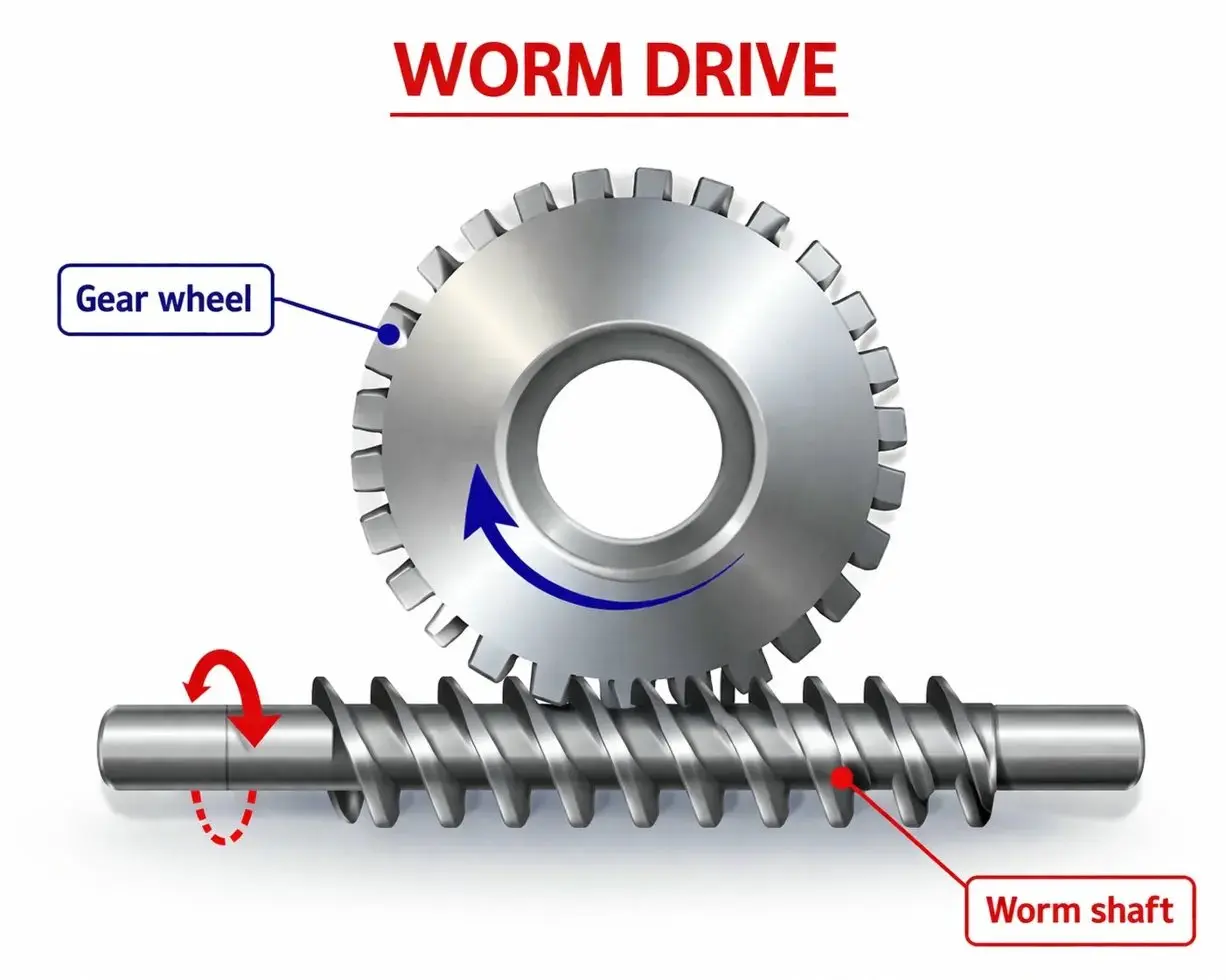
Single-pitch error produces a bump or dip in the angular velocity of the output shaft once per tooth engagement, at a frequency equal to the worm wheel tooth count times the wheel rotation speed. On a fourth-axis contour pass, this appears as a fine repeating surface texture pattern — sometimes visible only under raking light at the angle that catches the surface periodicity. For a 60-tooth wheel rotating at 0.5 RPM, this texture repeats 30 times per minute on the workpiece surface. DIN7 at M3 holds single-pitch error to approximately 18 micrometers; DIN6 holds it to 11 micrometers. The difference is measurable on the workpiece under surface profilometry.
Total pitch error determines how accurately the axis can return to a commanded angular position after a full rotation. For an indexing head that rotates to cut 36 equally-spaced gear teeth, total pitch error in the indexing worm wheel directly causes unequal tooth spacing in every gear produced on that machine. This is why gear grinding and hobbing machines specify DIN6 worm sets as a minimum — the gear being cut inherits the total pitch error of the machine’s indexing drive, multiplied by the gear’s mechanical advantage.
Profile deviation affects smoothness of transmission. A worm tooth with excessive profile deviation produces a varying velocity ratio during each tooth engagement — the wheel accelerates and decelerates slightly as the contact point traverses the tooth flank. This velocity ripple excites vibration at the mesh frequency, which is why some rotary table drives produce an audible tone at certain RPM values even with new gear sets.
Manufacturing at Our Facility
 |
 |
 |
 |
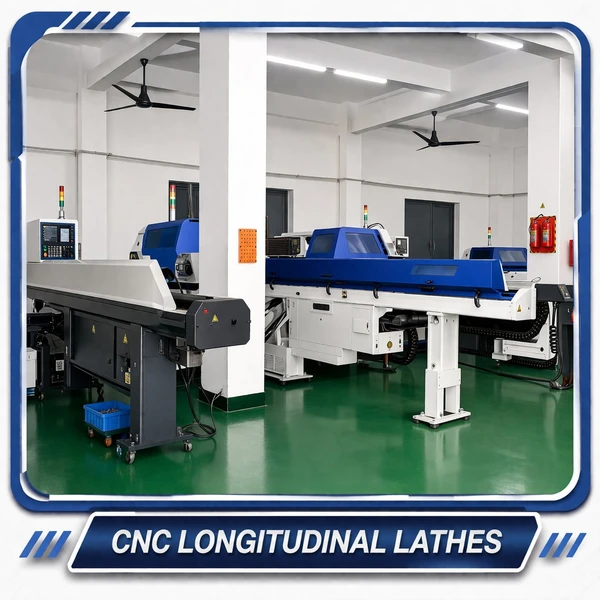
Thread grinding is performed after carburizing on all DIN6 and DIN7 worm shafts. Carburizing distorts the thread geometry — worms measured before and after the heat treatment cycle show lead errors 3 to 5 times larger than the pre-treatment value. Grinding corrects this distortion. Worms that are heat-treated but not subsequently ground carry the full heat treatment distortion into service, which is why many catalog DIN7 claims from lower-cost suppliers do not hold up to CMM verification on incoming inspection.
Duplex Worm Gears — The Backlash Problem Solved Permanently
A standard worm gear set has a fixed tooth thickness on both flanks of the worm thread. Backlash is set at assembly by the center distance between the worm and wheel shafts. As the bronze wheel teeth wear, the tooth gap widens and backlash increases — the only way to recover it is to replace the gear set. For a rotary table on a production machining center, a gear set replacement means taking the machine out of service, disassembling the rotary table, sourcing a replacement set at H7 bore accuracy, reassembling, and re-validating the axis accuracy. This event typically takes 2 to 4 days and costs more in lost production than the gear set itself.
A duplex worm (also called a dual-lead worm) is manufactured with a slightly different lead value on the left and right flanks of the thread. This creates a condition where the tooth thickness increases continuously from one end of the worm to the other — the thread is thicker at one end and thinner at the other. At the matching worm wheel, the different flank profiles produce different tooth gap geometries on the front and rear faces of each wheel tooth, but the critical dimension — wheel tooth thickness around the circumference — remains constant. This means the worm can be shifted axially to bring a thicker or thinner section into mesh with the wheel, closing or opening the backlash gap without changing the contact pattern geometry or load capacity.

In practice, the adjustment is made through an axial set screw or shim stack on the worm shaft bearing housing — a 15-minute procedure with standard hand tools, without removing the rotary table from the machine. A V-groove machined into the reference tooth on the worm identifies the zero-backlash axial position. Starting from this position, the adjustment range typically extends ±0.8 mm of axial shift, corresponding to a backlash adjustment range of approximately 0 to 0.15 mm at the pitch circle, depending on the lead difference specified. A well-maintained duplex set on a production rotary table can be readjusted 4 to 6 times over its service life before the wheel teeth have worn past their design limit — effectively multiplying the gear set’s useful precision life by that factor.
Replacement Reference for Common CNC Component Brands
Brand names below are used for dimensional identification only. Korea Ever-Power has no commercial relationship with these manufacturers and is not an authorized distributor for any of them. All trademarks are the property of their respective owners.
| Brand | Series / Product Range | How to Match |
|---|---|---|
| KHK Gears (Kohara) | SW, SS, SWG series worm wheel sets | Match module, tooth count, bore diameter from KHK part number |
| Boston Gear | L, HL, F series bronze wheel sets | AGMA module and center distance from catalog |
| Ondrives UK | Metric precision worm gear sets | DIN module, tooth count, bore from Ondrives catalog |
| Martin Sprocket | Standard industrial worm gear catalog | AGMA pitch and bore series |
| Güdel | Rotary module worm components | Dimensional drawing confirmation needed for custom flanges |
Customer Project References
Machining Center OEM — Daegu, South Korea · Q3 2024
Drive: B-axis rotary table, M4 DIN7, 40:1 ratio, 250 mm pitch diameter tin bronze wheel, right-hand worm
The OEM had sourced KHK SS4-40R sets from a regional distributor for three years. A 35% price increase and 12-week lead time in late 2023 forced a supplier review. The requirement was dimensional equivalence and the same DIN7 documentation standard as the Japanese original. Three sample sets from Korea Ever-Power were measured on incoming CMM — all three bore diameters within ±0.004 mm of H7 nominal. Angular repeatability testing with Renishaw AxiSet: ±11 arc-seconds against a target of ±15. Contact pattern coverage 76% on all three samples. Standing quarterly order placed within 30 days of sample receipt.
“The contact pattern photo in the documentation meant our quality team could make the approval decision without running a full axis qualification themselves.” — Quality Engineering Manager
CNC Gear Hobbing Machine Builder — Incheon, South Korea · Q1 2025
Drive: Differential indexing worm, M2.5 DIN6, 60:1 ratio, duplex specification
This application demanded DIN6 because every gear hobbed on the machine inherits the indexing drive’s total pitch error. The customer’s previous standard worm set at DIN7 was accumulating backlash after approximately 18 months of continuous production — causing progressive tooth spacing errors in the gears being cut. The duplex replacement was adjusted to 0.030 mm backlash at installation. After 14 months of operation, backlash measured at the 12-month service inspection was 0.061 mm — still within the 0.080 mm threshold, no adjustment required. The customer reported a measurable improvement in their finished gear pitch accuracy across all models produced on that machine.
“We did not realize the indexing drive was the source of our gear pitch problems until we saw the improvement after the duplex upgrade.”
Semiconductor Inspection Equipment Manufacturer — Gyeonggi-do, South Korea · Q2 2024
Drive: Wafer handler stage rotation, M1.5 DIN6, SS316 worm shaft and wheel, electropolished Ra 0.4 µm
Standard tin bronze wheel generated sub-micron copper particles that failed the customer’s ISO Class 5 clean room particle count specification at 0.3 µm. The entire bronze alloy was eliminated from the specification in favor of an SS316 matched pair with electropolished tooth flanks. All-stainless worm gear sets at M1.5 DIN6 are not stocked by most suppliers — Korea Ever-Power quoted a 16-working-day sample lead time against the customer’s 20-day project milestone. Two subsequent production batches over 12 months: zero incoming inspection holds or corrective actions on material compliance.
“Finding DIN6 stainless worm sets in M1.5 with proper documentation was the challenge. Korea Ever-Power solved it inside the project schedule.”
Precision Grinding Machine Retrofitter — Busan, South Korea · Q4 2024
Drive: Wheel dresser traverse on a retrofitted cylindrical grinder, M2 duplex, DIN7
The retrofit was replacing an aging cam-based dresser mechanism with a servo-driven worm drive. The existing bearing races ground on this machine had a profile tolerance of ±0.008 mm. With a standard M2 worm at 0.08 mm backlash, dressing reversal error was 0.015 mm — too large. Duplex M2 set adjusted to 0.018 mm backlash at installation reduced dressing reversal error to 0.006 mm. Ground bearing race profile deviation improved from Rk 1.2 µm to 0.7 µm. The customer was able to move into a higher-tolerance bearing class for one of their main customers as a direct result.
“A standard worm set would have been acceptable for most applications. This one required the duplex, and the geometry gain was measurable on the part.”
Standard Industrial vs CNC Precision — Eight Factors That Separate Them
| Factor | Standard Industrial Worm Gear | Korea Ever-Power CNC Precision Grade |
|---|---|---|
| Tooth accuracy | DIN8 – DIN9 as-hobbed | DIN5 – DIN7, ground after carburizing |
| Post-hardening operation | None — induction harden only | CNC thread grinding after pack carburizing |
| Bore tolerance (wheel) | H8 – H9 | H7 standard; H6 on request |
| Backlash specification | Unspecified — varies by batch | Measured and documented; duplex option to ±0.045 mm |
| Contact pattern check | Not performed | Greater than 70% face width — photograph included in shipment |
| Material traceability | Dimensional report only | Mill cert, heat treatment record, CMM dimensional report |
| Duplex backlash adjustment | Not available | Available — adjustment guide and lead difference spec included |
| Sample lead time | 4 – 8 weeks for catalog items | 15 – 22 working days from confirmed drawing |
For CNC applications requiring a complete enclosed drive unit rather than bare components, precision matched pairs are available in sealed housings. Compact worm gear reducers using CNC-grade matched sets are available for rotary axis and indexing drive applications where a ready-to-mount gearbox is the practical choice over a bare gear set integrated into a custom machine housing.

Frequently Asked Questions
Specify Your CNC Worm Gear — Get a Quote in One Working Day
Send your drawing, DIN class, module, tooth count, bore configuration, and quantity. We respond with a confirmed price and sample lead time within one working day. NDA available before any drawing exchange.
Editor: Cxm