The Drive That Failed in Summer but Not in Winter
A Korean printing plant installed a new worm gear drive on a roll-handling system in October. The drive ran without incident through November, December, January, and February. In mid-July, during the hottest week of the year, it began making noise and running hot. By August it had failed from scuffing of the worm thread flanks. The drive had been correctly specified for the mechanical load. The thermal specification had never been calculated.
The operating conditions in October: ambient temperature 18 degrees C, housing equilibrium temperature approximately 52 degrees C. In July: ambient temperature 34 degrees C (unventilated machine room), housing equilibrium temperature approximately 75 degrees C. At 75 degrees C, the ISO VG 460 mineral oil had viscosity below 100 cSt — inadequate for the required EHD film thickness at this sliding velocity. The drive was mechanically rated for the load at all seasons. It was thermally rated only for winter.
Thermal calculation is not complex — it requires four parameters and 10 minutes of calculation. This guide provides the framework for calculating equilibrium housing temperature, identifying whether a drive is within its thermal limit, and specifying the correct cooling or oil upgrade if it is not.
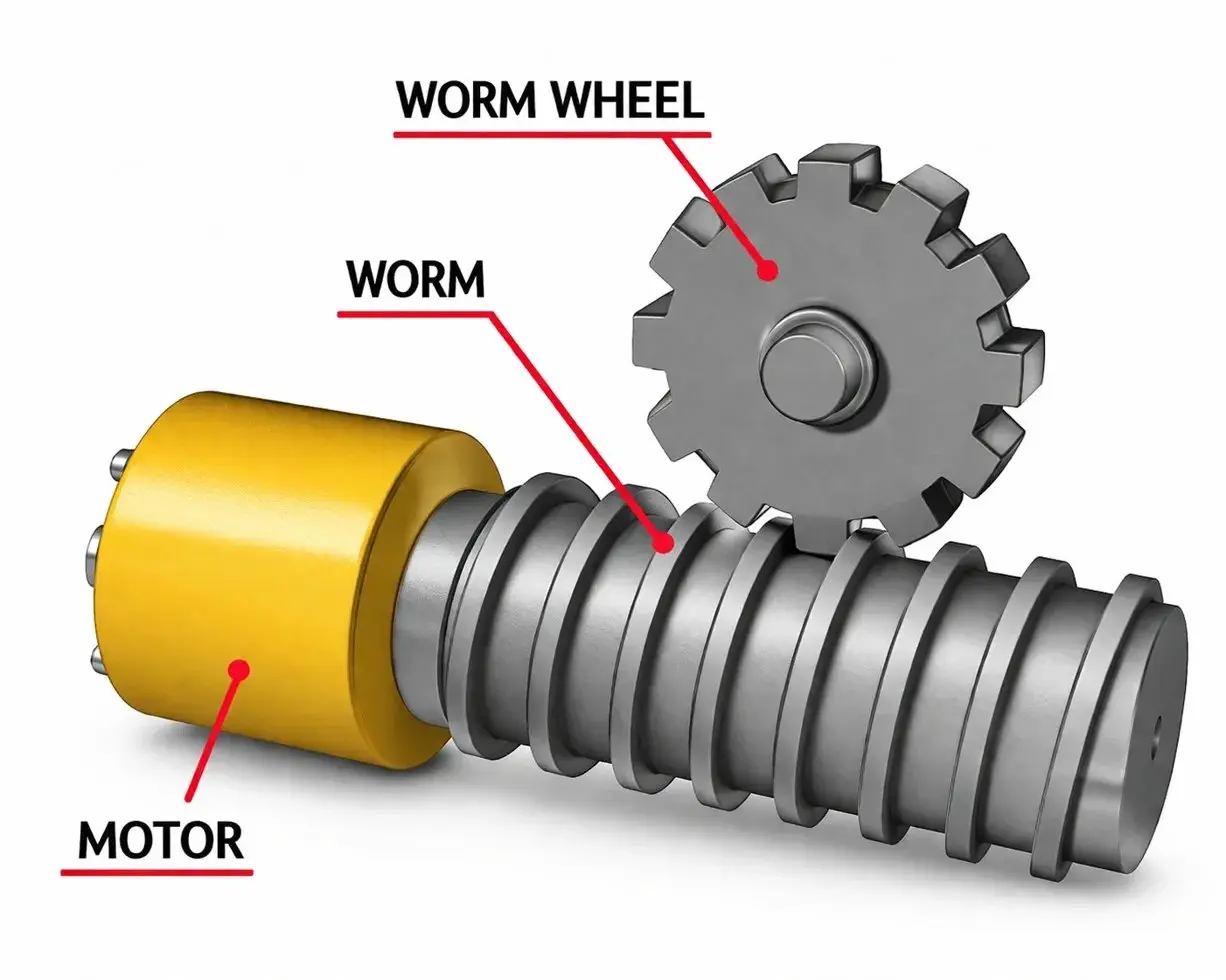

Step 1: Calculate Heat Generated — Power Loss in the Gear Mesh
A worm gear drive is an inefficient power transmission device by the standards of other gear types. Between 25% and 50% of the input power is converted to heat at the gear mesh contact. This heat must be continuously rejected through the housing surface to the ambient environment. If heat generation exceeds heat rejection, the housing temperature rises until a new equilibrium is reached — or until the lubrication system fails.
eta = worm gear mechanical efficiency (decimal) = tan(lambda) / tan(lambda + rho-prime)
Example: 3 kW input at 60% efficiency: Q_loss = 3,000 x (1 – 0.60) = 1,200 W continuous heat generation
At 75% efficiency: Q_loss = 3,000 x (1 – 0.75) = 750 W — 37% less heat for the same power
The efficiency is not fixed — it varies with lubricant viscosity (which varies with temperature), which is why the thermal problem is self-reinforcing. A drive starts cold, oil viscosity is high, efficiency is moderate (say 60%). As the housing heats up, oil viscosity drops, lubrication film thickness decreases, friction coefficient increases, efficiency falls further (perhaps to 55%), and heat generation increases from 1,200 W to 1,350 W. This is the thermal feedback loop described in the efficiency guide (B4), and it is why thermal calculations must be performed at operating temperature, not ambient.
Step 2: Calculate Housing Equilibrium Temperature
The housing reaches thermal equilibrium when heat generation equals heat rejection through the housing surface. The equilibrium temperature depends on heat loss, heat transfer coefficient, and housing surface area.
Example calculation: 3 kW input, 60% efficiency, Q_loss = 1,200 W. Housing surface area A = 0.08 m2 (typical small worm gear housing). Natural convection h = 12 W/m2K. Ambient 25 degrees C. T_housing = 25 + 1,200 / (12 x 0.08) = 25 + 1,250 = 1,275 degrees C — clearly wrong, because the formula is only valid for the cooling surface, not the total housing surface area. In practice, the effective radiating area is typically 60-80% of the housing total surface area. Recalculating with effective area 0.06 m2: T = 25 + 1,200/(12 x 0.06) = 25 + 1,667 — still clearly problematic. The correct interpretation: this drive cannot reject 1,200 W by natural convection from a 0.08 m2 housing. Forced cooling or a more efficient drive configuration is required.
The thermal rule of thumb: A natural convection worm gear housing can reject approximately 6-10 W per square metre of housing surface per degree C of temperature rise above ambient. A 0.08 m2 housing at 50 degrees C rise can reject 0.08 x 8 x 50 = 32 W. If your Q_loss exceeds this figure significantly, forced cooling or a higher-efficiency drive is required. For a 1,200 W heat loss, the required temperature rise to reject it naturally would be 1,200 / (0.08 x 8) = 1,875 degrees — physically impossible. The drive needs forced cooling or a much larger housing.
Factors That Raise or Lower Operating Temperature
Gear Ratio / Lead Angle
+
High ratio (single-start at 50:1) = shallow lead angle = low efficiency = more heat. Multi-start worm at same ratio = higher lead angle = better efficiency = less heat. If thermal rating is the constraint, multi-start worm specification is the primary design lever.
Operating Speed
-/+
Higher worm shaft speed increases sliding velocity at the mesh, shifting the lubrication regime toward EHD (lower friction, higher efficiency). However, higher speed also means more mesh cycles per unit time, so heat generation per unit time may still increase. Thermal rating varies with speed.
Oil Viscosity
–
Lower viscosity = better EHD film development at speed = lower friction coefficient = less heat generation. But viscosity that is too low does not separate surfaces adequately at low speed — mixed lubrication boundary regime means higher friction. Correct viscosity for operating conditions minimizes heat generation.
PAO vs Mineral Oil
-8 to -15 C
PAO has VI >150 vs 90-100 for mineral oil. At operating temperature, PAO of the same ISO VG grade maintains higher viscosity, providing better film — but also PAO has slightly lower friction coefficient (better boundary protection from the PAO base chemistry). Switching from mineral to PAO reduces operating temperature 5-15 degrees C.
Housing Surface Area
–
Larger housing = more surface to reject heat = lower equilibrium temperature. For a drive at its thermal limit, a larger housing specification (same gears, larger housing) may resolve the thermal problem without any other change. Worm gear reducers with extended fin housings are available.
Ambient Temperature
+
Ambient temperature directly adds to housing equilibrium temperature (T_housing = T_ambient + delta_T). A drive that is within thermal spec in winter may fail in summer if it was designed for ambient 20 degrees C and the summer ambient is 38 degrees C — the delta_T budget is consumed by the ambient increase.
Cooling Methods — Capacity, Cost, and When to Use Each
| Cooling Method | Heat Rejection Increase | Implementation Cost | Complexity | Best For |
|---|---|---|---|---|
| Natural convection (housing surface) | Baseline | None — standard supply | Nil | All drives — always the first consideration |
| Switch to PAO synthetic oil | 15-25% reduction in heat gen. | Low — oil change cost only | Nil | Drives running 5-15 C above target temp |
| Multi-start worm (higher efficiency) | 20-40% reduction in heat gen. | Medium — gear set change | Design change | Drives at thermal limit; efficiency improvement primary |
| Forced air cooling fan on housing | 2-4x rejection vs natural convection | Medium — fan + mounting | Low — fan power | Drives with 20-50% excess heat generation |
| Oil cooling coil (water or air) | 5-10x rejection vs natural convection | High — piping, heat exchanger | Medium — maintenance required | High-power drives; continuous industrial duty |
| Larger housing / finned housing | 1.5-2x rejection area | Medium — housing change | Low | Drives with modest excess heat; where space allows |
| Circulating oil system with cooler | 10-20x rejection capacity | High — pump, reservoir, cooler | High — full oil circuit | Very high power drives; enclosed worm reducers |
| Lower ambient temperature | Direct subtraction from equilibrium | Variable — HVAC if required | Low | All drives — often simplest first action |
Oil Viscosity at Operating Temperature — The Critical Variable
The thermal performance of a worm gear drive depends critically on the oil viscosity at operating temperature — not at ambient. Specifying ISO VG 460 mineral oil based on its 40 degrees C viscosity (460 cSt) misrepresents what the oil actually provides at the operating temperature inside the housing.
| Oil Type / Grade | Viscosity at 40 C | Viscosity at 60 C | Viscosity at 80 C | Viscosity Index | Suitable Range |
|---|---|---|---|---|---|
| Mineral ISO VG 220 | 220 cSt | 85 cSt | 38 cSt | ~95 | Ambient to 55 C housing |
| Mineral ISO VG 460 | 460 cSt | 155 cSt | 65 cSt | ~95 | Ambient to 65 C housing |
| Mineral ISO VG 680 | 680 cSt | 215 cSt | 90 cSt | ~95 | Ambient to 70 C housing |
| PAO ISO VG 220 (VI=155) | 220 cSt | 110 cSt | 58 cSt | 155 | Cold to 70 C housing |
| PAO ISO VG 460 (VI=155) | 460 cSt | 240 cSt | 130 cSt | 155 | Ambient to 85 C housing |
| PAO ISO VG 680 (VI=155) | 680 cSt | 360 cSt | 200 cSt | 155 | Up to 95 C housing |
| Ester ISO VG 460 (VI=170) | 460 cSt | 265 cSt | 150 cSt | 170 | High-temperature applications |
Minimum required viscosity for adequate EHD film in worm gear applications: approximately 60-120 cSt at operating temperature, depending on sliding velocity and module. At sliding velocity 3 m/s and Module 5: minimum approximately 80 cSt at operating temperature. Mineral ISO VG 460 at 80 degrees C provides only 65 cSt — below the minimum. PAO ISO VG 460 at 80 degrees C provides 130 cSt — above the minimum with margin.
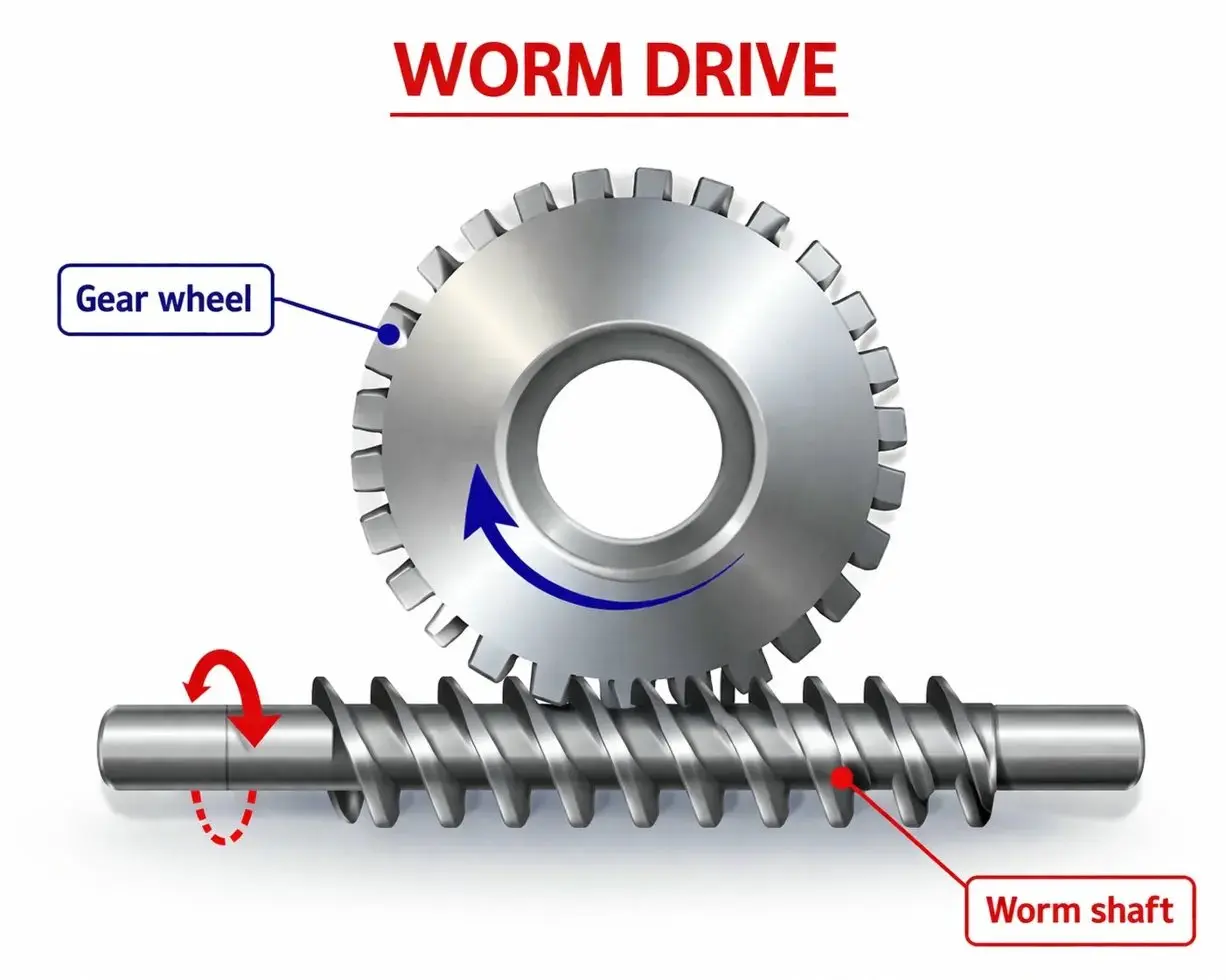
Korea Ever-Power — Products for Thermally Demanding Applications
 |
 |
 |
 |
 |
 |
Thermal Rating Decision Path — What to Do When the Drive is Too Hot
Korea Ever-Power
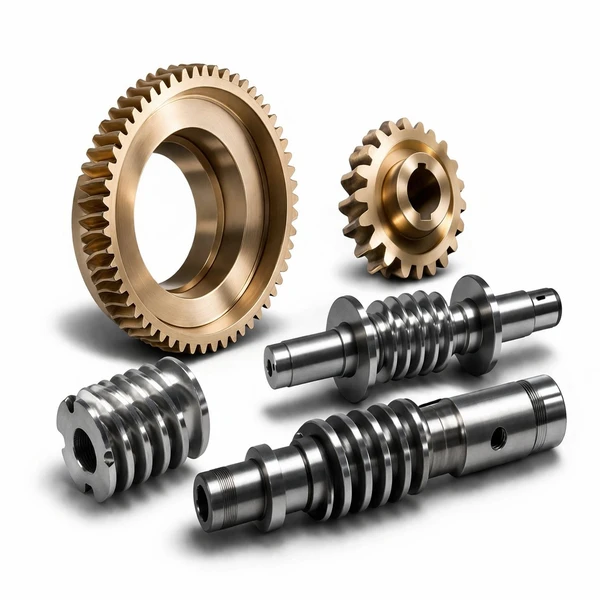
Worm Gear Products for Thermally Demanding Applications

Thermal FAQ
Worm Gear Thermal Management — Questions from Drive System Engineers
Get a Thermal Analysis for Your Worm Gear Drive
Provide input power, shaft speed, ambient temperature range, duty cycle, and housing configuration. Korea Ever-Power calculates the estimated equilibrium housing temperature and returns a specification recommendation — including whether PAO, multi-start, or forced cooling is needed — with the quotation.
Editor: Cxm