Application Engineering Guide · A5
✓ HACCP Zone 1&2
✓ SS316 Electropolished
✓ NSF H1 Compatible
✓ Full Documentation
“Stainless Steel Worm Gear” Is Not the Same as Food Grade
An SS304 worm gear passes visual inspection. It fails a HACCP Zone 1 audit. The surface finish, lubricant certification, and documentation trail determine whether your machine clears regulatory approval — or gets pulled two weeks after installation.
What the HACCP Audit Actually Found
In 2022, a Korean processed meat producer installed a new slicing and portioning line. The conveyor and portion-handling drives used gearboxes specified as “stainless steel worm gear drives” by the machinery builder. Four months after commissioning, during a routine HACCP third-party audit, three of the gear-driven assemblies were flagged. Not for corrosion. Not for contamination. For surface roughness.
The gearbox output shaft seal areas had machined surface roughness of Ra 3.2–6.4 µm. Meat processing regulations in South Korea require food contact and splash zone surfaces to have Ra ≤ 0.8 µm. The material was stainless steel. The material was not the problem. The finish was. The line was quarantined for four days while the gearboxes were removed, replated with electropolished shaft extensions, and re-certified.
This guide covers: HACCP zone classification and what each zone requires from gear components; the metallurgical difference between SS304 and SS316 in CIP environments; why NSF H1 lubricants create a bronze wheel compatibility problem; surface finish requirements by application; and how to build a documentation package that passes food safety audit.
HACCP Zone Classification — The Framework That Defines Everything
HACCP zone classification divides a food production environment into areas based on product contact risk. Gear components used in or near each zone face different regulatory and engineering requirements.
Z1
Direct Product Contact Zone
Gear components physically touch or are immersed in food product. Rare for drive gears but occurs in dough mixer drives, meat grinder drives, and some pressing equipment.
Requires: SS316L, Ra ≤ 0.4 µm, NSF H1 lubrication, full FDA/HACCP documentation
Z2
Splash and Drip Zone
Product may splash, drip, or drain onto gear components during normal operation or during cleaning. The most common zone for drive gears in food processing lines.
Requires: SS316, Ra ≤ 0.8 µm, NSF H1 lubricant, IP65+ sealing, documented materials
Z3
Hygienic Ambient Zone
No direct or splash contact but within the food production building. Regular wash-down cleaning occurs. Surfaces must be cleanable but product contact is not expected.
Requires: SS304 acceptable, Ra ≤ 1.6 µm, IP54+ sealing, cleanable surfaces

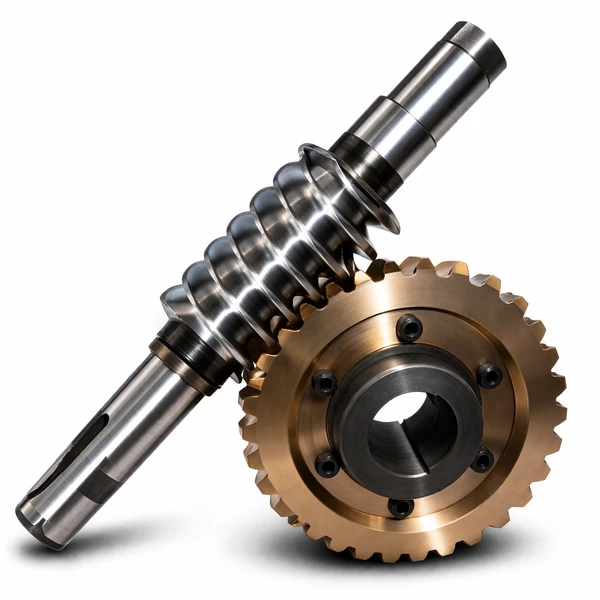
Korea Ever-Power SS316 worm gear with electropolished flanks (Ra ≤ 0.4 µm) — compliant with food processing Zone 1 and Zone 2 requirements.
SS316 vs SS304 vs Carbon Steel — The Metallurgy Decides the Zone
Standard CIP cleaning solutions in meat, dairy, and beverage facilities use sodium hydroxide (NaOH) at 1–2% concentration at 70–80°C for organic cleaning, followed by nitric acid or peracetic acid for sanitisation. SS304 contains 18% chromium — its passive oxide layer is susceptible to pitting attack from chloride ions above approximately 15°C. SS316 adds 2–3% molybdenum, raising the critical pitting temperature to approximately 50°C — above the temperature range of CIP operations.
SS316
Zone 1 & Zone 2
Molybdenum2.0–3.0%
Pitting temp~50°C onset
CIP compat.Full — NaOH + HNO3
Peracetic acidCompatible
Biofilm resist.High (after Ra ≤ 0.8)
✓ Correct for food production use
SS304
Zone 3 Only
MolybdenumNone
Pitting temp~15°C onset
CIP compat.Marginal — chloride risk
Peracetic acidMarginal at high temp
Biofilm resist.Lower — pits harbour bacteria
⚠ Acceptable for ambient clean zones only
Carbon+Zinc
Not Food Grade
ProtectionSacrificial zinc coating
CIP compat.None — NaOH strips zinc
Peracetic acidDestroys coating
Wash-downPoor
HACCP zoneNot acceptable in any zone
✗ Not for food environments
The NSF H1 Lubricant / Bronze Wheel Compatibility Problem
NSF H1 lubricants are formulated for incidental food contact. They are approved for use where the lubricant may come into contact with food in small quantities — the standard specification for Zone 1 and Zone 2 gear drives.
The issue: NSF H1 formulations exclude sulfur-based and chlorine-based EP (Extreme Pressure) additives — precisely the additives that provide anti-scuffing capacity in standard worm gear oils. Without EP additives, an NSF H1 lubricant has lower anti-scuffing capacity than a conventional worm gear oil, particularly at high sliding velocities above 6 m/s and elevated temperatures.
The specification path that resolves this: Worm shaft must be carburized and ground SCM415 at 58–62 HRC. The anti-scuffing capacity of the mesh depends primarily on hardness differential. A hardened SCM415 shaft paired with tin bronze wheel and NSF H1 PAO oil maintains adequate anti-scuffing across the food-relevant speed range. Keep sliding velocity below 4 m/s for NSF H1 applications.
Do not use NSF H2 lubricants where there is any possibility of food contact. NSF H2 certifies lubricants for use on non-food-contact surfaces only. H2 formulations may contain EP additives that are not approved for incidental food contact. Specify H1 throughout any Zone 1 or Zone 2 drive, regardless of housing sealing level.
Surface Finish Requirements by Application Position
Surface roughness (Ra) determines whether biofilm can establish itself on exposed metal surfaces. Bacterial cells (typically 1–10 µm) lodge in surface recesses deeper than their own diameter, where cleaning agents cannot reach them.
| Application Position |
HACCP Zone |
Ra Requirement |
Achievable by |
| Gear tooth flanks (exposed) |
Z1 |
Ra ≤ 0.4 µm |
CNC grinding + electropolishing |
| Shaft seal areas and journal |
Z1–Z2 |
Ra ≤ 0.4 µm |
CNC turning + precision grinding |
| Bore and keyway surfaces |
Z2 |
Ra ≤ 0.8 µm |
CNC boring + honing |
| Housing exterior (washdown) |
Z2–Z3 |
Ra ≤ 1.6 µm |
Standard machining |
| Non-contact structural faces |
Z3 |
Ra ≤ 3.2 µm |
Standard turning |
| As-cast / as-welded |
Not suitable |
Ra 6.3–25 µm |
Not acceptable in any food zone |
Food Machinery Applications and Their Specific Gear Requirements
| Food Machinery Type |
Zone |
Gear Specification |
Key Risk if Wrong |
| Slicing and portioning machine |
Z1–Z2 |
SS316, Ra ≤ 0.4 µm, NSF H1 PAO, SCM415 worm |
Bacterial harbouring; pitting corrosion from meat juices |
| Filling and dispensing equipment |
Z1 |
SS316L, Ra ≤ 0.4 µm electropolished, full documentation |
Product contamination; FDA documentation failure |
| Packaging line conveyor |
Z2–Z3 |
SS316, Ra ≤ 0.8 µm, IP65 sealing, NSF H1 |
Corrosion from wash-down; lubricant leakage onto packaging |
| Dairy processing line |
Z1–Z2 |
SS316, electropolished, CIP-rated sealing, full traceability |
Dairy acid corrosion; biofilm in surface recesses |
| Bakery and dough handling |
Z1–Z2 |
SS316, Ra ≤ 0.8 µm, food-safe coating on non-SS surfaces |
Dough embedding in surface defects; yeast contamination |
| Beverage filling line |
Z2–Z3 |
SS316 or SS304 (Z3 only), IP54+, NSF H1 where splash possible |
Carbonated acid attack on carbon steel; lubricant migration |
| Cold room conveyor (−18°C) |
Z2–Z3 |
SS316, cold-temp NSF H1 PAO (VI > 150), IP65 |
Low-temp viscosity overload; condensation corrosion |
Field Engineering
Four Food Processing Worm Gear Specifications — The Audit, the Failure, and the Fix
Gyeonggi-do, Korea · Processed Meat Facility
HACCP Audit Rejection — Surface Finish on Zone 2 Worm Gear Drives
A Korean processed meat producer installed slicing line drives specified as ‘stainless steel worm gear.’ The material was SS304. The finish was Ra 3.2 µm on seal journal areas. The HACCP audit found this unacceptable for Zone 2 product splash areas.
Fix: SS316 worm shaft with CNC-ground journal areas Ra ≤ 0.4 µm. Electropolished ZCuSn10Pb1 wheel flanks Ra ≤ 0.4 µm. Full material certificate, heat treatment record, CMM report, and surface finish measurement report shipped with each unit.
✓ HACCP Zone 2 certification achieved — first audit post-replacement
Chungcheongnam-do, Korea · Dairy Equipment OEM
Pitting Corrosion on SS304 Worm Shafts After 8 Months of CIP Cycling
A Korean dairy equipment manufacturer experienced pitting corrosion on worm gear output shafts after approximately 8 months in service. The CIP protocol used NaOH at 1.5% at 75°C, followed by peracetic acid. Analysis confirmed chloride-induced pitting on the SS304 shaft journals — the farm water supply contained 180 ppm chloride, above the critical pitting temperature for SS304 at 75°C.
Fix: SS304 → SS316 shaft (molybdenum suppresses pitting at CIP temperatures). No changes to dimensions or mounting. Material certification confirming Mo% included in delivery documentation to support the manufacturer’s CE technical file.
✓ Zero pitting corrosion events over subsequent 30-month monitoring period
Ho Chi Minh City, Vietnam · Beverage Packaging
NSF H2 Lubricant Leakage Contaminating Packaging — Audit Non-Conformance
A Vietnamese beverage packager experienced lubricant leakage from worm gear drives onto packaging materials on their filling line. The drives were specified with NSF H2 lubricant (non-food-contact grade). While the quantity was small, the H2 designation was sufficient for the customer’s food safety auditor to issue a non-conformance.
Fix: NSF H2 oil replaced with NSF H1 PAO ISO VG 220 throughout the drive system. Korea Ever-Power supplied replacement worm gear sets with upgraded shaft seals (dual-lip NBR with dust excluder). H1 lubricant certification documentation provided for inclusion in food safety management system files.
✓ Non-conformance closed — packaging customer food safety audit passed
Gyeonggi-do, Korea · Frozen Food OEM
Cold Room Conveyor Worm Gear Failure — Low-Temperature Lubricant Viscosity
A frozen food manufacturer’s cold storage conveyor system used conventional ISO VG 460 mineral oil in the worm gear corner drives. The cold room operated at −18°C. ISO VG 460 mineral oil at −18°C has kinematic viscosity exceeding 4,000 cSt — over 8× the design viscosity at operating temperature. The resulting viscous drag caused motor overcurrent on start-up.
Fix: ISO VG 460 mineral oil → NSF H1 PAO synthetic ISO VG 220 (VI > 160). PAO at −18°C viscosity is approximately 650 cSt — a 2.5× increase, well within motor and seal design margins. Worm gear sets unchanged. Lubricant certification added to food safety management documentation.
✓ Motor overcurrent events eliminated — conveyor runs reliably at −18°C
Korea Ever-Power Products
Food Grade Worm Gear Products
Zone 1 & Zone 2 · Full Documentation
SS316 Stainless Steel Worm Gear — Food Grade
The primary specification for food processing Zone 1 and Zone 2 drive applications. SS316 worm shaft (2.0–3.0% molybdenum) resists chloride pitting in CIP environments where NaOH cleaning runs at 70–80°C — the failure condition that makes SS304 unsuitable for food production. Journal and sealing areas CNC-ground and electropolished to Ra ≤ 0.4 µm as standard. The matched worm wheel is available in SS316 (for Z1 direct contact) or ZCuSn10Pb1 tin bronze with electropolished flanks (for Z2 splash zone). Full documentation package: mill heat number certificate, heat treatment record, CMM dimensional report, surface roughness measurement report. PPAP Level 1–3 available for food machinery OEM supply programs.
MaterialSS316 (2.0–3.0% Mo)
Surface finishRa ≤ 0.4 µm electropolished
Lubricant compat.NSF H1 PAO, non-EP oils
CIP resistanceNaOH 2%, HNO3 1%, PAA 0.5%
HACCP zoneZone 1 and Zone 2
View Product Specifications →
Zone 2 · Bronze or Full Stainless
Precision Worm Wheel — Food Processing Grade
Available in two configurations for food processing applications. The SS316 full-stainless variant is correct for Zone 1 direct product contact — hobbed from solid SS316 bar stock, with all tooth surfaces electropolished to Ra ≤ 0.4 µm. The ZCuSn10Pb1 tin bronze variant with electropolished flanks is correct for Zone 2 splash zone applications where the bronze anti-scuffing properties are needed at higher sliding velocities. Both variants are bore-machined to H7 tolerance on CMM and supplied with dimensional inspection report. Wheel tooth contact pattern tested on assembly rig before shipment — coverage ≥ 70% required, percentage documented.
Z1 materialSS316, fully electropolished
Z2 materialZCuSn10Pb1 + electropolished flanks
Bore toleranceH7 CMM verified
Contact pattern≥ 70% documented
View Product Specifications →
Documentation · Audit Support
Food Safety Documentation Package
For food machinery OEMs and production facilities that must maintain food safety management system documentation, Korea Ever-Power provides a structured documentation package that supports HACCP audit, CE/KS certification, and customer food safety system compliance. The standard package includes: material certificate to mill heat number, heat treatment record, CMM dimensional inspection report, surface roughness measurement report, and contact pattern photograph. Extended PPAP Level 1, 2, or 3 packages available. All documentation retained for 5 years from shipment date and available on request at no additional charge.
Standard docsMat. cert + CMM + surface Ra
PPAPLevel 1, 2, or 3 available
BiocompatibilityISO 10993-1 ref. available
Retention5 years from shipment
View Product Specifications →
Food Processing FAQ
Questions from Food Machinery Engineers and Quality Managers
What is the difference between NSF H1 and NSF H2 lubricants, and which do I need for a worm gear drive in a food facility?+
NSF H1 lubricants are formulated for applications where incidental contact with food product is possible. They use food-approved base oils and additive packages. NSF H2 lubricants are for non-food-contact surfaces only — they may contain additives that are not approved for food contact. For any worm gear drive in HACCP Zone 1 or Zone 2 — which includes most conveyor drives, portioning drives, filling drives, and agitator drives in food production areas — specify NSF H1. If there is any doubt about whether a drive position is Zone 2 or Zone 3, default to H1. The cost difference between H1 and H2 lubricants is small; the cost of a food safety non-conformance is not.
Can a tin bronze worm wheel be used in a food processing application, or must the wheel also be stainless steel?+
Tin bronze worm wheels are acceptable in HACCP Zone 2 (splash zone) food processing applications when the wheel flanks are electropolished to Ra ≤ 0.8 µm and the drive is adequately sealed against product ingress. In Zone 2, the risk is surface bacterial adhesion, not product contact — and a properly electropolished bronze surface provides adequate resistance. The case for bronze over stainless steel in Zone 2 is the tribological advantage: bronze provides better anti-scuffing performance at the sliding contact velocities typical of food machinery drives (1–6 m/s), particularly when using NSF H1 lubricants that lack EP additives. For Zone 1 direct product contact, the wheel must be SS316 or another FDA-acceptable material.
How do I specify a worm gear set for a cold room conveyor operating at −20°C?+
Three elements require attention for sub-zero operation. First, lubricant: ISO VG 460 mineral oil at −20°C reaches viscosities of 4,000–8,000 cSt, causing severe viscous drag and motor overcurrent. Specify NSF H1 synthetic PAO ISO VG 100 or 150, which maintains approximately 300–500 cSt at −20°C. Second, seal material: standard NBR seals become brittle below −20°C; specify FKM (Viton) or silicone seals. Third, housing material: standard ductile iron housings are acceptable to −30°C; below −30°C, specify ferritic stainless steel or aluminium housing to avoid brittle fracture risk.
Does Korea Ever-Power supply PPAP documentation for food machinery OEM supply programs?+
Yes. PPAP Level 1 (Part Submission Warrant), Level 2 (PSW + limited supporting documentation), and Level 3 (PSW + full supporting documentation) are available for established supply programs. Confirm the required PPAP level at order placement — Level 3 requires additional production documentation lead time and should be agreed in the initial order confirmation. PPAP is not available on first-order prototype or sample quantities; it is available for production supply programs after sample approval.
What cleaning agents can I use on an SS316 worm gear shaft in a CIP cleaning cycle?+
SS316 is compatible with: sodium hydroxide (NaOH) at up to 4% concentration, 80°C; phosphoric acid (H3PO4) at up to 2%, 60°C; nitric acid (HNO3) at up to 2%, 60°C; peracetic acid (PAA) at up to 0.3%, 40°C; and chlorinated alkaline CIP agents at up to 200 ppm active chlorine, 50°C. Avoid CIP solutions containing hydrochloric acid (HCl) — this will cause rapid pitting corrosion on all grades of stainless steel.
Do I need to disclose the worm gear material and lubricant to my food safety auditor?+
For equipment in Zone 1 and Zone 2, yes. Your HACCP documentation should include a list of all materials in contact with or adjacent to food product, including drive train materials and lubricants. The documentation package from Korea Ever-Power (material certificate, lubricant compatibility confirmation, surface finish report) provides the information needed for this disclosure. If your facility undergoes IFS, BRC, or SQF certification in addition to HACCP, additional disclosure requirements may apply.
Can I use the same worm gear set in both a food processing facility and a pharmaceutical manufacturing facility?+
The material specification (SS316, Ra ≤ 0.4 µm electropolished) is the same. The documentation requirements differ. Food processing facilities typically require NSF/FDA compliance documentation. Pharmaceutical manufacturing facilities under GMP regulations require additional documentation: ISO 10993-1 biocompatibility grouping, material traceability to starting stock, and PPAP or equivalent qualification documentation. Korea Ever-Power can provide the standard food-grade documentation package for food applications and the extended pharmaceutical package for GMP applications — confirm which documentation standard applies at order placement.
How do I handle lubricant change intervals for a worm gear drive in a food processing environment?+
NSF H1 PAO synthetic gear oils have extended drain intervals compared to mineral oils — typically 3,000–4,000 operating hours for enclosed drives at normal operating temperatures. For food processing applications where the housing temperature remains below 60°C, an annual oil change (or every 2,000 hours, whichever comes first) is appropriate. The first oil change after any gear replacement or new installation should be at 50–100 operating hours to remove running-in bronze wear particles. Use only NSF H1 certified lubricants for top-up — mixing H1 and H2 lubricants in a Zone 1 or Zone 2 drive invalidates the H1 compliance of the entire fill.
Specify Your Food Grade Worm Gear Drive
Provide HACCP zone, machine type, drive position, sliding velocity, lubricant requirement, and documentation standard (HACCP, BRC, IFS, PPAP). Korea Ever-Power returns a complete food-grade specification with surface finish confirmation and documentation availability within one working day.
Editor: Cxm