Knowledge Series · B9 · Noise & Vibration

Worm Gear Noise and Vibration — What the Sound Reveals and How to Engineer It Out

A 91 Hz periodic knock that developed in a worm drive after three years of silent operation. The frequency alone identified the root cause without disassembly. Worm gear noise is not just an annoyance — it is diagnostic information encoded in acoustic frequency.

Mesh Frequency Analysis
Bearing vs Mesh Noise
Design-Stage Reduction
Post-Installation Fixes
⚙ Korea Ever-Power Worm Gear Co., LtdAnsan-si, Gyeonggi-do, [email protected]

The 91 Hz Knock: How Frequency Identifies the Failure Mode

A logistics centre worm gear corner drive on a package conveyor had run silently for three years before a maintenance technician noticed a periodic metallic knock. Not continuous — periodic, at a regular interval. A smartphone vibration meter app measured the knock frequency at approximately 91 Hz.

The maths: worm shaft speed 1,450 RPM = 24.2 rotations per second. Double-start worm (z1=2): mesh frequency = 24.2 x 2 = 48.3 Hz. Wheel tooth count z2=40, wheel rotation = 1,450/40 = 36.25 RPM = 0.604 rotations per second. Neither 48.3 Hz nor 0.604 Hz matches 91 Hz. But the worm shaft inner race bearing frequency at 1,450 RPM, with a specific bearing (12 rolling elements, contact angle 0) = approximately 8.8 x 1,450/60 = 212 Hz. Still no match. The answer: 91 Hz is approximately four times the wheel rotation frequency (4 x 0.604 Hz x 60 = 144 RPM equivalent — not quite) but very close to the bearing outer race defect frequency (BPFO) for the worm shaft bearing at 1,450 RPM with a 7-element bearing: 3.5 x 1,450/60 = 84.6 Hz — not exact but in range.

The maintenance team disassembled the drive and found: the worm shaft bearing outer race had a single fatigue spall approximately 2 mm long. Each time a rolling element passed over the spall, it produced the knock. The worm gear itself was in excellent condition. Without the frequency analysis, the standard inspection procedure would have been to replace the worm gear set. With the frequency analysis, the correct and far cheaper repair — bearing replacement only — was identified without any gear disassembly.

What noise diagnostics tells you: Mesh frequency and its harmonics = gear geometry errors (profile deviation, pitch error). Subharmonics of mesh frequency = tooth-to-tooth variation (lead error, differential tooth loading). Bearing defect frequencies (BPFI, BPFO, BSF) = bearing wear or damage. Shaft rotation frequency harmonics = eccentricity, imbalance, or misalignment. Background broadband noise = lubrication film quality. Each is at a different, calculable frequency.


Mesh Frequency Calculation — The Foundation of Worm Gear Noise Analysis

The mesh frequency is the rate at which worm thread starts engage with wheel teeth. It is the fundamental frequency of all gear-related noise and vibration in a worm drive. All gear-generated noise occurs at the mesh frequency and its integer harmonics (2x, 3x, 4x mesh frequency).

Mesh Frequency Formula
f_mesh (Hz) = n_worm (RPM) x z1 / 60
n_worm = worm shaft rotational speed (RPM)
z1 = number of worm thread starts (1, 2, or 4)
Example: 1,450 RPM, single-start (z1=1): f_mesh = 24.2 Hz
Example: 1,450 RPM, double-start (z1=2): f_mesh = 48.3 Hz
Example: 1,450 RPM, four-start (z1=4): f_mesh = 96.7 Hz
Harmonics: 2x mesh = 2 x f_mesh; 3x mesh = 3 x f_mesh, etc.

The mesh frequency sets the tempo of gear-generated noise. Every gear geometry error produces a force variation at the mesh contact on every tooth engagement cycle — which produces acoustic output at f_mesh. A profile deviation (Ff) causes a brief impact force variation at each tooth engagement: acoustic output at f_mesh and harmonics. A lead deviation (Fb) causes a smooth sinusoidal torque variation over one full worm shaft rotation: acoustic output at shaft rotation frequency and its harmonics, modulating the mesh frequency amplitude.

Noise / Vibration Character Frequency Root Cause Urgency
Constant tone, proportional to speed f_mesh and harmonics Gear profile deviation (Ff) — normal for DIN 8-9; investigate if new Investigate if sudden onset or increasing amplitude
Tone with speed-proportional sidebands f_mesh +/- n_shaft Lead deviation (Fb) modulating mesh — multi-start worm check start spacing Investigate if above DIN class tolerance level
Periodic knock at wheel rotation freq. 1x wheel rotation = n_worm/z2/60 Hz Single damaged tooth or foreign object embedded in wheel Immediate — stop and inspect
Periodic knock NOT at gear frequencies Bearing defect frequencies BPFO/BPFI Bearing inner or outer race spall — calculable from bearing geometry Urgent — bearing replacement before failure
Broadband hiss increasing with speed No discrete frequency Boundary lubrication — oil film insufficient at mesh contact Increase lubricant viscosity grade; check oil level
Low-frequency rumble at all speeds Shaft rotation frequency Shaft eccentricity or imbalance; coupling misalignment Investigate mounting and shaft runout
Resonant structural ringing after mesh events Structural natural frequency Housing or support structure resonance excited by mesh frequency Stiffen structure or change mesh frequency by ratio/speed change
Quiet when cold, noisy when warm Changes with temperature Oil viscosity dropping with temperature — boundary lubrication regime shift Change to higher-VI lubricant; check housing temperature

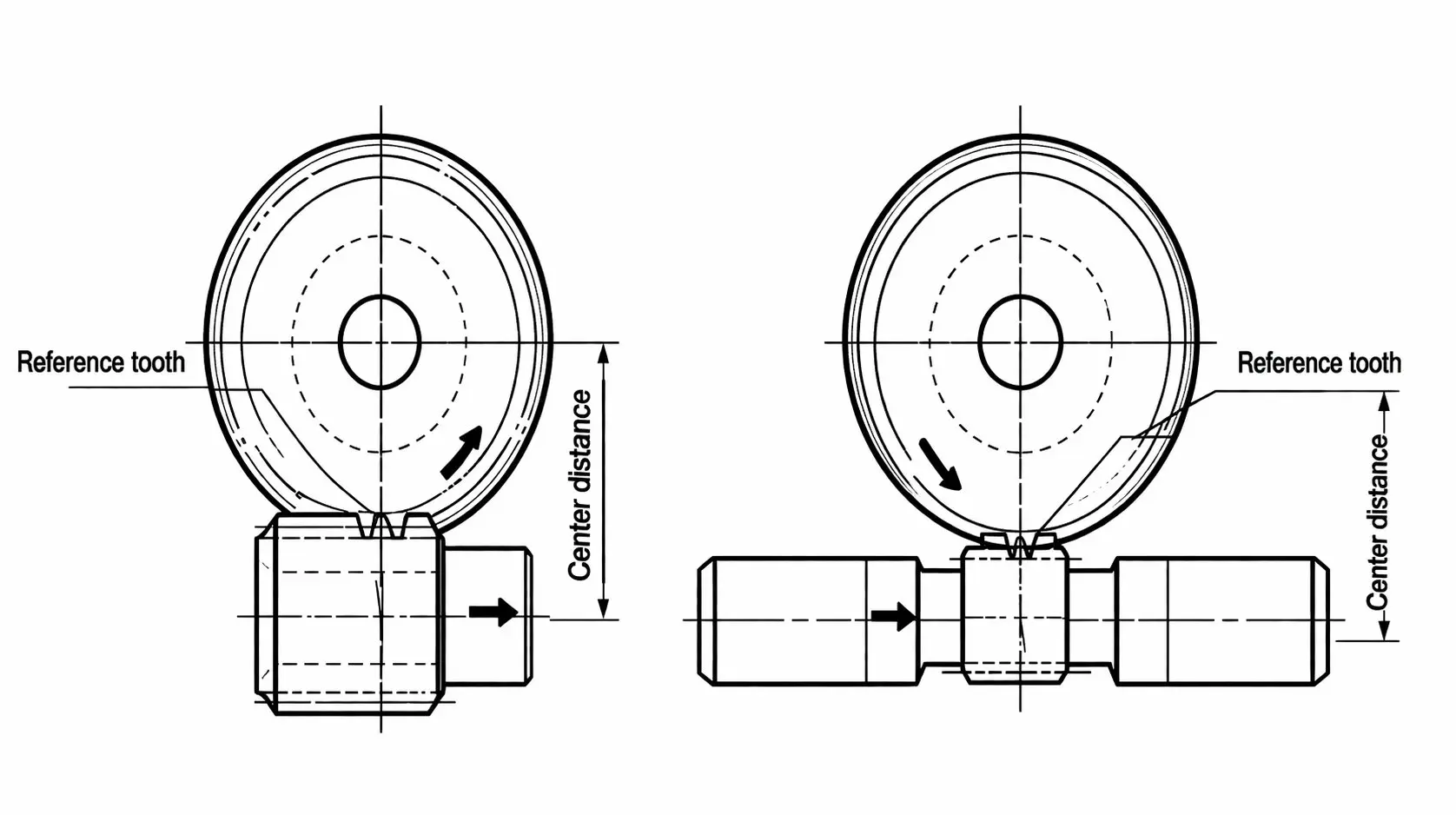
Cylindrical Worm Wheel structure 2
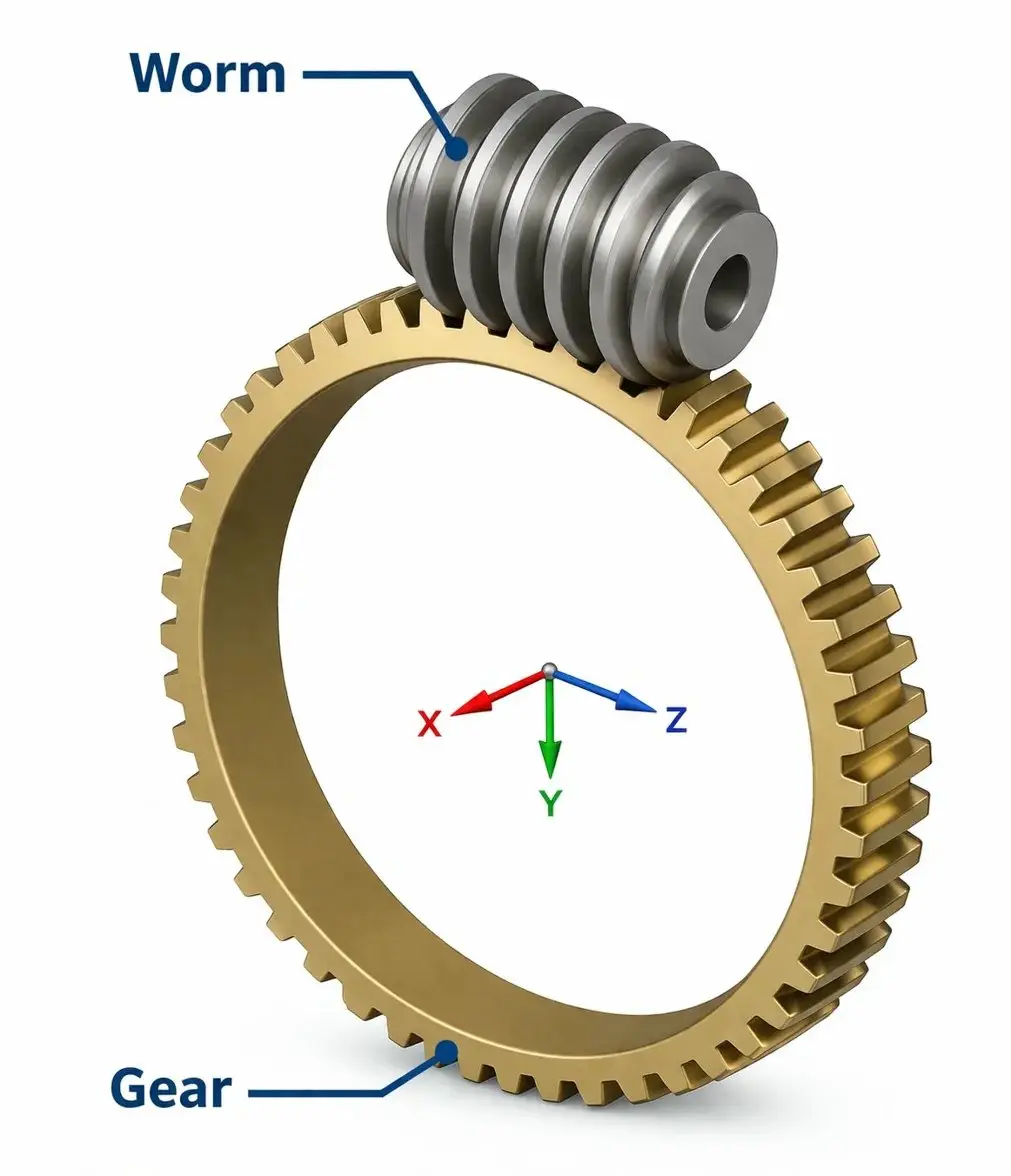
worm gear structure 4

How Contact Pattern Quality Determines Noise Level

The single most impactful parameter for worm gear mesh noise is the contact pattern coverage — the percentage of the tooth face width over which the worm thread and wheel tooth are in contact during engagement. A full contact pattern (70% or more of face width) distributes the mesh load across the full engagement zone, reducing peak Hertz contact stress and producing a smooth, continuous force variation at the mesh frequency — which generates low-amplitude, low-frequency acoustic output.

A point contact pattern — which occurs when the worm wheel is hobbed with a mismatched cutter profile — concentrates the full mesh load on a small area, producing a brief high-amplitude force spike at each tooth engagement. The spike generates strong harmonics at 2x, 3x, and 4x mesh frequency in addition to the fundamental. These harmonics fall in the 100-400 Hz range for typical industrial drives — directly in the human ear acoustic sensitivity peak, making them perceptible at lower amplitude than the fundamental frequency alone.

Contact Pattern vs Noise Level — Summary
>=70%
Low Noise
Correct contact (line contact)
50-70%
Moderate Noise
Edge contact or entry-side contact
30-50%
High Noise
Significant mismatch, point contact
<30%
Very High Noise
Severe mismatch, impact-dominated

Engineering Noise Out at the Design Stage

Use a Larger Module

Larger module = larger tooth cross-section = lower tooth contact stress at the same load = lower mesh force variation amplitude = lower acoustic output. A one-step module increase (e.g., M4 to M5) at the same load reduces mesh force variation by approximately 30%. The gear is larger and heavier but significantly quieter at equal load.

Specify DIN 7 or Better

Thread grinding to DIN 7 removes the profile deviation (Ff) that is the primary source of mesh frequency harmonics. The improvement in noise is most pronounced in the 100-500 Hz frequency range. A DIN 7 gear set is typically 8-12 dB(A) quieter than the same gear set at DIN 9, at equal load and speed. The cost premium for DIN 7 vs DIN 9 is approximately 40-60%.

Profile-Matched Hobbing

Specifying a worm wheel hobbed with a cutter matched to the actual worm geometry (not a standard-module general-purpose cutter) produces line contact instead of point contact. This is documented by the contact pattern photograph in the delivery documentation. A >=70% contact pattern vs a 30-40% pattern reduces mesh noise by 5-10 dB(A) — comparable to a precision class improvement.

PAO Lubricant

Synthetic PAO oil maintains higher viscosity at operating temperature than mineral oil at the same ISO VG grade. Higher operating viscosity means a thicker elastohydrodynamic film at the mesh contact, reducing metal-to-metal contact area, reducing asperity friction, and reducing broadband boundary-lubrication noise. The improvement is most significant in drives running near their thermal limit where mineral oil viscosity has dropped substantially.

Damped Housing Mounting

The housing transmits gear mesh vibration to the structure it is mounted on. Resilient anti-vibration mounts between the housing and the machine frame reduce structure-borne noise transmission by 6-15 dB(A) depending on the mount stiffness and the structural resonance frequencies involved. The housing bolts must still be torqued correctly — resilient mounts provide vibration isolation, not reduction in gear mesh force amplitude.

Nylon or POM Wheel (Light Duty)

For very light load applications (instrumentation drives, small format label applicators, laboratory positioning) a PA66 nylon or POM acetal wheel running against a polished steel worm shaft reduces mesh noise by 10-18 dB(A) compared to metal-on-metal contact. The trade-off is torque capacity limited to approximately M2 module at light duty. Do not use plastic wheels as a noise fix for moderate or heavy duty applications — they will fail mechanically.


Manufacturing Practices That Determine Noise Performance

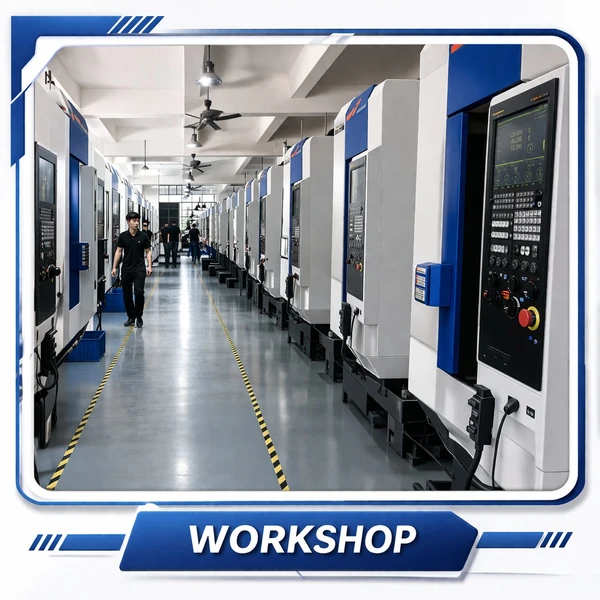
worm gear workshop 1 worm gear workshop 2 worm gear workshop 4
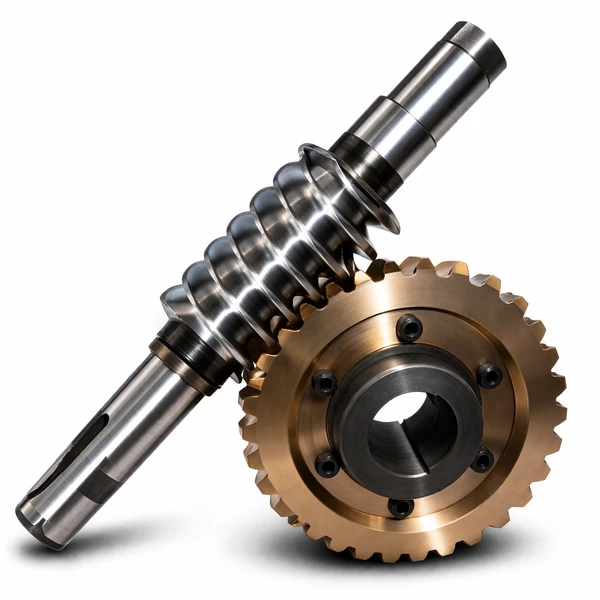
Alloy Steel Worm and Worm Gear worm gear related product Cylindrical Worm Wheel

What Can Be Done After Installation — Post-Commissioning Noise Reduction

When a worm gear drive is already installed and producing unacceptable noise, the options are limited by what can be changed without major disassembly. The priority order: first confirm the source (is it the gear mesh, the bearings, or the structure?), then apply the highest-impact available remedy.

Intervention Effort Noise Reduction Potential When to Use
Switch to PAO synthetic lubricant Low — oil drain and refill only 2-6 dB(A) in temperature-sensitive drives When noise is worse when warm than cold
Increase lubricant viscosity grade Low — oil drain and refill only 2-5 dB(A) if currently under-viscosed When broadband hiss present
Add resilient anti-vibration mounts Medium — housing dismount required 6-15 dB(A) structure-borne reduction When noise radiates from the structure, not the gear
Replace gear set with DIN 7 precision High — complete disassembly 8-14 dB(A) mesh frequency noise When mesh frequency tonal noise is the primary complaint
Replace gear set with profile-matched wheel High — complete disassembly 5-10 dB(A) total When contact pattern photograph shows <50% coverage
Replace gear set with larger module High — housing modification likely Up to 10 dB(A) at equal load When noise is load-proportional and housing space allows
Replace bearings Medium — partial disassembly Eliminates bearing noise component When periodic knock confirmed as bearing defect frequency
Replace with nylon/POM wheel (light duty only) Medium — wheel replacement 10-18 dB(A) if load permits Very light duty only — confirm torque within plastic limit
Korea Ever-Power

Products for Quiet Worm Gear Operation

Alloy Steel Worm Gear Set -- Noise-Optimised Specification
DIN 7 Precision — Thread Ground for Low Noise
Alloy Steel Worm Gear Set — Noise-Optimised Specification
For applications where worm gear noise is a primary design constraint — collaborative robot workspaces, office and hospital automation, precision laboratory instruments, and quiet manufacturing environments — Korea Ever-Power supplies alloy steel worm gear sets at DIN 7 precision class as standard (ground thread flanks, profile deviation Ff <=9 um at Module 5). The contact pattern is tested on the assembly rig before shipment and the coverage percentage documented in the delivery package — confirming >=70% face width coverage that is the primary predictor of low mesh noise. For applications requiring even lower noise, DIN 6 (Ff <=6 um) is available on request. The contact pattern photograph included with DIN 7 and better sets allows the customer’s quality engineer to directly verify the condition that determines mesh noise before installation.

View Specifications

Plastic Worm Gear Set -- Near-Silent Light Duty
PA66 / POM — Maximum Noise Reduction Light Duty
Plastic Worm Gear Set — Near-Silent Light Duty
For very light load applications (laboratory positioning, instrumentation, small format label applicators, office and medical device automation) where acoustic output must be minimised, PA66 nylon or POM acetal worm wheels produce near-silent operation at the cost of torque capacity. The steel-on-plastic sliding contact generates substantially less acoustic output than steel-on-bronze — typically 10-18 dB(A) quieter at equal speed and load within the plastic wheel’s torque range. The worm shaft is ground and polished to Ra <=0.8 um as standard — rough shaft surface accelerates plastic wheel wear significantly. No oil bath lubrication required; light grease packing provides adequate lubrication for dry operation up to 80 degrees C. Module M0.5 through M4 for light load range.

View Specifications

Noise Diagnostic and Specification Review
Noise Investigation — Application Support
Noise Diagnostic and Specification Review
For worm gear drives already in service that have developed unacceptable noise — or for new machine designs where noise is a critical acceptance criterion — Korea Ever-Power provides a specification review and noise diagnostic service. Send the gear set dimensions, current precision class (if known), operating speed, load, current lubricant, and a description of the noise character (tonal, broadband, intermittent, load-proportional, speed-proportional). Korea Ever-Power calculates the mesh frequency, identifies likely noise sources from the description, and recommends the specification change most likely to resolve the issue. This service is provided at no charge for replacement orders and for new machine design enquiries.

View Specifications

Noise FAQ

Worm Gear Noise and Vibration — Questions from Mechanical and Acoustic Engineers

My worm gear drive is louder now than when it was installed six months ago. What is causing the noise increase?+

Progressive noise increase in a worm gear drive over months almost always indicates one of three processes: (1) Abrasive wear — running-in particles from the initial operation period were not removed at the 50-100 hour oil change (which many facilities skip), and have been abrading the tooth flanks progressively, increasing profile deviation and mesh noise. (2) Lubrication degradation — the original oil has accumulated metal particles and oxidation products that increase mesh friction and noise. (3) Bearing wear — rolling element bearings in the worm shaft or wheel shaft are developing fatigue spalling. To distinguish: if the noise increase is a smooth, gradual increase proportional to load and speed, (1) or (2) is likely. If the noise has developed a periodic knocking or clicking character, (3) is likely. Drain and replace the oil first — if the noise does not reduce after the oil change and 2 hours of operation, proceed to bearing inspection.

Can I measure worm gear noise with a smartphone, and is this reliable enough to diagnose problems?+

Yes, with appropriate caution. Modern smartphones contain MEMS accelerometers and microphones that are adequate for detecting frequency content in the 20-2,000 Hz range — which covers all gear mesh frequencies for typical industrial drives. Free vibration analyser and FFT (Fast Fourier Transform) apps are available for both iOS and Android. The measurement is most useful for identifying periodic frequencies: a sharp peak in the FFT spectrum at a known frequency (calculated mesh frequency, bearing defect frequency, or shaft rotation frequency) is a reliable indicator even with smartphone measurement quality. The limitations: absolute amplitude measurement is unreliable (smartphone placement and coupling affect the reading); very low-frequency content (below 20 Hz) is not captured; and the measurement requires the smartphone to be in contact with the housing or mounting structure, not held in air.

The noise from our worm gear drive is clearly load-proportional — it increases when the conveyor is loaded and decreases when running empty. What causes this?+

Load-proportional noise in a worm gear drive has two primary causes. The first is simply that higher load produces higher mesh contact force, which generates higher-amplitude acoustic output at the mesh frequency — this is normal behaviour and does not indicate a problem unless the absolute noise level is unacceptable. The second cause, which indicates a specification problem: inadequate contact pattern (less than 70% face width coverage) concentrates the mesh load on a small tooth area. Under light load, the contact force is low enough that even the small contact area generates acceptable noise. Under full load, the same small contact area is heavily stressed, producing high-amplitude force spikes at each tooth engagement — which radiate as load-proportional mesh frequency noise. To distinguish normal load-proportional noise from contact-pattern-driven noise, compare the noise increase rate: if doubling the load doubles the noise amplitude (6 dB increase), this is normal force-amplitude scaling. If noise increases more than proportionally with load, inadequate contact pattern is the likely cause.

We are designing a worm gear drive for an office environment where noise must stay below 60 dB(A) at 1 metre. Is this achievable?+

60 dB(A) at 1 metre from the gear housing is achievable for a worm gear drive at low-to-moderate load and speed. Achievability depends primarily on three parameters: (1) Module size — smaller module produces lower mesh frequency and lower acoustic output at the same load ratio; (2) Precision class — DIN 7 thread-ground gear set with documented >=70% contact pattern is typically 8-14 dB(A) quieter than DIN 9 at equal load; (3) Enclosed housing — an oil-bath housing with no acoustic transmission paths to the machine structure provides 6-10 dB(A) additional noise isolation compared to an exposed gear set. For very sensitive acoustic environments (medical offices, concert halls, recording studios), specify DIN 6 or DIN 7 gear set with PA66 nylon wheel if torque allows, PAO lubricant, resilient anti-vibration mounts, and acoustic foam lining on the housing interior.

What is the difference between airborne noise and structure-borne noise from a worm gear drive, and why does it matter?+

Airborne noise is acoustic pressure waves propagating directly from the gear housing through air to the listener. Structure-borne noise is vibration energy travelling through the machine structure — mounting bolts, frame members, panels — and radiating as acoustic energy from a larger surface area further from the gear. The distinction matters because the remediation is different. Airborne noise is reduced by acoustic enclosures around the gear or by reducing the gear noise source. Structure-borne noise is reduced by breaking the vibration transmission path between the gear housing and the radiating structure — using resilient anti-vibration mounts, flexible couplings, or acoustic damping pads. In practice, most worm gear noise complaints in industrial machines are dominated by structure-borne noise — the gear housing couples to the machine frame through rigid bolts, and the entire machine panel becomes a large-area radiator at the mesh frequency.

Our worm gear produces a high-pitched whine at a specific motor speed but not at others. What causes this and how do we fix it?+

A noise that is prominent at only one specific operating speed but not others is characteristic of structural resonance. At the specific speed, the mesh frequency (f_mesh = n_worm x z1 / 60) coincides with a natural frequency of the housing, mounting structure, or machine panel. At that frequency, the structure amplifies the gear mesh force vibration and radiates it loudly. Solutions in order of implementation ease: (1) Change the operating speed slightly (even 3-5%) to detune the mesh frequency from the structural resonance — if a variable speed drive is used, this is a controller parameter change; (2) Add mass or stiffening to the resonating structure to shift its natural frequency away from the mesh frequency; (3) Add damping (constrained layer damping material) to the resonating panel to reduce its response at resonance; (4) Change to a different gear ratio to produce a different mesh frequency at the same operating speed.

Is it normal for a worm gear to be noisier in cold weather at startup?+

Yes, and it is usually not a sign of a problem. Cold mineral gear oil has much higher viscosity than at operating temperature — ISO VG 460 mineral oil at 5 degrees C may be 6-8x more viscous than at 40 degrees C. This high-viscosity cold oil creates increased viscous drag as the worm thread churns through it, producing low-frequency churning noise. As the housing warms and oil viscosity drops to its design operating range, the noise level reduces. If the startup noise is a churning or gurgling character and resolves within 10-20 minutes of running, this is normal cold-start behaviour. If the startup noise is a metallic knock or grind that does not resolve with warmup, this is a different problem — stop and investigate. To eliminate cold-start noise: switch from mineral to PAO synthetic oil, which has a much higher viscosity index (VI >150) and maintains more consistent viscosity across the startup-to-operating temperature range.

We need to meet the EU Machinery Directive noise emission requirements for our machine. What documentation does Korea Ever-Power provide for the gear set’s acoustic contribution?+

Korea Ever-Power does not provide acoustic test data for gear sets as standalone components — acoustic output depends on the complete machine including housing, mounting structure, coupling, and operating conditions, not on the gear set alone. For EU Machinery Directive noise emission documentation (required under Annex I, Section 1.7.4), the responsible person is the machine manufacturer, not the gear component supplier. Korea Ever-Power can support the machine manufacturer’s noise emission assessment by providing: the gear precision class (DIN class number) and contact pattern coverage percentage — both relevant to predicting mesh noise contribution; the recommended lubricant specification — relevant to lubrication noise contribution; and any application-specific noise test data from previous installations of the same gear set specification, where available from our application engineering records. Request this information at order placement for inclusion in the machine technical file.

Specify a Quieter Worm Gear Drive

Provide operating speed, load, current noise complaint, precision class (if known), and acoustic target. Korea Ever-Power identifies the specification change most likely to meet the noise requirement and returns a confirmed quotation within one working day.

Editor: Cxm