The 91 Hz Knock: How Frequency Identifies the Failure Mode
A logistics centre worm gear corner drive on a package conveyor had run silently for three years before a maintenance technician noticed a periodic metallic knock. Not continuous — periodic, at a regular interval. A smartphone vibration meter app measured the knock frequency at approximately 91 Hz.
The maths: worm shaft speed 1,450 RPM = 24.2 rotations per second. Double-start worm (z1=2): mesh frequency = 24.2 x 2 = 48.3 Hz. Wheel tooth count z2=40, wheel rotation = 1,450/40 = 36.25 RPM = 0.604 rotations per second. Neither 48.3 Hz nor 0.604 Hz matches 91 Hz. But the worm shaft inner race bearing frequency at 1,450 RPM, with a specific bearing (12 rolling elements, contact angle 0) = approximately 8.8 x 1,450/60 = 212 Hz. Still no match. The answer: 91 Hz is approximately four times the wheel rotation frequency (4 x 0.604 Hz x 60 = 144 RPM equivalent — not quite) but very close to the bearing outer race defect frequency (BPFO) for the worm shaft bearing at 1,450 RPM with a 7-element bearing: 3.5 x 1,450/60 = 84.6 Hz — not exact but in range.
The maintenance team disassembled the drive and found: the worm shaft bearing outer race had a single fatigue spall approximately 2 mm long. Each time a rolling element passed over the spall, it produced the knock. The worm gear itself was in excellent condition. Without the frequency analysis, the standard inspection procedure would have been to replace the worm gear set. With the frequency analysis, the correct and far cheaper repair — bearing replacement only — was identified without any gear disassembly.
What noise diagnostics tells you: Mesh frequency and its harmonics = gear geometry errors (profile deviation, pitch error). Subharmonics of mesh frequency = tooth-to-tooth variation (lead error, differential tooth loading). Bearing defect frequencies (BPFI, BPFO, BSF) = bearing wear or damage. Shaft rotation frequency harmonics = eccentricity, imbalance, or misalignment. Background broadband noise = lubrication film quality. Each is at a different, calculable frequency.
Mesh Frequency Calculation — The Foundation of Worm Gear Noise Analysis
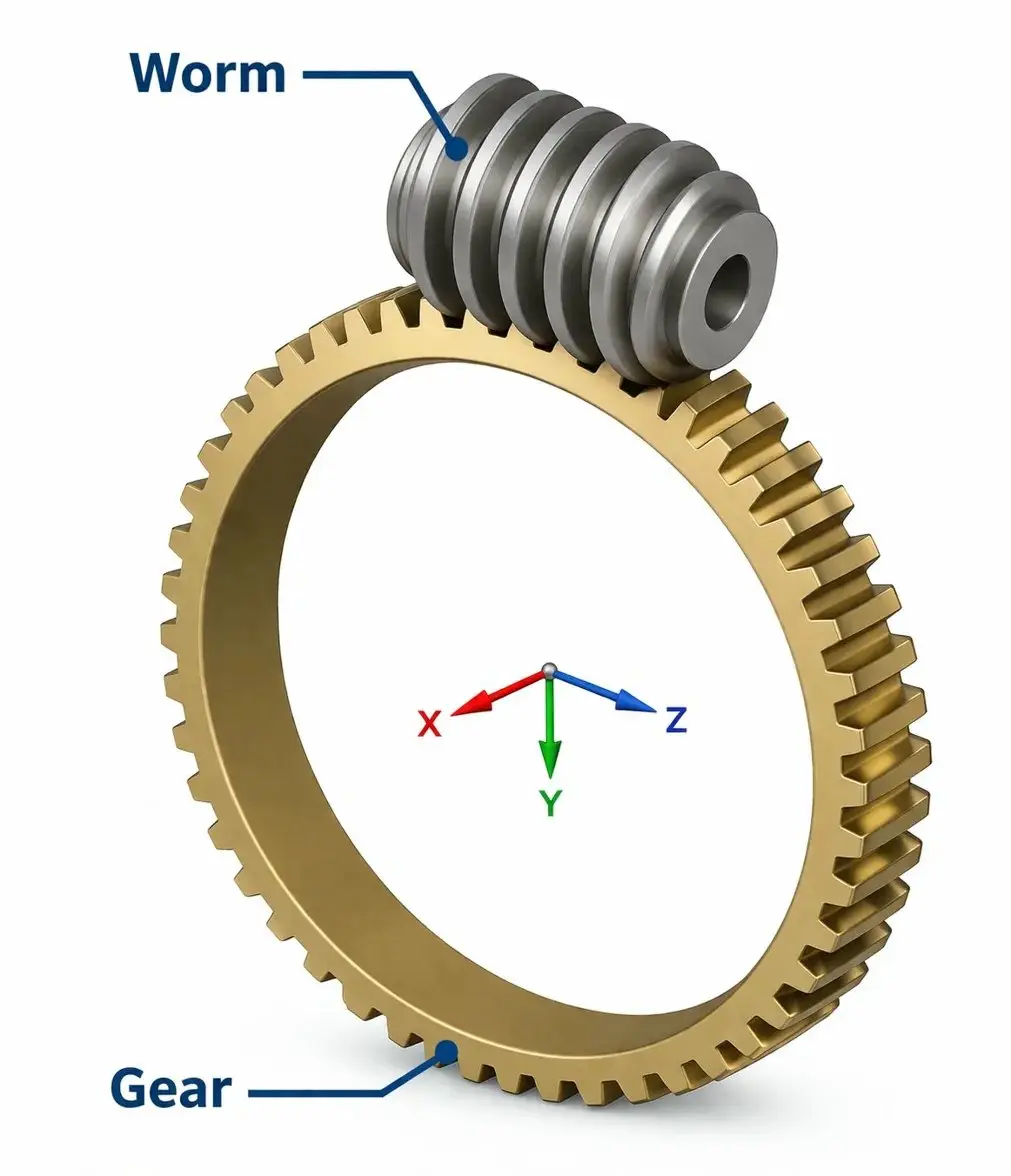
The mesh frequency is the rate at which worm thread starts engage with wheel teeth. It is the fundamental frequency of all gear-related noise and vibration in a worm drive. All gear-generated noise occurs at the mesh frequency and its integer harmonics (2x, 3x, 4x mesh frequency).
z1 = number of worm thread starts (1, 2, or 4)
Example: 1,450 RPM, single-start (z1=1): f_mesh = 24.2 Hz
Example: 1,450 RPM, double-start (z1=2): f_mesh = 48.3 Hz
Example: 1,450 RPM, four-start (z1=4): f_mesh = 96.7 Hz
Harmonics: 2x mesh = 2 x f_mesh; 3x mesh = 3 x f_mesh, etc.
The mesh frequency sets the tempo of gear-generated noise. Every gear geometry error produces a force variation at the mesh contact on every tooth engagement cycle — which produces acoustic output at f_mesh. A profile deviation (Ff) causes a brief impact force variation at each tooth engagement: acoustic output at f_mesh and harmonics. A lead deviation (Fb) causes a smooth sinusoidal torque variation over one full worm shaft rotation: acoustic output at shaft rotation frequency and its harmonics, modulating the mesh frequency amplitude.
| Noise / Vibration Character | Frequency | Root Cause | Хитност |
|---|---|---|---|
| Constant tone, proportional to speed | f_mesh and harmonics | Gear profile deviation (Ff) — normal for DIN 8-9; investigate if new | Investigate if sudden onset or increasing amplitude |
| Tone with speed-proportional sidebands | f_mesh +/- n_shaft | Lead deviation (Fb) modulating mesh — multi-start worm check start spacing | Investigate if above DIN class tolerance level |
| Periodic knock at wheel rotation freq. | 1x wheel rotation = n_worm/z2/60 Hz | Single damaged tooth or foreign object embedded in wheel | Immediate — stop and inspect |
| Periodic knock NOT at gear frequencies | Bearing defect frequencies BPFO/BPFI | Bearing inner or outer race spall — calculable from bearing geometry | Urgent — bearing replacement before failure |
| Broadband hiss increasing with speed | No discrete frequency | Boundary lubrication — oil film insufficient at mesh contact | Increase lubricant viscosity grade; check oil level |
| Low-frequency rumble at all speeds | Shaft rotation frequency | Shaft eccentricity or imbalance; coupling misalignment | Investigate mounting and shaft runout |
| Resonant structural ringing after mesh events | Structural natural frequency | Housing or support structure resonance excited by mesh frequency | Stiffen structure or change mesh frequency by ratio/speed change |
| Quiet when cold, noisy when warm | Changes with temperature | Oil viscosity dropping with temperature — boundary lubrication regime shift | Change to higher-VI lubricant; check housing temperature |
How Contact Pattern Quality Determines Noise Level
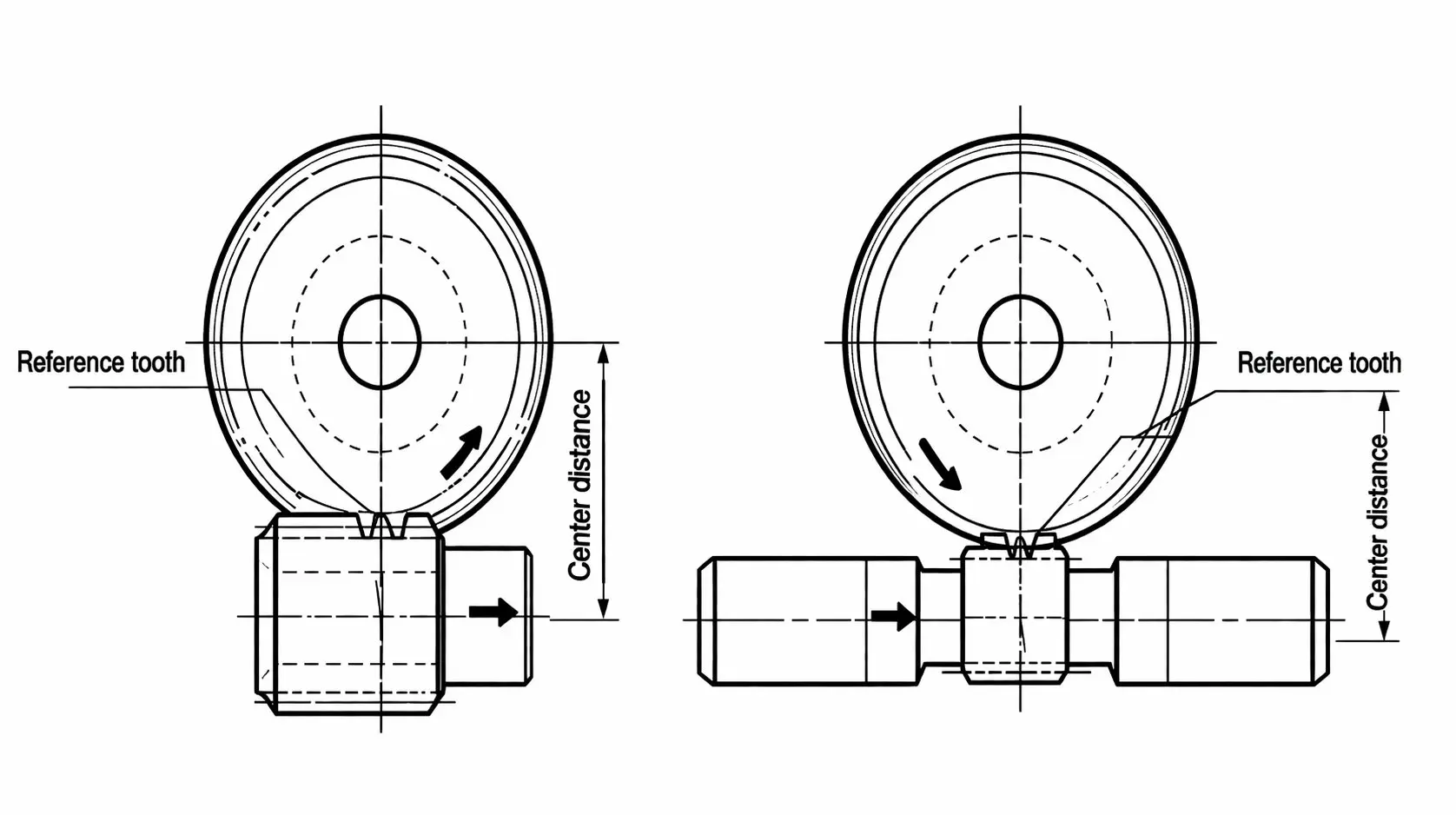
The single most impactful parameter for worm gear mesh noise is the contact pattern coverage — the percentage of the tooth face width over which the worm thread and wheel tooth are in contact during engagement. A full contact pattern (70% or more of face width) distributes the mesh load across the full engagement zone, reducing peak Hertz contact stress and producing a smooth, continuous force variation at the mesh frequency — which generates low-amplitude, low-frequency acoustic output.
A point contact pattern — which occurs when the worm wheel is hobbed with a mismatched cutter profile — concentrates the full mesh load on a small area, producing a brief high-amplitude force spike at each tooth engagement. The spike generates strong harmonics at 2x, 3x, and 4x mesh frequency in addition to the fundamental. These harmonics fall in the 100-400 Hz range for typical industrial drives — directly in the human ear acoustic sensitivity peak, making them perceptible at lower amplitude than the fundamental frequency alone.
Engineering Noise Out at the Design Stage
Use a Larger Module
Larger module = larger tooth cross-section = lower tooth contact stress at the same load = lower mesh force variation amplitude = lower acoustic output. A one-step module increase (e.g., M4 to M5) at the same load reduces mesh force variation by approximately 30%. The gear is larger and heavier but significantly quieter at equal load.
Specify DIN 7 or Better
Thread grinding to DIN 7 removes the profile deviation (Ff) that is the primary source of mesh frequency harmonics. The improvement in noise is most pronounced in the 100-500 Hz frequency range. A DIN 7 gear set is typically 8-12 dB(A) quieter than the same gear set at DIN 9, at equal load and speed. The cost premium for DIN 7 vs DIN 9 is approximately 40-60%.
Profile-Matched Hobbing
Specifying a worm wheel hobbed with a cutter matched to the actual worm geometry (not a standard-module general-purpose cutter) produces line contact instead of point contact. This is documented by the contact pattern photograph in the delivery documentation. A >=70% contact pattern vs a 30-40% pattern reduces mesh noise by 5-10 dB(A) — comparable to a precision class improvement.
PAO Lubricant
Synthetic PAO oil maintains higher viscosity at operating temperature than mineral oil at the same ISO VG grade. Higher operating viscosity means a thicker elastohydrodynamic film at the mesh contact, reducing metal-to-metal contact area, reducing asperity friction, and reducing broadband boundary-lubrication noise. The improvement is most significant in drives running near their thermal limit where mineral oil viscosity has dropped substantially.
Damped Housing Mounting
The housing transmits gear mesh vibration to the structure it is mounted on. Resilient anti-vibration mounts between the housing and the machine frame reduce structure-borne noise transmission by 6-15 dB(A) depending on the mount stiffness and the structural resonance frequencies involved. The housing bolts must still be torqued correctly — resilient mounts provide vibration isolation, not reduction in gear mesh force amplitude.
Nylon or POM Wheel (Light Duty)
For very light load applications (instrumentation drives, small format label applicators, laboratory positioning) a PA66 nylon or POM acetal wheel running against a polished steel worm shaft reduces mesh noise by 10-18 dB(A) compared to metal-on-metal contact. The trade-off is torque capacity limited to approximately M2 module at light duty. Do not use plastic wheels as a noise fix for moderate or heavy duty applications — they will fail mechanically.
Manufacturing Practices That Determine Noise Performance
 |
 |
 |
 |
 |
 |
What Can Be Done After Installation — Post-Commissioning Noise Reduction
When a worm gear drive is already installed and producing unacceptable noise, the options are limited by what can be changed without major disassembly. The priority order: first confirm the source (is it the gear mesh, the bearings, or the structure?), then apply the highest-impact available remedy.
| Intervention | Effort | Noise Reduction Potential | When to Use |
|---|---|---|---|
| Switch to PAO synthetic lubricant | Low — oil drain and refill only | 2-6 dB(A) in temperature-sensitive drives | When noise is worse when warm than cold |
| Increase lubricant viscosity grade | Low — oil drain and refill only | 2-5 dB(A) if currently under-viscosed | When broadband hiss present |
| Add resilient anti-vibration mounts | Medium — housing dismount required | 6-15 dB(A) structure-borne reduction | When noise radiates from the structure, not the gear |
| Replace gear set with DIN 7 precision | High — complete disassembly | 8-14 dB(A) mesh frequency noise | When mesh frequency tonal noise is the primary complaint |
| Replace gear set with profile-matched wheel | High — complete disassembly | 5-10 dB(A) total | When contact pattern photograph shows <50% coverage |
| Replace gear set with larger module | High — housing modification likely | Up to 10 dB(A) at equal load | When noise is load-proportional and housing space allows |
| Replace bearings | Medium — partial disassembly | Eliminates bearing noise component | When periodic knock confirmed as bearing defect frequency |
| Replace with nylon/POM wheel (light duty only) | Medium — wheel replacement | 10-18 dB(A) if load permits | Very light duty only — confirm torque within plastic limit |
Products for Quiet Worm Gear Operation

Noise FAQ
Worm Gear Noise and Vibration — Questions from Mechanical and Acoustic Engineers
Specify a Quieter Worm Gear Drive
Provide operating speed, load, current noise complaint, precision class (if known), and acoustic target. Korea Ever-Power identifies the specification change most likely to meet the noise requirement and returns a confirmed quotation within one working day.
Уредник: Cxm