Application Engineering Guide

Worm Gear Drives for Packaging Machinery — Reliability, Indexing, and the Cost of Getting It Wrong

The average packaging line experiences 37 minutes of unplanned downtime per day. A significant fraction originates in worn or incorrectly specified worm gear drives on indexing stations, filling heads, and sealing equipment. This guide addresses the root causes — and the specification decisions that extend mean time between failures.

Why Packaging Machinery Drives Fail Faster Than Industrial Conveyors

At first specification, a packaging machine worm gear drive looks similar to a general conveyor drive. Both are right-angle corner drives. Both require self-locking for inclined sections. Both are in industrial environments with dust and variable temperature. The similarity ends there. The packaging machine drive faces three conditions that a standard conveyor drive specification does not address — and these conditions are responsible for the majority of premature packaging drive failures.

High-cycle fatigue

Packaging machines cycle at 40–400 cycles per minute, 3 shifts per day, 6 days per week. A rotary filling machine running at 120 bottles per minute accumulates 300 million tooth mesh contacts per year — enough for sub-surface pitting fatigue to initiate in an underspecified gear within 12–18 months even at modest torque loads.

→ Tooth pitting initiating from sub-surface fatigue at pitch line. Progressive noise increase followed by sudden tooth fracture.

Wash-down exposure

Food and beverage packaging machines are cleaned with high-pressure hot water and cleaning chemicals daily. A worm gear drive without IP65-minimum sealing will accumulate water in the housing, contaminating the lubricant and initiating corrosive attack on the shaft thread flanks and wheel tooth faces within weeks.

→ Green-black oil contamination from corrosive attack on bronze wheel. Accelerated wear producing metallic debris. Housing rust.

Rapid start-stop cycles

Packaging machine indexing drives start from rest and stop precisely, hundreds of times per hour. Each start-stop cycle generates an impact torque pulse 2–4× the running torque at the motor coupling — transmitted directly to the worm shaft. An underspecified shaft material (C45 induction vs 40Cr through-hardened) will fatigue-crack from the root fillet under this cyclic impact loading.

→ Root fillet fatigue cracking initiated at start-stop torque peaks. Crack propagates until sudden tooth fracture during production.


Indexing Packaging Drives — Speed, Accuracy, and the Backlash Problem at Temperature
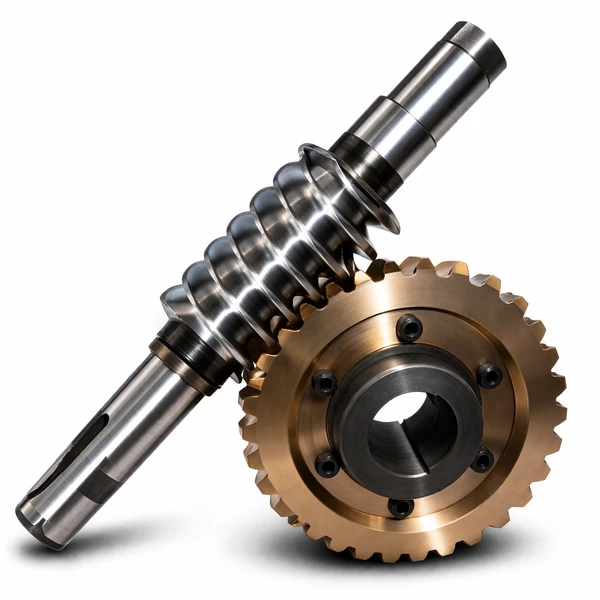
Precision worm wheel for packaging machine indexing drives

High-precision worm wheel for packaging machine indexing — contact pattern ≥ 70% face width, documented at shipment.

Indexing packaging machinery — rotary filling carousels, cartoning lines, blister pack thermoformers — must advance a precise distance, stop, perform a process operation, then advance again. Positional accuracy of the index affects the alignment of the package at each process station. A rotary filling machine with 12 filling heads on a 600 mm pitch circle must stop each head within ±0.5 mm of its target position to achieve consistent fill volumes without spillage.

The worm gear drive backlash that is acceptable in a conveyor application creates a real problem in an indexing drive. If the indexing motion always approaches from the same direction (the star wheel always rotates clockwise), backlash creates no position error — the load takes up the clearance in the consistent direction. When the indexing motion must reverse — as occurs in many blister pack and carton erecting machines — backlash creates a position overshoot on every reversal.

The temperature dimension makes this more complex: at startup, the packaging machine housing is at ambient temperature (20–25°C). After 45 minutes of running, the housing reaches 55–65°C. Over this temperature rise, standard mineral oil viscosity drops 55–65%, reducing the lubrication preload on the gear mesh and effectively increasing functional backlash by 0.02–0.04 mm. On a 150 mm pitch radius worm wheel, this is 0.8–1.6 arc-minutes of additional dead zone that appears during the first hour of each production shift.

Temperature-Dependent Backlash in Packaging Machine Worm Gear Drives
20°C startup
ISO VG 460 mineral, ~1,600 cSt
0.05 mm nominal
Indexing within spec
55°C operating
ISO VG 460 mineral, ~120 cSt
0.07–0.09 mm functional
Near or over tolerance
55°C with PAO 460
PAO synthetic, VI>150, ~280 cSt
0.05–0.06 mm functional
Within spec, stable

Wash-Down Specification — What Packaging Machinery Drives Actually Require

IP65 is the minimum sealing specification for any worm gear drive installed in a food or beverage packaging environment — dust-tight and protected against low-pressure water jets from any direction. This protects against the standard daily clean-down procedure on most packaging lines. Higher sealing levels are required in specific zones:

IP54
Dust protection (partial) + splash water
Dry ambient zones, secondary equipment areas
⚠ Marginal — minimum for clean dry areas only
IP65
Dust-tight + low-pressure jet wash
Primary packaging areas, standard clean-down
✓ Standard for most packaging machine drives
IP67
Dust-tight + immersion to 1m, 30 min
CIP (clean-in-place) zones, high-pressure wash
✓ Required for direct product exposure zones
IP69K
Dust-tight + high-pressure, high-temperature wash
Direct wash-down with steam and high-pressure hose
✓ Dairy, meat processing, open-mix packaging

Changeover Time and Format Flexibility — The Hidden Value of Worm Gear Interchangeability

Modern food and beverage packaging lines run multiple product formats — different bottle heights, different carton dimensions, different fill volumes — on the same line with format changeovers 2–5 times per shift. The worm gear drives on these machines are often part of the format-change system: different output speeds require different gear ratios, or different product sizes require different pitch motions at the indexing station.

A packaging machine designed for quick-change worm gear sets uses identical housing centre distances across different ratio options. The worm wheel — which carries the ratio information in its tooth count — can be swapped in the same housing without housing modification. A 40-tooth wheel (40:1 ratio) and a 50-tooth wheel (50:1 ratio) can use the same housing if the housing accepts both wheel diameters with appropriate centre distance adjustment. This interchangeability reduces changeover time and eliminates the need to stock complete gearboxes as format-change spares — only the wheel needs to be stocked.

Designing for interchangeability: Specify the same bore diameter, keyway, and hub dimensions across all wheel tooth counts in your format range. Korea Ever-Power can manufacture wheels from 20 teeth to 100 teeth at the same module, bore, keyway, and hub face width — allowing a single housing design to accommodate any ratio in the format range. Provide your format ratio range and bore requirements, and we confirm the dimensional compatibility before your first housing design is committed to tooling.


Packaging Machine Types — Mapped to Worm Gear Specification Requirements

Packaging Machine Type Drive Function Key Requirement Recommended Specification Critical Risk
Rotary filling carousel Index filling heads to product stations Position accuracy ±1 mm; self-locking at each station M4–M6, 40Cr, ZCuSn10Pb1, IP65, duplex for ±0.5mm Backlash growth causing fill station misalignment
Horizontal flow wrapper Drive film tensioning and sealing jaw Constant speed + precise seal timing M3–M5, 40Cr, single-start for self-locking jaw hold Jaw timing drift causing incomplete seals
Carton erector Index carton blank into erecting mandrel Precise stop position for blank pickup M2–M4, 40Cr, duplex worm, soft-start recommended Start-stop impact fatigue at high cycle rate
Labeling machine Drive label applicator and product rotation Low backlash for label position accuracy M1–M3, SCM415, duplex, DIN7 precision Label misregistration from backlash growth
Blister pack thermoformer Index film through forming, filling, sealing Precise film advance distance M4–M8, 40Cr, standard or duplex, IP54+ Film stretch causing misaligned blisters
Sachet machine (VFFS) Drive forming tube and sealing jaws High cycle rate, consistent jaw closure M2–M4, SCM415 CG for high cycle, IP65 Root fillet fatigue at high start-stop frequency
Rotary cap torque Apply and tighten bottle caps to torque spec Torque repeatability ±5% M4–M6, 40Cr, standard backlash Overtorque or undertorque causing cap failures
Case packer / palletiser Index cases into packing pattern Heavy duty, self-locking in inclined sections M6–M10, 40Cr or SCM415, ZCuAl10Fe3 for impact Tooth fracture under sudden impact from case jam

Field Engineering

Four Packaging Line Worm Gear Specifications — Downtime Root Cause and Engineering Resolution

Gyeonggi-do, Korea · Beverage Packaging OEM
Rotary Filling Carousel — Indexing Position Drift During Production Shift

Situation: A Korean bottled water manufacturer operating three 24-head rotary filling carousels reported progressive filling station misalignment that developed over the first 2 hours of each production shift. At startup, all 24 filling heads aligned within ±0.3 mm of target. By hour 2, misalignment of 3–4 filling heads had reached ±1.2 mm — causing fill level variation and occasional spillage triggering the line’s vision system to reject bottles.

Resolution: Root cause: standard mineral ISO VG 460 lubricant dropping in viscosity from ~1,600 cSt (cold start) to ~110 cSt at 58°C housing equilibrium, increasing functional backlash from 0.05 mm to 0.09 mm. Specification change: standard mineral oil → PAO synthetic ISO VG 460 (VI=155, viscosity at 58°C approximately 280 cSt). Additionally upgraded from standard to duplex worm gear, calibrated to zero backlash at median operating temperature.

✓ Position drift eliminated · Rejections dropped from 1.8% to 0.1% · Payback on gear upgrade: 4 production shifts
Hanoi, Vietnam · Snack Food Packaging
Sachet Machine Worm Gear — Root Fillet Fatigue from High Start-Stop Frequency

Situation: A Vietnamese snack food manufacturer’s VFFS (vertical form fill seal) sachet machine was replacing worm wheels every 4–5 months. The machine ran at 220 sachets per minute across 22-hour daily production — approximately 291,000 start-stop cycles per day on the sealing jaw drive. Failed wheel inspection showed root fillet cracking initiating at the tooth root and propagating toward the tooth tip — a bending fatigue failure pattern, not surface wear.

Resolution: Root cause: C45 induction-hardened shaft (surface hardness verified at 46 HRC — below the 50 HRC target for the specification) was producing inadequate hardness differential against the tin bronze wheel, and the cyclic start-stop torque pulses at 220 cycles/minute were producing bending fatigue stress concentration at the root fillet of the bronze wheel. Resolution: SCM415 carburized shaft (62 HRC surface hardness, 1.1 mm case depth) with the same tin bronze wheel. Case depth verified at ≥0.8 mm at the root fillet specifically — not just the nominal case depth.

✓ Fatigue failure mode eliminated · Wheel life >12 months verified · Root fillet case depth documented
Jakarta, Indonesia · Beverage Canning Line
Rotary Seaming Machine — Wash-Down Corrosion Accelerating Wheel Wear

Situation: A Jakarta beverage canning plant was experiencing accelerated worm wheel wear on their can seaming machine drives — wear rate 3× the expected design life rate. Oil sample analysis showed water content at 2.8% (severely contaminated) and green metallic deposits (copper sulfide from EP additive contamination). Investigation: the maintenance team had been refilling worm gear housings from the same oil drum used for the can conveyor helical gear drives — EP-additive oil had been entering the worm housings for approximately 8 months.

Resolution: Two-part resolution: (1) Immediate: drain all four seaming machine worm gear housings, flush with non-EP mineral oil, inspect wheel flanks visually (minor green staining confirmed — EP attack was early-stage), refill with correct non-EP PAO ISO VG 320. (2) Systematic: separate labelled oil containers for worm gear drives (red cap = worm gear oil — no EP) and conveyor helical drives (blue cap = EP gear oil). Written maintenance procedure updated to specify oil type by machine serial number.

✓ Corrosive attack stopped · Wear rate returned to design specification · No gear replacement required
Busan, Korea · Cosmetics Packaging
High-Mix Labeling Machine — Frequent Format Change Wearing Wheel Bore

Situation: A Korean cosmetics contract packer running 35+ different product formats per week was experiencing premature bore wear on the labeling machine worm wheels. Each format change required removing and replacing the wheel (different wheel tooth counts for different label pitch speeds). After 6–8 months and approximately 1,200 format changes, the bore had enlarged beyond H7 tolerance from repeated fitting and removal, producing shaft float and label misregistration.

Resolution: Specification change: standard H7/k6 transition fit (allow removal) → spline coupling at the wheel bore for format-change wheels, with the worm wheel bore designed to accept the spline without force fitting. The spline coupling transmits full torque at zero axial clearance while allowing removal without bore damage. Korea Ever-Power machined the modified bore pattern in the same wheel production run — no housing modification required. Format change time reduced from 18 minutes to 6 minutes per format.

✓ Bore wear eliminated · Format change time reduced 67% · Spline coupling — no housing modification

Korea Ever-Power Products

Worm Gear Products for Packaging Machinery

Alloy Steel Worm Gear Set — Packaging Grade
Standard Packaging Duty · D2 · IP65 Ready
Alloy Steel Worm Gear Set — Packaging Grade
The foundation specification for standard packaging machine drives — filling carousels, horizontal flow wrappers, cartoners, and conveyor drives. The 40Cr through-hardened worm shaft at 50–56 HRC provides the hardness differential against ZCuSn10Pb1 tin bronze wheel that packaging machine duty demands: sufficient to support the moderate torques and moderate-cycle frequencies of standard packaging operations, while the tin bronze wheel’s lead-phase boundary lubrication protects against the brief boundary lubrication conditions during start-stop cycles. The complete matched set ships with CMM inspection report covering bore diameter (H7), shaft runout, and lead error on the worm thread — the three parameters that most directly affect packaging machine indexing accuracy and noise level. For high-cycle packaging applications (above 200 cycles per minute), the upgrade to SCM415 carburized shaft (58–62 HRC, 0.8–1.2 mm case depth) is recommended — providing substantially better root fillet fatigue resistance against the cyclic impact torque of rapid start-stop operation. Module range M1.5 through M8 covers light labeling drives through heavy case packer drives. Non-standard tooth counts for format-change interchangeability programs are available as Level 3 semi-custom at the same delivery lead time as catalog reorders once the first batch is qualified.
Shaft40Cr 50–56 HRC / SCM415 58–62 HRC option
WheelZCuSn10Pb1 tin bronze, Mat. cert included
BoreH7 — CMM verified, spline option available
ModuleM1.5 – M8 (standard), other on request
IP compatibilityIP65 housing compatible

View / Request Specification →

Duplex Worm Gear — Packaging Machine Indexing Drive
Indexing Accuracy · Format Change
Duplex Worm Gear — Packaging Machine Indexing Drive
The correct specification for packaging machines where indexing position accuracy must be maintained across temperature changes during the production shift, and where backlash-induced position drift causes fill station misalignment, label misregistration, or blister pack film misalignment. The duplex worm’s adjustable backlash eliminates the temperature-dependent backlash increase that causes production shift warm-up periods to produce out-of-specification product — the backlash can be calibrated to zero at median operating temperature (typically 50–60°C for a packaging machine housing in production), ensuring consistent indexing accuracy from start-up through the full shift. For format-change programs, the duplex worm shaft remains in the housing during wheel changes — only the worm wheel is replaced for the format change, and the backlash is re-set by axial shift after each wheel installation. This reduces format change time compared to complete gear set replacement and eliminates re-learning the backlash adjustment procedure. The duplex gear set is available in the same material specifications as the standard alloy steel set, including the SCM415 carburized option for high-cycle applications. Contact Korea Ever-Power with your indexing accuracy requirement, operating temperature range, and cycle rate to receive a backlash calibration recommendation specific to your application.
BacklashCalibrated to zero at operating temperature
Temperature stabilityPAO lubricant recommendation included
Format changeWheel-only replacement compatible
PrecisionDIN6–DIN7 standard, DIN5 on request
Cycle rateHigh-cycle SCM415 option available

View / Request Specification →

Packaging Line Format Change Supply Program
Format Change Program · Supply Agreement
Packaging Line Format Change Supply Program
For packaging machine builders and food and beverage production facilities operating multi-format packaging lines, Korea Ever-Power provides format change worm gear supply programs that cover the full range of ratio variants required for the line’s format portfolio. The supply program structure: (1) Qualification of a master gear set geometry (shaft specification, housing centre distance, bore standard); (2) Production of the full format range (typically 3–8 different wheel tooth counts) to the same bore and hub dimensions, confirmed interchangeable in the same housing; (3) Stocking of all format variants at Korea Ever-Power against agreed minimum stock quantities — with call-off fulfillment in 5 working days; (4) Annual review of format range to add or remove variants as the production schedule changes. For food and beverage packaging lines, the supply program includes the NSF H1 lubricant documentation and IP65 sealing compatibility confirmation for each gear set in the format range — supporting the facility’s HACCP prerequisite programme maintenance records. Production facilities operating under FSSC 22000 or BRC can request the supply program documentation in a format compatible with their supplier qualification procedure.
Format range3–8 ratio variants per program
InterchangeabilityConfirmed same bore/hub dimensions
StockKorea Ever-Power holds buffer stock
Call-off5 working days from confirmed stock
Food complianceNSF H1 + IP65 documentation available

View / Request Specification →

Packaging Machinery FAQ

Worm Gear in Packaging Machines — Questions from Machine Builders and Production Engineers

Our packaging machine worm wheels wear out every 6 months under normal production. What is causing this and what is the correct service life we should expect?+

A correctly specified worm gear set in standard packaging machine duty (moderate torque, 2-3 shifts/day, IP65 sealing, non-EP lubricant) should provide 3–5 years of service before wheel replacement is required. If you are replacing every 6 months, one of four problems is almost certainly present: (1) hardness differential violation — the shaft hardness is below specification, typically caused by a C45 shaft that was specified as 40Cr; verify shaft hardness with a portable Rockwell tester; (2) EP-additive lubricant contaminating the oil — check for green tint and copper sulfide deposits in the drained oil; (3) contamination from wash-down water through inadequate sealing — check for white milky appearance in the oil (water contamination); (4) operating above rated torque due to a process jam or incorrect gear ratio for the actual load. Drain oil and inspect at the next failure for the characteristic damage pattern (abrasive, corrosive, or scuffing) to identify the root cause.

We need to run our packaging line at 25% higher speed for a new product. Can we simply increase the motor speed with a VFD, or do we need new gear sets?+

Increasing motor speed by 25% increases the worm shaft speed by 25%, which raises the sliding velocity at the mesh by 25%. This has two effects: (1) efficiency may improve slightly (higher sliding velocity → better hydrodynamic lubrication → lower friction coefficient); and (2) more importantly, the RMS torque at the worm wheel increases if the driven packaging mechanism load does not decrease proportionally. If the packaging mechanism torque is constant (e.g., a filling carousel), the worm wheel is now experiencing 25% more load cycles per unit time — this reduces fatigue life by approximately 40% (fatigue life is inversely proportional to roughly the cube of cycle frequency for high-cycle fatigue). Before increasing speed, confirm the current gear set duty class and cycle rate against the new operating point. If the gear set is currently running at 60–70% of its rated torque, a 25% speed increase may be accommodated. If running above 80% of rated torque, a module upgrade is advisable.

What is the minimum IP rating for a worm gear drive on a packaging machine that gets daily wash-down with hot water?+

IP65 is the absolute minimum — this covers low-pressure water jets from any direction, which is appropriate for standard clean-down hoses at normal distance. For packaging machines using high-pressure clean-down or steam cleaning, IP67 is the correct minimum specification. For open-mix food packaging environments (dairy, meat) where the machine body is regularly subjected to full submersion-equivalent cleaning with hot detergent and disinfectant, IP69K is required. Note that IP rating is a housing specification, not a gear set specification — the worm gear set itself (shaft, wheel, key) must be compatible with the lubricant and the environment, but the IP rating is achieved by the housing, seal, and vent design. Korea Ever-Power can confirm which gear set and seal specifications (NBR or FKM seals, lubricant type) are compatible with the housing IP rating required.

For a packaging machine that runs product A at 80 RPM output and product B at 60 RPM output from the same motor, what is the best gear ratio approach?+

Two approaches: (1) Single gear ratio with VFD speed adjustment — one gear set at a ratio between 80 and 60 RPM equivalents, motor speed adjusted by VFD for each product. This works if the VFD speed range doesn’t take the worm shaft below the minimum sliding velocity for adequate lubrication (typically avoid below 300–400 RPM worm shaft). (2) Two interchangeable worm wheels — different tooth counts for each ratio, same housing. This is the format-change approach and provides exact gear ratios at optimal motor operating points. The second approach is preferable if the motor operating point matters (energy efficiency, torque headroom) or if VFD frequency range limitations constrain approach (1). Korea Ever-Power can manufacture both wheel tooth count variants in the same bore, hub, and face width specification for drop-in interchange in the same housing.

Our labeling machine requires ±0.5 mm label placement accuracy at the label applicator, which is 200 mm from the worm wheel shaft. What backlash specification do I need?+

At 200 mm from the worm wheel shaft axis, ±0.5 mm linear accuracy corresponds to ±0.143° angular accuracy at the shaft. For a bidirectional approach (label applicator oscillates), the backlash must be less than this value — in practice, ≤ 0.1° (approximately 0.08 mm at a 50 mm pitch radius worm wheel) with margin. A standard worm gear at DIN8–DIN9 precision with 0.05–0.10 mm backlash is at or near this specification — acceptable if new but likely to exceed specification within 12 months of production. For reliable ±0.5 mm across the machine’s service life, specify a duplex worm gear at DIN7 precision with initial near-zero backlash. The duplex gear allows periodic re-calibration as wear increases backlash, restoring label placement accuracy without gear set replacement.

We are buying a second-hand packaging machine. The original worm gear specification is unknown. How do we specify a replacement?+

Start with measurements: bore diameter (measured with internal micrometer to H7 tolerance), keyway dimensions (width and depth to DIN 6885A), number of wheel teeth (count them), and worm shaft lead (measure one thread pitch × number of starts, or ask Korea Ever-Power to reverse-engineer from the shaft dimensions). Module can usually be determined from the wheel tooth count and pitch diameter (pitch diameter = module × tooth count). From module and tooth count you can determine centre distance. With these parameters, Korea Ever-Power can identify the corresponding standard specification or confirm a custom specification if the gear was non-standard. Bring the old gear set to any inspection (or send photographs + measurements) and we will identify the specification and confirm availability. The documentation from the replacement set will then provide the material specification that was absent from the original purchase.

What lubricant should we use for a worm gear drive in a food-adjacent packaging environment where incidental product contact is possible?+

NSF H1 certified PAO synthetic gear oil at the ISO VG grade appropriate for your housing operating temperature (see the Lubrication Guide for viscosity selection by temperature). NSF H1 lubricants are formulated for incidental food contact — they are approved for use where small quantities may contact food product. Do not use NSF H2 lubricants (non-food-contact surfaces only) in any zone where product contact is possible. For packaging machines operating in HACCP Zone 2 (splash zone, as would apply to a drive near a filling station), NSF H1 is mandatory. For Zone 3 (ambient clean zone, no product contact path), standard non-EP mineral or PAO oil is acceptable. The NSF H1 lubricant specification is documented in the Korea Ever-Power food-grade supply documentation package for SS316 worm gear sets, and is available as an additional documentation element for standard alloy steel sets ordered for food-adjacent packaging applications.

How do we reduce the noise from our worm gear packaging drives? The current noise level is affecting the factory floor environment.+

Worm gear drives are inherently quieter than spur gear trains but can produce significant noise under certain conditions. Primary noise reduction measures: (1) Verify contact pattern — a point-contact mesh from a mismatched cutter profile produces significantly more mesh noise than a ≥70% line contact pattern; request a contact pattern photograph from the replacement gear set to confirm this is addressed; (2) Check lubricant viscosity — oil that is too thin (either because the wrong grade was specified or the housing temperature is too high) produces more boundary-contact noise; confirm the oil grade against the housing temperature; (3) Check for loose mounting — a worm gear housing that is not fully torqued to its mounting surface acts as a noise radiator, amplifying mesh noise through the structure; (4) For very low load applications (labeling drives, small format indexers), consider nylon (PA66) worm wheels — these reduce mesh noise by 8–12 dB(A) at the cost of reduced torque capacity.

Specify Your Packaging Machine Worm Gear Drive

Provide machine type, indexing accuracy requirement, cycle rate, operating temperature range, wash-down IP requirement, and any format-change ratio range. Korea Ever-Power returns a confirmed packaging-grade worm gear specification with interchangeability confirmation and lead time within one working day.

Editor: Cxm