Why Packaging Machinery Drives Fail Faster Than Industrial Conveyors
At first specification, a packaging machine worm gear drive looks similar to a general conveyor drive. Both are right-angle corner drives. Both require self-locking for inclined sections. Both are in industrial environments with dust and variable temperature. The similarity ends there. The packaging machine drive faces three conditions that a standard conveyor drive specification does not address — and these conditions are responsible for the majority of premature packaging drive failures.
High-cycle fatigue
Packaging machines cycle at 40–400 cycles per minute, 3 shifts per day, 6 days per week. A rotary filling machine running at 120 bottles per minute accumulates 300 million tooth mesh contacts per year — enough for sub-surface pitting fatigue to initiate in an underspecified gear within 12–18 months even at modest torque loads.
→ Tooth pitting initiating from sub-surface fatigue at pitch line. Progressive noise increase followed by sudden tooth fracture.
Wash-down exposure
Food and beverage packaging machines are cleaned with high-pressure hot water and cleaning chemicals daily. A worm gear drive without IP65-minimum sealing will accumulate water in the housing, contaminating the lubricant and initiating corrosive attack on the shaft thread flanks and wheel tooth faces within weeks.
→ Green-black oil contamination from corrosive attack on bronze wheel. Accelerated wear producing metallic debris. Housing rust.
Rapid start-stop cycles
Packaging machine indexing drives start from rest and stop precisely, hundreds of times per hour. Each start-stop cycle generates an impact torque pulse 2–4× the running torque at the motor coupling — transmitted directly to the worm shaft. An underspecified shaft material (C45 induction vs 40Cr through-hardened) will fatigue-crack from the root fillet under this cyclic impact loading.
→ Root fillet fatigue cracking initiated at start-stop torque peaks. Crack propagates until sudden tooth fracture during production.
Indexing Packaging Drives — Speed, Accuracy, and the Backlash Problem at Temperature
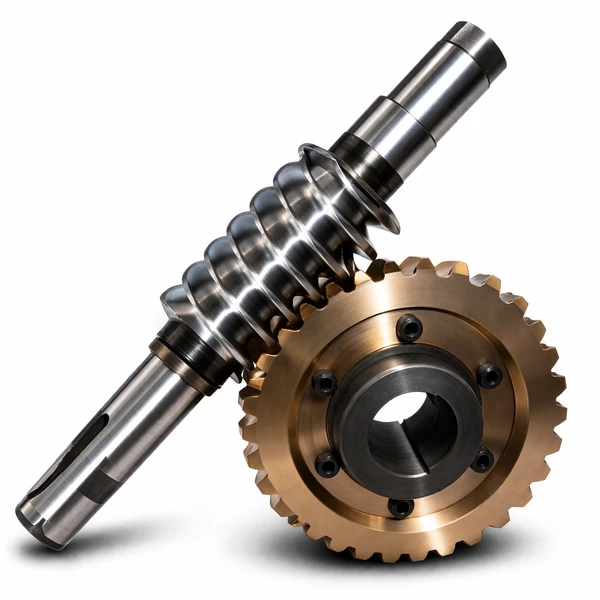
Indexing packaging machinery — rotary filling carousels, cartoning lines, blister pack thermoformers — must advance a precise distance, stop, perform a process operation, then advance again. Positional accuracy of the index affects the alignment of the package at each process station. A rotary filling machine with 12 filling heads on a 600 mm pitch circle must stop each head within ±0.5 mm of its target position to achieve consistent fill volumes without spillage.
The worm gear drive backlash that is acceptable in a conveyor application creates a real problem in an indexing drive. If the indexing motion always approaches from the same direction (the star wheel always rotates clockwise), backlash creates no position error — the load takes up the clearance in the consistent direction. When the indexing motion must reverse — as occurs in many blister pack and carton erecting machines — backlash creates a position overshoot on every reversal.
The temperature dimension makes this more complex: at startup, the packaging machine housing is at ambient temperature (20–25°C). After 45 minutes of running, the housing reaches 55–65°C. Over this temperature rise, standard mineral oil viscosity drops 55–65%, reducing the lubrication preload on the gear mesh and effectively increasing functional backlash by 0.02–0.04 mm. On a 150 mm pitch radius worm wheel, this is 0.8–1.6 arc-minutes of additional dead zone that appears during the first hour of each production shift.
Wash-Down Specification — What Packaging Machinery Drives Actually Require
IP65 is the minimum sealing specification for any worm gear drive installed in a food or beverage packaging environment — dust-tight and protected against low-pressure water jets from any direction. This protects against the standard daily clean-down procedure on most packaging lines. Higher sealing levels are required in specific zones:
Changeover Time and Format Flexibility — The Hidden Value of Worm Gear Interchangeability
Modern food and beverage packaging lines run multiple product formats — different bottle heights, different carton dimensions, different fill volumes — on the same line with format changeovers 2–5 times per shift. The worm gear drives on these machines are often part of the format-change system: different output speeds require different gear ratios, or different product sizes require different pitch motions at the indexing station.
A packaging machine designed for quick-change worm gear sets uses identical housing centre distances across different ratio options. The worm wheel — which carries the ratio information in its tooth count — can be swapped in the same housing without housing modification. A 40-tooth wheel (40:1 ratio) and a 50-tooth wheel (50:1 ratio) can use the same housing if the housing accepts both wheel diameters with appropriate centre distance adjustment. This interchangeability reduces changeover time and eliminates the need to stock complete gearboxes as format-change spares — only the wheel needs to be stocked.
Designing for interchangeability: Specify the same bore diameter, keyway, and hub dimensions across all wheel tooth counts in your format range. Korea Ever-Power can manufacture wheels from 20 teeth to 100 teeth at the same module, bore, keyway, and hub face width — allowing a single housing design to accommodate any ratio in the format range. Provide your format ratio range and bore requirements, and we confirm the dimensional compatibility before your first housing design is committed to tooling.
Packaging Machine Types — Mapped to Worm Gear Specification Requirements
| Packaging Machine Type | Drive Function | Key Requirement | Recommended Specification | Critical Risk |
|---|---|---|---|---|
| Rotary filling carousel | Index filling heads to product stations | Position accuracy ±1 mm; self-locking at each station | M4–M6, 40Cr, ZCuSn10Pb1, IP65, duplex for ±0.5mm | Backlash growth causing fill station misalignment |
| Horizontal flow wrapper | Drive film tensioning and sealing jaw | Constant speed + precise seal timing | M3–M5, 40Cr, single-start for self-locking jaw hold | Jaw timing drift causing incomplete seals |
| Carton erector | Index carton blank into erecting mandrel | Precise stop position for blank pickup | M2–M4, 40Cr, duplex worm, soft-start recommended | Start-stop impact fatigue at high cycle rate |
| Labeling machine | Drive label applicator and product rotation | Low backlash for label position accuracy | M1–M3, SCM415, duplex, DIN7 precision | Label misregistration from backlash growth |
| Blister pack thermoformer | Index film through forming, filling, sealing | Precise film advance distance | M4–M8, 40Cr, standard or duplex, IP54+ | Film stretch causing misaligned blisters |
| Sachet machine (VFFS) | Drive forming tube and sealing jaws | High cycle rate, consistent jaw closure | M2–M4, SCM415 CG for high cycle, IP65 | Root fillet fatigue at high start-stop frequency |
| Rotary cap torque | Apply and tighten bottle caps to torque spec | Torque repeatability ±5% | M4–M6, 40Cr, standard backlash | Overtorque or undertorque causing cap failures |
| Case packer / palletiser | Index cases into packing pattern | Heavy duty, self-locking in inclined sections | M6–M10, 40Cr or SCM415, ZCuAl10Fe3 for impact | Tooth fracture under sudden impact from case jam |
วิศวกรรมภาคสนาม
Four Packaging Line Worm Gear Specifications — Downtime Root Cause and Engineering Resolution
สถานการณ์: A Korean bottled water manufacturer operating three 24-head rotary filling carousels reported progressive filling station misalignment that developed over the first 2 hours of each production shift. At startup, all 24 filling heads aligned within ±0.3 mm of target. By hour 2, misalignment of 3–4 filling heads had reached ±1.2 mm — causing fill level variation and occasional spillage triggering the line’s vision system to reject bottles.
ปณิธาน: Root cause: standard mineral ISO VG 460 lubricant dropping in viscosity from ~1,600 cSt (cold start) to ~110 cSt at 58°C housing equilibrium, increasing functional backlash from 0.05 mm to 0.09 mm. Specification change: standard mineral oil → PAO synthetic ISO VG 460 (VI=155, viscosity at 58°C approximately 280 cSt). Additionally upgraded from standard to duplex worm gear, calibrated to zero backlash at median operating temperature.
สถานการณ์: A Vietnamese snack food manufacturer’s VFFS (vertical form fill seal) sachet machine was replacing worm wheels every 4–5 months. The machine ran at 220 sachets per minute across 22-hour daily production — approximately 291,000 start-stop cycles per day on the sealing jaw drive. Failed wheel inspection showed root fillet cracking initiating at the tooth root and propagating toward the tooth tip — a bending fatigue failure pattern, not surface wear.
ปณิธาน: Root cause: C45 induction-hardened shaft (surface hardness verified at 46 HRC — below the 50 HRC target for the specification) was producing inadequate hardness differential against the tin bronze wheel, and the cyclic start-stop torque pulses at 220 cycles/minute were producing bending fatigue stress concentration at the root fillet of the bronze wheel. Resolution: SCM415 carburized shaft (62 HRC surface hardness, 1.1 mm case depth) with the same tin bronze wheel. Case depth verified at ≥0.8 mm at the root fillet specifically — not just the nominal case depth.
สถานการณ์: A Jakarta beverage canning plant was experiencing accelerated worm wheel wear on their can seaming machine drives — wear rate 3× the expected design life rate. Oil sample analysis showed water content at 2.8% (severely contaminated) and green metallic deposits (copper sulfide from EP additive contamination). Investigation: the maintenance team had been refilling worm gear housings from the same oil drum used for the can conveyor helical gear drives — EP-additive oil had been entering the worm housings for approximately 8 months.
ปณิธาน: Two-part resolution: (1) Immediate: drain all four seaming machine worm gear housings, flush with non-EP mineral oil, inspect wheel flanks visually (minor green staining confirmed — EP attack was early-stage), refill with correct non-EP PAO ISO VG 320. (2) Systematic: separate labelled oil containers for worm gear drives (red cap = worm gear oil — no EP) and conveyor helical drives (blue cap = EP gear oil). Written maintenance procedure updated to specify oil type by machine serial number.
สถานการณ์: A Korean cosmetics contract packer running 35+ different product formats per week was experiencing premature bore wear on the labeling machine worm wheels. Each format change required removing and replacing the wheel (different wheel tooth counts for different label pitch speeds). After 6–8 months and approximately 1,200 format changes, the bore had enlarged beyond H7 tolerance from repeated fitting and removal, producing shaft float and label misregistration.
ปณิธาน: Specification change: standard H7/k6 transition fit (allow removal) → spline coupling at the wheel bore for format-change wheels, with the worm wheel bore designed to accept the spline without force fitting. The spline coupling transmits full torque at zero axial clearance while allowing removal without bore damage. Korea Ever-Power machined the modified bore pattern in the same wheel production run — no housing modification required. Format change time reduced from 18 minutes to 6 minutes per format.
ผลิตภัณฑ์เอเวอร์พาวเวอร์จากเกาหลี
Worm Gear Products for Packaging Machinery


คำถามที่พบบ่อยเกี่ยวกับเครื่องจักรบรรจุภัณฑ์
เฟืองตัวหนอนในเครื่องจักรบรรจุภัณฑ์ — คำถามจากผู้ผลิตเครื่องจักรและวิศวกรฝ่ายผลิต
ระบุระบบขับเคลื่อนเฟืองตัวหนอนของเครื่องบรรจุภัณฑ์ของคุณ
ระบุประเภทเครื่องจักร ความแม่นยำในการกำหนดตำแหน่ง อัตราการทำงาน ช่วงอุณหภูมิการทำงาน ข้อกำหนดด้านการล้างทำความสะอาด และช่วงอัตราส่วนการเปลี่ยนรูปแบบใดๆ บริษัท Korea Ever-Power จะส่งคืนข้อมูลจำเพาะของเฟืองตัวหนอนเกรดบรรจุภัณฑ์ที่ได้รับการยืนยัน พร้อมการยืนยันความสามารถในการใช้งานทดแทน และระยะเวลาในการจัดส่งภายในหนึ่งวันทำการ
บรรณาธิการ: Cxm