Eight Tonnes, No Power, No Brake — and the Conveyor Didn’t Move
In a parts warehouse on the outskirts of Incheon, an overhead pallet conveyor carries loaded pallets — up to 800 kg each — along a 12° inclined track between ground-level receiving and an elevated dispatch platform seven metres above. During a grid power outage in January 2023 that lasted fourteen hours, six fully loaded pallets were suspended on the incline. The motor controllers lost power. The worm gear drives held every pallet in place without a brake. Not one millimetre of movement.
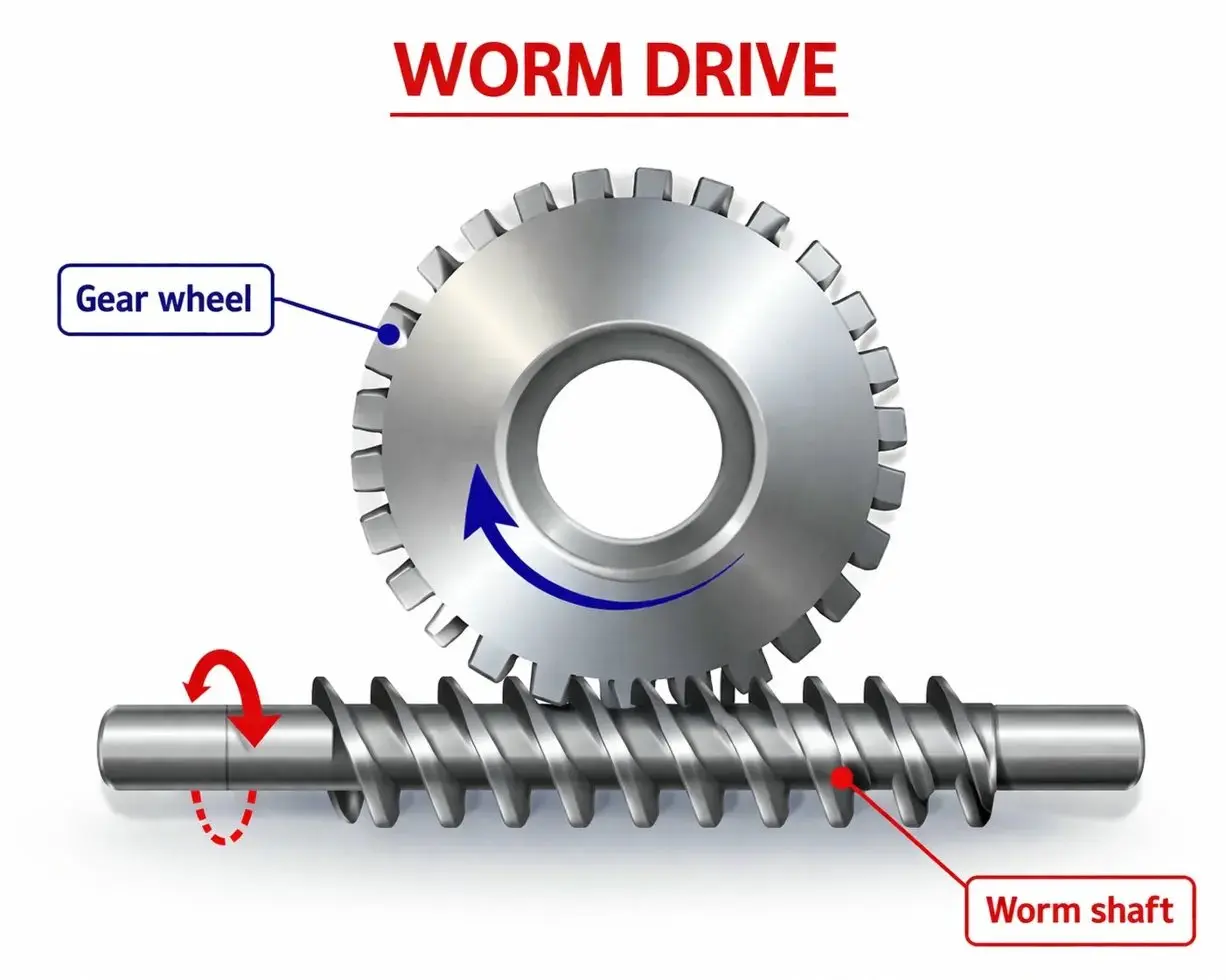
This is the property that makes a correctly specified conveyor worm gear drive fundamentally different from any other gear type in load-holding applications. Helical, bevel, and spur gears all require external braking to hold a load. A worm gear drive — when geometry is properly matched to operating conditions — holds position through friction at the thread-to-tooth contact surface. The gear mesh is the brake.
Understanding exactly when this is reliable — and when it is not — is the engineering question this guide addresses. The failure mode of an incorrectly specified self-locking worm drive is not gradual degradation. It is sudden release.

Why Worm Drives Dominate Conveyor System Design
A conveyor engineer choosing a drive for a right-angle corner station, an inclined section, or a hoist drive has several gear options. Worm gear drives command the majority of these applications for three simultaneous properties no other compact gear delivers:
- Single-stage right-angle reduction in a compact housing. A helical gear pair requires a bevel-helical combination to achieve 90° shaft crossing. A worm gear set does it in a single gear pair whose dimensions scale primarily with the worm wheel diameter — not the reduction ratio. A 50:1 set is essentially the same physical size as a 20:1 set at the same module.
- High single-stage reduction. Conveyor systems typically require 20:1 to 100:1 ratios. A single worm gear stage covers this entire range. A helical train requires three to four stages, with corresponding increases in housing size, oil volume, and failure probability.
- Self-locking at appropriate ratios. For inclined conveyors and hoists, self-locking is a safety requirement. The property arises naturally from worm geometry when the lead angle is smaller than the friction angle — requiring no additional components beyond the gear set itself.
Framework: Worm gear drives are appropriate for conveyor applications with ratios of 15:1 to 300:1, shaft crossing angles of 90°, output speeds below 150 RPM, and duty cycles below 100% continuous. For 100% continuous high-power duty, consider an enclosed worm gear reducer where thermal management is designed into the housing.
The Self-Locking Condition: Engineering the Safety Margin
Self-locking occurs when the lead angle λ at the worm pitch cylinder is smaller than the effective friction angle ρ’. The engineering challenge is that ρ’ changes with temperature, lubricant condition, and time in service.
ρ’ = effective friction angle — arctan(μ / cos α)
μ = friction coefficient — varies with lubricant viscosity, temperature, surface condition
α = normal pressure angle (typically 20°) — cos 20° = 0.940
The friction coefficient μ for oil-lubricated hardened steel on tin bronze ranges from 0.03 (slow speed, high-viscosity oil) to 0.12 (high speed, low-viscosity oil). At 20°C with ISO VG 460 mineral oil, μ typically falls around 0.06–0.08, giving a friction angle ρ’ of approximately 3.7°–4.9°. A single-start worm at 40:1 with a 50 mm pitch diameter has a lead angle of approximately 2.9° — satisfying the self-locking condition under these conditions.
At elevated temperature in summer operation the same drive running at 75°C with a fully synthetic low-viscosity oil may have μ = 0.03–0.04, giving ρ’ ≈ 1.8°–2.4°. The same lead angle of 2.9° no longer satisfies self-locking. A loaded pallet on a 12° incline will slide downward when the motor is de-energised.
Critical specification error: Self-locking must be verified at maximum operating temperature with the actual specified lubricant, not at ambient conditions with mineral oil. For safety-critical conveyor applications — inclined belts, hoists above occupied areas, AGV lifts — self-locking verification must include thermal and lubricant worst-case conditions.
When to Use Duplex Worm for Conveyor Indexing
Standard single-lead worm gears have backlash — the small angular clearance when rotation direction reverses. For typical inclined conveyors and corner drives, backlash of 0.04–0.10 mm at the pitch cylinder is inconsequential. Indexing conveyors that must position a PCB carrier within ±0.5 mm are a different problem: a standard worm at 60 mm pitch radius introduces ±1.5 mm of dead zone that exceeds the allowable tolerance.
For these applications, a duplex worm gear with adjustable backlash is the correct specification. The dual-lead shaft allows tooth thickness adjustment by axial shift, closing backlash without replacing components — one set can be re-adjusted 4–6 times over its service life.
Duty Class Selection — From Light Package Handling to Underground Mining
Conveyor applications span an enormous range of load levels and duty cycles. Matching the gear specification to the duty class is the first engineering decision in any conveyor worm gear selection.
| Duty Class | Worm Shaft | Wheel Material | Surface Treatment | Precision | Module |
|---|---|---|---|---|---|
| D1 Light | C45 induction hardened | ZCuSn10Pb1 tin bronze | Standard phosphate | DIN8–DIN9 | M1–M4 |
| D2 Medium | 40Cr through-hardened | ZCuSn10Pb1 tin bronze | Zinc phosphate | DIN7–DIN8 | M2–M6 |
| D3 Heavy | SCM415 carburized + ground | ZCuAl10Fe3 al-iron bronze | Case + zinc phosphate | DIN6–DIN7 | M4–M10 |
| D4 Severe | 42CrMo or SCM415 CG | ZCuAl10Fe3 + GGG40 hub | Full documentation | DIN6 | M6–M12 |
Duty class D3 and D4 specify aluminum-iron bronze (ZCuAl10Fe3) rather than tin bronze. Aluminum-iron bronze has approximately double the tensile strength of standard tin bronze. In conveyor applications with shock loading, this higher strength is critical for preventing the plastic tooth deformation that causes sudden failure. The trade-off is lower anti-scuffing performance — offset by the mandatory carburized and hardened worm shaft specification at these duty classes.
Practical Sizing: A Worked Example for an Inclined Belt Conveyor
The following sizing procedure applies to a medium-duty inclined belt conveyor in an automotive parts distribution centre. Design parameters:
- Incline angle: 18°
- Conveyor belt speed: 0.3 m/s
- Total loaded mass on inclined section: 600 kg
- Motor: 4-pole, 1450 RPM, 3 kW (to be confirmed after gear ratio selection)
- Conveyor drive drum diameter: 200 mm (shaft rotational speed required: 28.6 RPM)
Motor confirmation: Worm gear efficiency at 50:1 ratio with standard mineral oil lubrication is approximately 55–65%. Input power required ≈ 1.66 kW. The 3 kW motor has adequate power. Confirm thermal capacity for continuous operation.
Field Engineering
Four Conveyor Worm Gear Specifications — What the Application Required and Why
A tier-1 Korean automotive supplier was replacing ZCuSn10Pb1 tin bronze worm wheels every 4–6 months on their body panel conveyors. The drive started under full load four times per shift. CMM analysis of failed wheels showed subsurface crack propagation from the root fillet — a signature of fatigue under repetitive overload, not surface scuffing.
Fix: ZCuSn10Pb1 → ZCuAl10Fe3 aluminum-iron bronze (tensile strength 550 MPa vs 220 MPa). Same module, same bore. The SCM415 carburized worm shaft already met the required surface hardness.
A Vietnamese electronics manufacturer experienced progressive position drift on a PCB carrier indexing conveyor over the course of the operating day. At the start of the shift (25°C), indexing accuracy was within ±0.3 mm. By mid-afternoon (factory at 38°C, drive housings at ~68°C), position error had grown to ±1.8 mm — beyond the ±1.0 mm tolerance.
Fix: Duplex worm gear with adjustable backlash eliminated the temperature-dependent drift. Backlash re-zeroed in 30-minute procedure without part replacement.
An Indonesian coal mine’s surface conveyor system sat idle for approximately 80 days during an extended monsoon shutdown. On recommissioning, seven of eleven corner drive worm gear sets showed heavy pitting corrosion on the worm thread flanks. The specification had been standard zinc-plated C45 worm shafts.
Fix: Zinc phosphate replaced with full hot-dip galvanizing on shaft body plus grease-packed sealed housing. Added commissioning procedure: 2-hour dry run at 20% load after any shutdown exceeding 30 days.
A logistics centre was installing a vertical pallet lift (travel height 6.2 m) with a working zone directly below. The project safety review required documented verification that the worm gear drive would self-lock in the event of motor failure or power loss. The initial specification did not include self-locking documentation.
Fix: SCM415 carburized worm, single-start (z1=1), ratio 60:1. Self-locking calculation provided at 20°C, 60°C, and 80°C. At 80°C with 460 cSt oil: λ = 1.52°, ρ’ = 3.04°, safety margin 1.52°. Full documentation included for safety review.
Korea Ever-Power Products
Conveyor Worm Gear Products for Every Duty Class

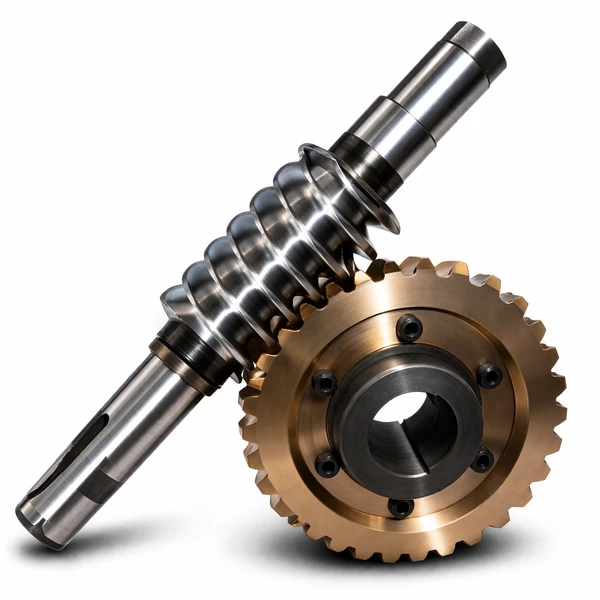

For enclosed worm gear reducers with integrated housing, seals, and oil bath lubrication designed for continuous conveyor duty, see our site: wormgearreduer.top
Engineering FAQ
Conveyor Worm Gear — Questions from Drive System Engineers
Specify Your Conveyor Worm Gear Drive
Provide conveyor inclination, belt speed, drum diameter, maximum load, duty class, and operating environment. Korea Ever-Power returns a confirmed worm gear specification with self-locking calculation, material recommendation, and pricing within one working day.