Customized Worm Gear Set | OEM/ODM, Ratio 20:1–300:1, Full Material & Gear Type Coverage
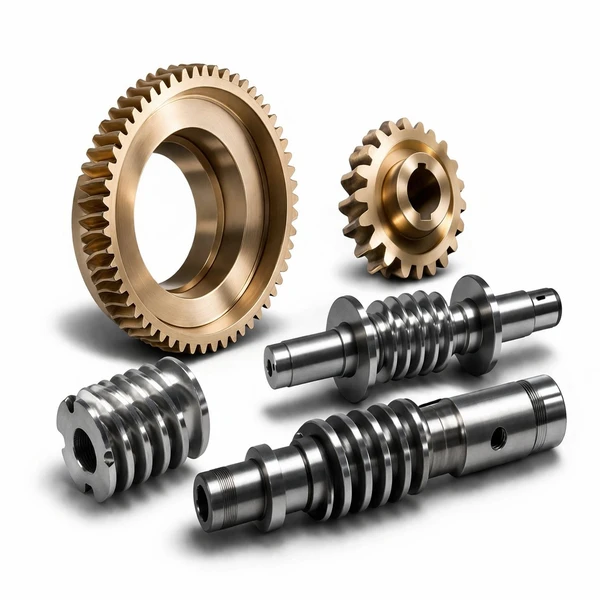
OEM worm gear sets with ratio 20:1 to 300:1+ in a single stage. Gear types: spur, helical, internal, ring, bevel, hypoid, crown wheel, gear shaft, worm & worm shaft, spline shaft. Materials: C45, 40Cr, 20CrMnTi, 42CrMo, 17CrNiMo6, brass, bronze, nylon and more. Heat treatment: quenching, carburizing, nitriding, salt bath. Custom from 3D CAD, 2D drawings, or physical samples.
Product Overview
Every standard gear catalog was built for the most common applications. Module M4, ratio 20:1, C45 steel, 60-tooth wheel with Ø25 mm bore — this specification covers a large fraction of general industrial drives. But product engineering rarely produces the most common application. An automotive electric power steering column needs 73:1 from a compact package in 42CrMo with a left-hand worm. A medical positioning table needs 48:1 in stainless steel with a DIN7-class tolerance and a keyway at 15° to a specific face datum. A defense turret traverse needs 120:1 with carburized 20CrMnTi worm and a ductile iron wheel with machined mounting bolt circle. None of these exist in any catalog. Korea Ever-Power Worm Gear Co., Ltd manufactures custom worm gear sets to any ratio, any material pairing, any bore configuration — from 3D CAD files, 2D drawings, or physical samples when drawings are not available. The NDA is signed before the first drawing is shared.
Why Worm Gears for High-Ratio Single-Stage Drives
The worm — a cylindrical gear resembling a threaded screw — paired with a worm wheel allows smaller gearboxes or planetary drives while retaining full torque or power transmission capacity. It is common for worm gear reductions to reach 20:1 and extend to 300:1 or more in a single stage that would require two or three stages of helical gearing to replicate. The geometry that makes this possible also produces the most distinctive operational feature: the worm can effortlessly drive the worm wheel, but the worm wheel cannot drive the worm back. When the gear attempts to rotate the worm, the shallow lead angle of the worm thread means that friction between the contact surfaces keeps the worm locked in position — self-locking is a natural consequence of the geometry, not an add-on feature.
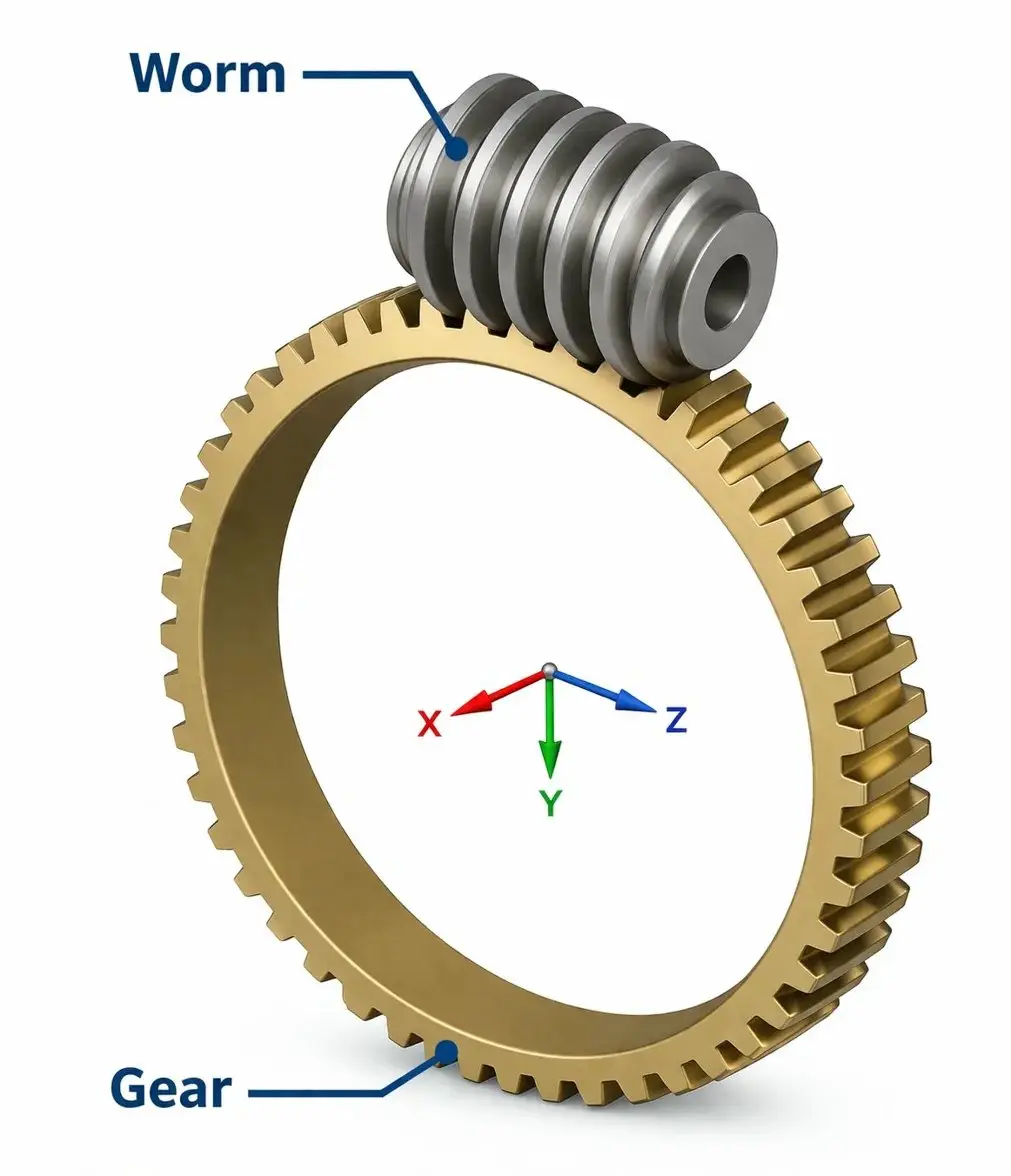
OEM Worm Gear Set — Full Service Scope
| Gear Types | Spur gear, helical gear, internal spur gear, ring gear, straight/spiral bevel gear, hypoid gear, crown wheel & pinion, gear shaft, worm gear & worm shaft, spline shaft & bushing, etc. |
| Gear Material | Carbon steel, alloy steel, stainless steel, brass, bronze, cast iron, nylon, etc. { GB Steel grades: C45, 40Cr, 20CrMo, 20CrMoTi, 17CrNiMo6, 20CrMnTi, 42CrMo, etc. } |
| Processing | Gear blank turning, gear hobbing, gear milling, gear shaping, gear shaving, tooth grinding, broaching, etc. |
| Heat Treating | Quenching, carburizing, nitriding, carbon-nitriding, salt bath quenching, etc. |
| Application | Automotive, Agricultural, Electronic, Industrial, Medical, Defense, Off-highway, etc. |
GB Steel Grade Guide — Selecting the Right Alloy for Your Application
The GB steel grade list in the OEM services table is not interchangeable — each grade has a specific combination of hardenability, core toughness, and heat treatment response that makes it appropriate for certain worm gear applications and inappropriate for others. Selecting the wrong grade produces premature tooth fatigue, inadequate surface hardness, or excessive brittleness after heat treatment. The guide below covers the six most commonly specified grades for worm gears in industrial and automotive applications.

| Grade | Heat Treatment | Surface / Core Hardness | Best For | Avoid When |
|---|---|---|---|---|
| C45 | Induction hardening | 55–60 HRC surface / 22–28 HRC core | General industrial worm shafts, low-to-medium torque, indoor environment | High shock loading — low core toughness fractures under impact |
| 40Cr | Through-hardening or induction | 50–55 HRC surface / 32–38 HRC core | Agricultural gearboxes, moderate shock, where C45 core toughness is marginal | Highest precision grades — machinability slightly lower than C45 |
| 20CrMo | Carburizing + quenching | 58–62 HRC case / 30–38 HRC core | Medium-load automotive auxiliary drives, small-module precision worm shafts | Very large gear bodies — hardenability depth may be insufficient for thick sections |
| 20CrMnTi | Carburizing + quenching | 58–62 HRC case / 33–40 HRC core | High-load automotive transmission worms, heavy-duty off-highway drives, defense | Light-load applications where cost is primary — overkill for general industrial duty |
| 17CrNiMo6 | Carburizing + quenching | 60–63 HRC case / 38–44 HRC core | Aircraft gearboxes, wind turbine pitch drives, maximum fatigue strength requirement | Standard industrial duty — material and heat treatment cost is 3–4× C45; not economically justified below maximum fatigue requirements |
| 42CrMo | Through-hardening + tempering | 48–54 HRC uniform through-section | EPS column gears, press screws, heavy structural drives where uniform hardness through the section is preferred over a case-and-core structure | Applications requiring the highest surface hardness only — 42CrMo's uniform hardness means the core is harder (and less tough) than carburized grades with a soft core |
Heat Treatment Selection — Quenching vs Carburizing vs Nitriding for Worm Gears
Heat treatment method is often specified without understanding what each process actually achieves at the tooth surface. The four methods in the OEM services table produce different hardness distributions, case depths, and residual stress states — with direct consequences for wear resistance, impact tolerance, and gear accuracy after treatment.
Quenching & Tempering
Through-hardening process: the gear is heated above the austenite transition, quenched in oil or water, then tempered at 150–600°C to the target hardness. Produces uniform hardness from surface to core. The trade-off is brittleness at high hardness — above approximately 55 HRC, the toughness of through-hardened steel drops sharply. For worm gear applications requiring both wear resistance and shock load tolerance, through-hardening is typically not the first choice. Best applied to worm shaft materials (42CrMo, 40Cr) where core toughness is slightly less critical than for the wheel, and for gear bodies with large sections where case hardening depth is insufficient.
Carburizing & Quenching
Case hardening process: carbon is diffused into the surface at 880–930°C over 4–20 hours to a depth of 0.3–2.0 mm, then the gear is quenched to form martensite in the case only. The result is a hard case (58–63 HRC) over a tough core (30–40 HRC). This combination gives the best combination of wear resistance and impact resistance — the hardened surface resists abrasive and adhesive wear, and the tough core absorbs shock loading at the tooth root. For worm gear applications in automotive, off-highway, and agricultural equipment where shock loads are regular, carburizing is the standard specification. The grain structure improvement from the carburizing cycle also slightly improves the material's fatigue strength, extending service life beyond what a simple hardness comparison would predict.
Nitriding
Surface diffusion of nitrogen at 480–520°C — below the tempering temperature for most alloy steels. This means the gear can be fully machined to final dimensions, then nitrided, with only 0.01–0.02 mm of dimensional change — an advantage for precision gear teeth where post-nitriding grinding would otherwise be required to restore tooth geometry. Nitrided surfaces reach 60–70 HN (approximately equivalent to 65–70 HRC on the nitrided layer scale). The case depth is shallow (0.15–0.5 mm), which limits the maximum contact pressure the surface can withstand — nitriding is appropriate for precision gear drives at moderate contact pressures, not for heavily loaded drives where the case depth is insufficient to support the subsurface stress field.
Carbon-Nitriding (Carbonitriding)
A variant of carburizing where both carbon and nitrogen are diffused simultaneously at 800–880°C. The nitrogen addition improves the hardenability of the case, allows lower quench temperatures (reducing distortion), and produces a more compressive residual stress in the case that improves fatigue resistance. Carbonitriding is typically applied to smaller gear parts (module M1–M3) and parts requiring good surface hardness with minimum distortion after heat treatment — common in automotive transmission and small industrial gearbox applications where post-treatment grinding is expensive or impractical. The case depth is generally 0.1–0.5 mm, shallower than conventional carburizing.
Processing Methods — What Each Operation Contributes to Gear Accuracy
The processing list in the OEM services table is not a menu of equivalent alternatives — each operation plays a specific role in the production sequence, and the combination determines the achievable precision class. Understanding this helps buyers specify a realistic process for their target tolerance without over-specifying expensive operations for tolerances that simpler processes can achieve.
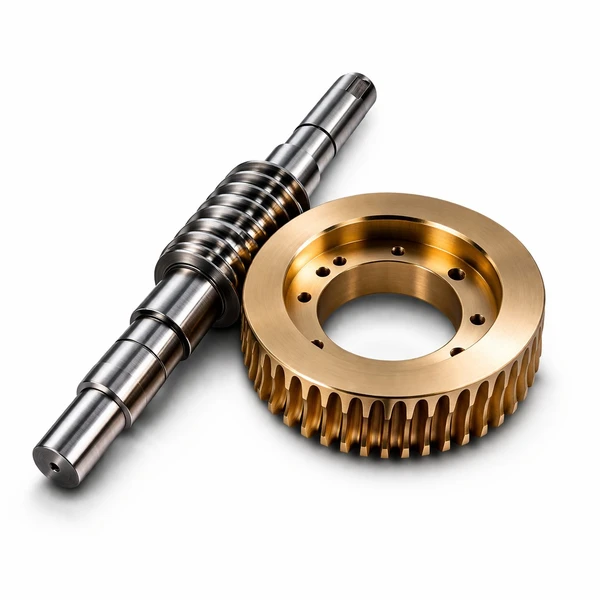
- →Gear blank turning — Sets the OD, bore, and face dimensions. Accuracy here determines how well the gear runs true on the mandrel during hobbing. A poorly turned blank with bore runout produces a hobbed gear with periodic tooth spacing error — this error cannot be corrected by subsequent grinding.
- →Gear hobbing — The primary tooth-cutting operation. Achieves DIN8–DIN9 accuracy as-cut in most materials. The hob geometry determines the tooth profile; the hob mounting accuracy on the hobbing machine determines the lead error. Well-maintained hobbing equipment and sharp hobs are essential for DIN7 or better directly from hobbing.
- →Gear shaving — A finishing operation performed before heat treatment. A hardened shaving cutter removes 0.01–0.05 mm from the tooth flanks while simultaneously applying slight crowning (tooth profile modification) to reduce edge loading under misalignment. Achieves DIN6–DIN7 accuracy but cannot be performed after heat hardening — the tooth surface is too hard for the cutter. For applications requiring DIN6–DIN7 with carburized teeth, shaving is performed before carburizing and grinding is required after.
- →Tooth grinding — The only process capable of consistently achieving DIN5–DIN6 on hardened tooth flanks. A profiled grinding wheel removes 0.05–0.15 mm from the hardened tooth surface, correcting the geometric distortion introduced by the heat treatment cycle. Tooth grinding is the most expensive tooth-finishing operation — it adds significant cost to the per-piece price and requires grinding cycle development for each new gear geometry. Specify only when DIN5–DIN6 is confirmed as a requirement.
- →Broaching — Applied to internal keyways, splines, or non-circular bore profiles after gear teeth are cut. Broaching produces keyways and splines in a single pass with high geometric consistency — tolerances of ±0.005 mm on keyway width are achievable. For custom worm gear wheel bores with non-standard keyway positions or profiles, broaching is the correct process; milled keyways are appropriate where tight positional accuracy is not critical.
Custom OEM vs Standard Catalog — The Complete Procurement Comparison
The right sourcing strategy depends on the application, the production volume, and the supply chain risk tolerance. This comparison is written for engineers and procurement managers making a sourcing decision, not for marketing purposes — both options have legitimate use cases.
| Decision Factor | Custom OEM (Korea Ever-Power) | Standard Catalog Brand |
|---|---|---|
| Ratio availability | Any ratio — tooth count and worm start count designed to your specification without rounding to the nearest catalog ratio | Fixed catalog ratios: typically 5:1, 10:1, 20:1, 30:1, 50:1, 100:1 — any other ratio requires a multi-stage arrangement or mechanical modification |
| Material specification | Any material: C45 through 17CrNiMo6, brass, bronze, stainless, nylon — specify independently for the worm and the wheel | Limited to catalog material options, typically 2–3 choices per model; worm and wheel material pairing is fixed |
| Bore and keyway | Any bore diameter from Ø6 mm to Ø80 mm, any keyway standard (DIN 6885, ANSI B17.1, or custom), any tap position | Pilot bore only (requires secondary machining) or fixed finished bore in standard motor shaft sizes |
| Module range | M0.5 to M12 — any module with correct matched hob; non-standard modules on request with hob lead time | Fixed catalog modules: M1, M1.5, M2, M2.5, M3, M4, M5, M6, M8, M10 typically |
| Supply continuity | Dedicated tooling held in-house; reorders reproduced from same setup with same tolerance — no re-qualification needed on reorder | Subject to catalog revisions, EOL discontinuation, and supplier changes — replacement re-qualification may be required |
| IP and confidentiality | NDA before drawing submission; customer design is not shared or replicated for other customers | Standard catalog — design is public; no IP concern but also no exclusivity |
| Sample-to-production path | Sample produced from drawing or sample part; qualified in your mechanism before production commitment; sample cost credited on order | Order directly from catalog; no sampling step — what you order is what the standard part is |
| Best fit for | Product engineering (requires specific ratio, material, or bore), OEM programs with validated supply, high-value equipment requiring long supply chain certainty | Maintenance replacement where catalog part is the OEM specified part, prototype builds where standard ratio is acceptable, non-critical applications |
OEM Development Process — From First Contact to Validated Production
Custom gear development follows a defined sequence that protects both the buyer's IP and the supplier's production investment. Korea Ever-Power's standard process for new OEM worm gear set development:
- →Step 1 — NDA and inquiry. Before any drawing or sample is shared, an NDA is signed if requested. Inquiry is submitted with available information: target ratio, output torque (Nm), input speed (RPM), material preferences, operating environment, bore configuration, and quantity forecast. Missing parameters are confirmed through a brief technical exchange — we return a confirmed specification for approval before quoting.
- →Step 2 — Quotation and drawing confirmation. We return a price and lead time quotation with a confirmed 2D drawing or 3D model for approval. For reverse-engineered parts (from sample, no drawing), we return the measured drawing within 3–5 working days for customer confirmation before production.
- →Step 3 — Sample production. On drawing approval, samples are produced and typically ready in 15–25 working days depending on module size, material, and heat treatment method. Sample cost is charged separately and credited in full on the first production order.
- →Step 4 — Customer validation. Customer installs samples in the actual mechanism and validates fit, mesh quality, noise, backlash, and endurance cycle performance. Any corrections to bore, tooth profile, or surface finish are incorporated in a second sample round — typically 5–8 working days for a correction batch.
- →Step 5 — Production and dedicated tooling. On sample approval, tooling (hobs, fixtures, inspection gauges) is dedicated to this part number and retained in-house for the customer's production lifetime. Reorders are filled from the same setup — no re-qualification required. Production quantities ship with dimensional inspection records on request.
Application Sectors — Engineering Requirements Per Industry
- ▶Automotive (EPS, seat adjustment, sunroof, mirror, parking brake) — Automotive worm gear sets have the most demanding combination of requirements: compact packaging, high cycle count (10–30 million cycles over vehicle life), wide temperature range (−40°C to +125°C), specific torque envelope, and PPAP-compatible supply documentation. The worm is typically 20CrMnTi carburized and ground; the wheel is bronze or nylon depending on the noise requirement. Material traceability to mill certificate level is standard in Tier 1 supply chains.
- ▶Agricultural machinery (rotary tiller, transplanting, irrigation) — Agricultural drives experience the widest mechanical abuse of any gear application: shock loads from stone impacts, seasonal storage without lubrication for months, wide temperature swings, and field-level maintenance without special tools. 40Cr quenched-and-tempered worm shafts with aluminum-iron bronze wheels are the standard combination — higher core toughness than C45 for shock tolerance, higher strength than tin bronze for impact loads. Sealed gearbox housing retention of lubricant over months of storage is critical — specify IP67-rated sealing if the gearbox will be stored outdoors between seasons.
- ▶Electronic and semiconductor equipment — Wafer handling robots, probe station positioners, and semiconductor process chamber valves require extremely clean operation — no lubricant migration, no metal particle generation, and minimal vibration at the mesh frequency. Worm gears in these applications are typically M1.0–M2.0 in stainless steel or nitrided alloy steel, run dry or with PTFE grease, and held to DIN6–DIN7 for low backlash. The gear housing often requires special sealing to prevent particle contamination of the semiconductor process environment.
- ▶Medical equipment (surgical robots, positioning tables, infusion pumps) — Medical worm drives have unique requirements not seen in industrial applications: sterilization compatibility (autoclave 134°C or EtO gas), FDA-compliant or biocompatible surface treatments, traceable material certificates, and zero contamination tolerance. Stainless steel SS316 is the default material; lubrication is typically food-grade silicone or PTFE. Design review documentation and material certificates meeting ISO 13485 traceability requirements are provided on request.
- ▶Defense and off-highway (turret drives, tracked vehicle final drives, construction equipment) — Defense and off-highway worm gear sets are specified for maximum load capacity and maximum service life in extreme environments. 17CrNiMo6 or 20CrMnTi carburized worm shafts with DIN6-class tooth accuracy are common. Documentation requirements include full material traceability, proof load testing records, and in some cases first article inspection (FAI) reports to MIL or AQAP standards. Korea Ever-Power has produced defense-program gear sets and can support documentation requirements for military procurement.
- ▶Industrial automation (conveyors, packaging, solar trackers, hoists) — Industrial OEM drives span the widest range of requirements: from slow-speed high-load conveyor drives (40:1 to 100:1, bronze wheel, continuous 24-hour duty) to precision packaging machine feeds (15:1, DIN7, frequent start-stop) to solar tracker azimuth drives (60:1 to 150:1, sealed housing, 25-year service life). The key advantage of custom OEM for industrial automation builders is supply chain continuity — a standard catalog part may be discontinued when the catalog supplier changes; a custom part with dedicated tooling held by Korea Ever-Power is available as long as the product is in service.

Why Korea Ever-Power for OEM Worm Gear Sets
- ◈Full gear family coverage: spur, helical, bevel, hypoid, worm, and spline — one engineering team covers all gear types needed in a complex multi-stage drive, eliminating coordination between multiple specialized suppliers.
- ◈Diverse material supply in-house: all GB steel grades, copper alloys, engineering plastics — the matched worm and wheel come from the same quality system and material traceability record.
- ◈Reverse engineering capability: engineers can design from 3D CAD, 2D drawings, or physical sample parts when drawings are unavailable — CMM measurement returns a confirmed drawing within 3–5 working days.
- ◈Dedicated tooling retention: hobs, fixtures, and inspection gauges for customer parts are kept in-house for the production lifetime — reorders fill at standard lead time without setup charges.
- ◈No MOQ pressure for development: prototypes and small pre-production batches are accepted to support the validation process — production commitment is made after, not before, quality is confirmed.
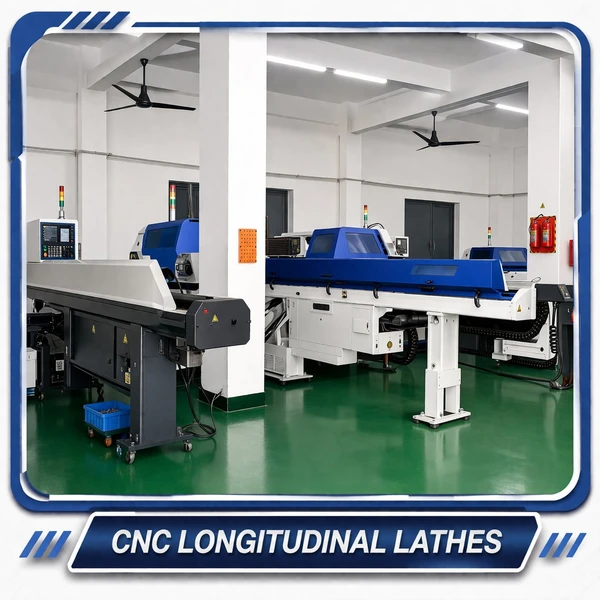
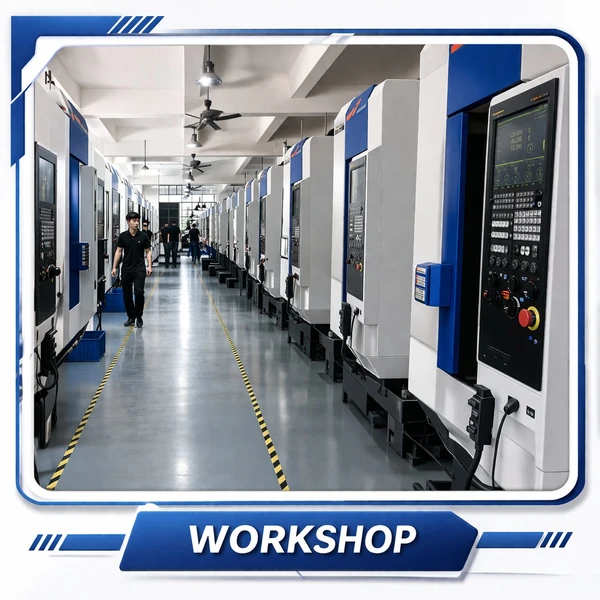
Production Facility
 |
 |
 |
 |
 |
 |
Related Components
Worm Shaft — The hardened steel drive counterpart to the worm gear set . They can ensure a low-friction mesh, protects the worm shaft from accelerated wear, and supports quiet, reliable operation across a wide speed range.
Worm Gear Reducer — A fully enclosed unit integrating the worm and wheel within a sealed housing. Ideal when consistent center distances, simplified mounting, and protected internal components are required — particularly in humid or wash-down environments.

Packaging & Shipping
All gears are packaged for safe shipping and convenient storage, using the most appropriate materials and method for the gear type. Precision gear sets are individually wrapped in anti-rust VCI paper and sealed in polyethylene bags before boxing — this prevents surface oxidation during sea freight transit through humid environments. Large worm wheels are individually foam-mounted to prevent tooth face contact during transport. Wooden crates are used for shipments exceeding 50 kg or for gears with tight tolerances where carton handling may risk transit distortion.
We work with your freight forwarder to ship directly to your facility. If you do not have a forwarder, we arrange international shipment to any convenient port and work with experienced freight forwarders who regularly handle precision mechanical components to worldwide destinations.

Frequently Asked Questions
Can you produce customized products from our design drawings?
Yes. Korea Ever-Power is a professional metal fabrication and gear manufacturing supplier with an engineering team experienced in custom gear development. We accept 2D drawings in DWG, DXF, or PDF format, and 3D models in STEP, IGES, SolidWorks, or CATIA format. If your drawing is incomplete — for example, if the tooth profile tolerance or bore fit class is not specified — we will flag the gaps and return a confirmed specification for approval before production begins. We do not proceed with missing specifications that would affect the final function of the gear.
Will my drawing be secure?
Yes. We will not release your design, 3D model, or sample part information to any third party without your written permission. We sign NDA agreements before any drawing or sample is submitted — this is our standard practice for all new OEM customers, not an exception requested on a case-by-case basis. Production tooling made to customer specifications is treated as customer property held in our facility — it is not used for any other customer's production and is returned or destroyed on written request from the customer.
What is the minimum order quantity?
We do not set a rigid minimum order quantity. For standard-module custom worm gear sets (module M2–M8 in common steel grades), small quantities of 10–50 pieces are accepted for initial production validation. For non-standard modules or unusual material combinations requiring special tooling purchase, a minimum quantity corresponding to a reasonable amortization of tooling cost is discussed at quotation — typically 50–200 pieces for the first order, with no minimum on reorders once tooling is in-house. Contact us with your forecast and timeline and we will advise on the economically appropriate quantity structure.
Can samples be provided before a mass production commitment?
Yes. Samples are produced from the confirmed drawing before the production order is placed. Sample quantities are typically 3–10 pieces depending on the validation test protocol. Sample cost covers material, machining, and heat treatment and is charged separately from the production quotation. On placement of the production order, the sample cost is credited in full against the first production invoice. Sample lead time is 15–25 working days depending on module size, material, and heat treatment method.
How are non-conforming parts handled after delivery?
All our products pass QC inspection with an inspection report before delivery. Non-conformances are rare because the inspection step catches deviations before shipment. In the event that a non-conformance is found on receipt: contact us immediately with photographs and the specific dimensions or characteristics that fail your incoming inspection. We will review and respond within 24 hours on working days. Confirmed manufacturing defects are corrected by rework or replacement at our cost, including outbound freight for the replacement shipment. We do not dispute measurement data from calibrated instruments.
What are the payment terms?
Payment before shipment is required. Accepted payment methods are T/T (bank transfer) and L/C (letter of credit). For established customers with a purchase history, extended payment terms may be discussed — contact us. For first orders, the standard process is 30–50% deposit on order confirmation and 50–70% balance before shipment.
Customer Reviews
Jang Seong-jun — Supply Chain Manager, Suwon Automotive Components Co. (Q1 2026)
Custom helical worm sets for an electric power steering column gearbox — 42CrMo worm shaft, tin bronze wheel, DIN6 class, Ø32 mm bore with 8×6 DIN 6885 keyway. Korea Ever-Power produced three sample rounds for our validation process. First round: bore concentricity out of spec by 0.008 mm. We reported it with CMM data. Second round: corrected within 24 hours of the report, back in spec on all three sample pieces. Third round: production confirmation batch of 20 pieces — all passed our incoming PPAP Level 2 documentation requirements. Total OEM development time from NDA signing to production approval: 11 weeks. Within our program gate schedule.
Choi Yun-seo — R&D Engineer, Daejeon Medical Device Manufacturing (Q3 2025)
We needed a non-standard ratio of 73:1 for a surgical positioning table axis — not available in any catalog and not achievable with two stages without exceeding the housing dimension limit. Korea Ever-Power designed the single-stage tooth combination (73T wheel, single-start stainless worm), confirmed the self-locking margin under our specified load, and delivered three DIN7-class samples in 14 calendar days from NDA signing. First-round samples measured correctly on all critical dimensions. NDA was signed the same day we requested it, before we shared any drawing. That speed and discretion is essential for medical device development programs.
Oh Jin-ho — Procurement Manager, Incheon Agricultural Equipment Corp. (Late 2025)
Annual OEM program for custom worm gear sets in four different ratios — our rotary tiller and transplanting equipment families. Korea Ever-Power holds dedicated tooling for all four part numbers. Reorder lead time has consistently been 2–4 days shorter than the first order because the setup is already proven. Batch-to-batch bore tolerance spread is within ±0.012 mm across eight quarters of ordering, which our assembly team works to without incoming inspection. Price has been stable with only a 4% increase in two years — acceptable given material price movements. No supplier qualification events required in the period.
Han Soo-bin — Technical Director, Busan Defense Systems Ltd (Q4 2025)
High-load custom worm sets for a defense system azimuth drive — 20CrMnTi worm shaft, carburized and ground to DIN6, ductile iron wheel, full material traceability to mill certificate. Korea Ever-Power supplied all required documentation: material cert with chemical composition and mechanical properties, dimensional inspection report, heat treatment record. Gear mesh was smooth and within our backlash specification on the first production batch without any rework. We have added Korea Ever-Power to our approved supplier list for precision mechanical drive components in defense programs.
Additional information
| Editor | Cxm |
|---|
Related products
-

Alloy Steel Worm and Worm Gear for Auto Parts
-

Stainless Steel Worm Gear for CNC | ANSI/DIN, Module 1–3, Hardness 55–60 HRC
-

Duplex Worm Gear | Dual-Lead, Continuously Adjustable Backlash
-

Cylindrical Worm Wheel | Line Contact, High Load Capacity, Bronze & Cast Iron
-

Brass Worm Wheel | M0.5, 20T×1T Matched Set
-

Worm and Wheel | Module M3–M12, Ratio 20:1–300:1, Line Contact Transmission
-

Plastic Worm Gear | POM & Nylon, Module M0.2–M2.0, Self-Lubricating Drive