The Running-In Process: Why Material Chemistry at the Contact Surface Determines Gear Life
When a new worm gear set is assembled and started, the tooth flank surfaces are not perfectly conformed. Even with precise manufacturing, micro-asperities on both surfaces are taller than the oil film thickness at startup. These asperities meet and deform plastically — a process called running-in — until the contact geometry is sufficiently smooth for hydrodynamic lubrication to separate the surfaces completely.
Whether running-in proceeds correctly or degenerates into scuffing failure depends entirely on the material pairing at the contact. In a correct pairing, the softer wheel material cold-works and conforms to the harder shaft thread, creating a smooth, work-hardened contact zone. In an incorrect pairing — wrong hardness differential, wrong wheel alloy chemistry, inadequate shaft hardness — the asperity contacts generate local flash temperatures that exceed the adhesion threshold. Metal transfers from one surface to the other. The transferred metal creates abrasive particles. The drive deteriorates in weeks.
Why it’s a pairing decision: The shaft material determines the hardness that the wheel material must conform to. The wheel material determines the anti-scuffing properties that the shaft surface condition must support. Getting one right and the other wrong produces the same failure mode as getting both wrong.
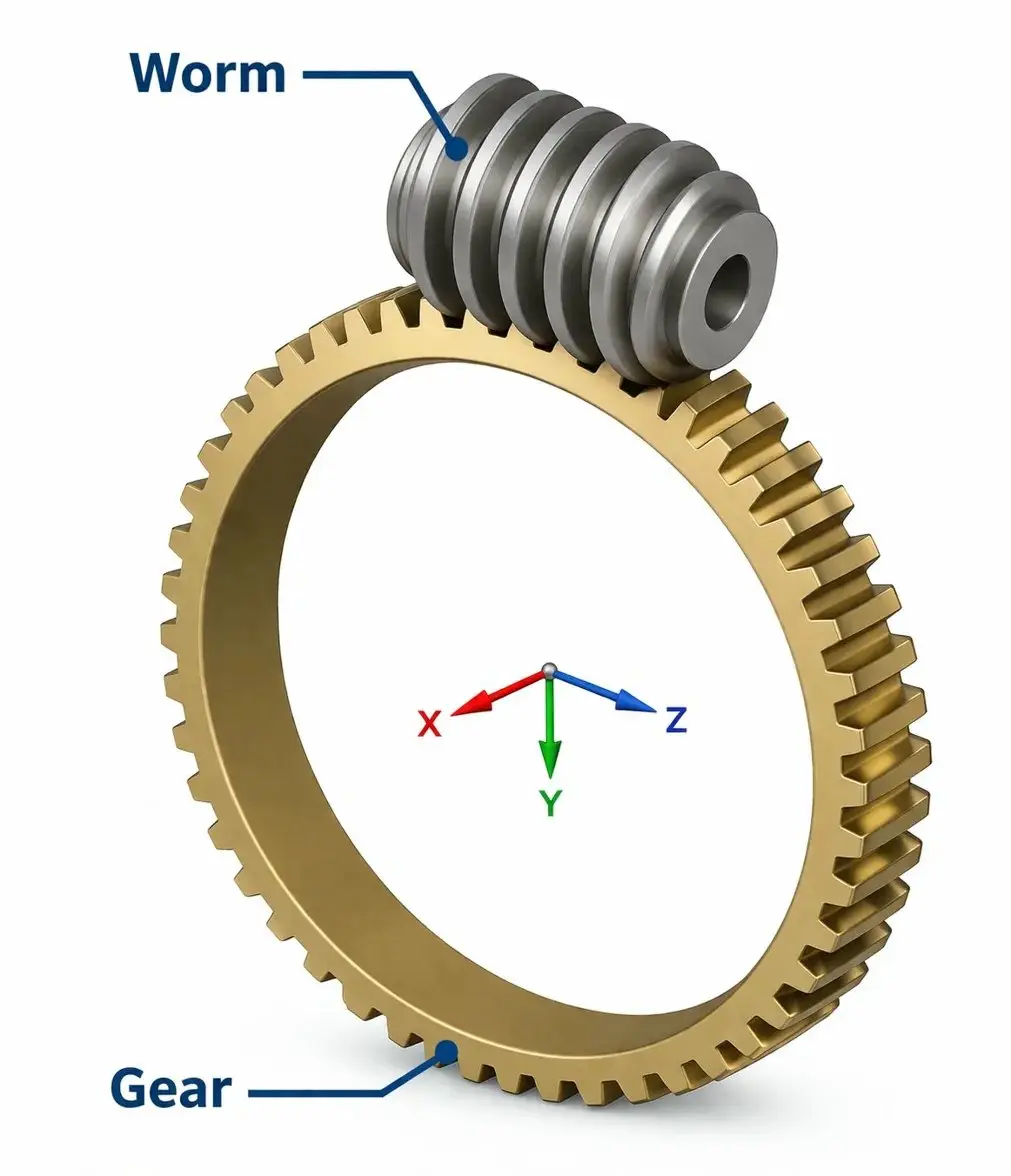
Worm Shaft Material Selection — The Steel Grade Progression
Worm shaft material selection is a function of three requirements: surface hardness for anti-scuffing performance at the mesh, core toughness for resistance to shock loading and fatigue, and hardenability — the depth to which hardness can be achieved by heat treatment.
45–55HRC
C45 Steel — 45–55HRC Surface Hardness
The entry-level specification for light-duty worm shafts. C45 through-hardened achieves only 42–48 HRC surface hardness — inadequate for anti-scuffing against tin bronze at sliding velocities above 2 m/s. Induction hardening of the thread flanks pushes surface hardness to 50–55 HRC, which is the minimum acceptable for standard-duty worm drives. The limitation of C45 is low alloy content — the hardenability is shallow. Acceptable for light-duty, low-shock applications at moderate sliding velocities.
50–56HRC
40Cr Steel — 50–56HRC Surface Hardness
The standard alloy steel specification for medium-duty worm drives. The 1% chromium addition provides substantially higher hardenability than C45 — a 40Cr shaft through-hardened to 50–56 HRC maintains this hardness across the full cross-section of typical worm shaft diameters (20–80 mm). This eliminates the case-core transition failure mode that affects C45 induction-hardened shafts under shock loading. Default specification for Korea Ever-Power’s standard alloy steel worm gear sets — the correct specification for conveyor drives, agricultural machinery, and industrial automation at moderate duty cycles.
58–62HRC
SCM415 Steel — 58–62HRC Surface Hardness
The premium specification for heavy-duty worm drives where shock loading, continuous high-torque operation, or maximum service life is required. The carburizing process diffuses carbon into the surface layer to a depth of 0.8–1.5 mm, creating a hard martensitic surface of 58–62 HRC while the core retains the original low-carbon toughness. The critical detail: the thread is ground after carburizing, not before. Post-carburize grinding ensures the final hardness and geometry are both at the specification values simultaneously.
54–58HRC
42CrMo Steel — 54–58HRC Surface Hardness
For large-section, high-torque worm shafts (typically Module M8 and above) where carburizing case depth becomes impractical relative to the section size. Through-hardened 42CrMo at 54–58 HRC provides more consistent hardness through the full tooth section than a carburized case on a large substrate. Tensile strength at this hardness: approximately 1,700–1,900 MPa. Correct for high-torque applications at large module.
28–34HRC
SS316 Steel — 28–34HRC Surface Hardness
The material that must be specified when corrosion resistance, food safety compliance, or marine atmosphere is the primary constraint. The surface hardness of 28–34 HRC is significantly lower than any of the alloy steel grades above. This lower hardness means lower surface fatigue resistance and lower anti-scuffing performance per unit of sliding velocity. Compensate by: keeping sliding velocity below 4 m/s; using NSF H1 PAO lubricant; and confirming the design torque is within the reduced capacity of the SS316 set rather than assuming equal capacity to an equivalent alloy steel set.
Worm Wheel Material — Six Alloys and Their Application Domain
The worm wheel is the wearing component in a correctly specified worm gear drive. The shaft is designed to be significantly harder, so the wheel wears preferentially — progressively conforming to the shaft thread geometry over the running-in period. The wheel is, in effect, a sacrificial tribological component whose wear rate and wear mechanism must be controlled by material selection.
Material Pairing Selection Matrix
| Shaft → Wheel ↓ | C45 induction 50–55 HRC |
40Cr through 50–56 HRC |
SCM415 carb. 58–62 HRC |
42CrMo through 54–58 HRC |
SS316 28–34 HRC |
|---|---|---|---|---|---|
| ZCuSn10Pb1 Tin Bronze |
✓ Acceptable
Light duty only
|
✓✓ Best
Standard duty
|
✓✓ Excellent
Heavy duty
|
✓✓ Excellent
Large module
|
✗ Not for corr. env.
|
| ZCuAl10Fe3 Al-Iron Bronze |
✗ Insufficient
hardness diff.
|
⚠ Marginal
Avoid shock loads
|
✓✓ Correct
Impact duty
|
✓✓ Correct
Heavy section
|
N/A
|
| ZCuZn38Mn2Pb2 Mn Brass |
✓ Light duty
|
✓✓ Medium duty
|
✓✓ Heavy duty
|
✓ Heavy duty
|
✗ Not for corr.
|
| SS316 Stainless |
✗ Galvanic corr.
|
✗ Galvanic corr.
|
✗ Galvanic corr.
|
✗ Galvanic corr.
|
✓✓ Food/Marine Z1
|
| PA66 / POM Plastic |
✓ Light
Polish shaft first
|
✓ Light duty
|
Overkill
|
Overkill
|
✓ Low noise dry
|
A Practical Decision Path for New Applications
Korea Ever-Power Products
Worm Gear Products by Material Specification


Material Selection FAQ
Worm Gear Material Questions from Engineers and Buyers
Get a Material Recommendation for Your Application
Provide duty class, operating environment, shock load conditions, continuous torque, and any special requirements (food, marine, documentation). Korea Ever-Power confirms the correct shaft-wheel material pairing with hardness differential calculation before order placement.
Editor: Cxm