The FDA 483 That Referenced a Gear Material Certificate Gap
In 2021, a Korean medical device manufacturer received an FDA Form 483 observation during a routine inspection of their surgical positioning unit production line. The observation did not concern the device’s mechanical performance. It cited the absence of a traceable material certificate for a worm gear component in the positioning drive train — a component whose material was specified in the device’s 510(k) technical file as SS316, but whose incoming inspection records contained only a supplier-issued certificate of conformance without mill heat number traceability.
The gap between “stainless steel” as a material designation and SS316 with verified molybdenum content as a documented specification is, in FDA quality system terms, a design verification gap. The device performs correctly. The evidence that it was built to specification is incomplete. Under 21 CFR Part 820 (Quality System Regulation), the absence of traceable component documentation is a system-level nonconformance — regardless of whether the component caused any clinical incident.
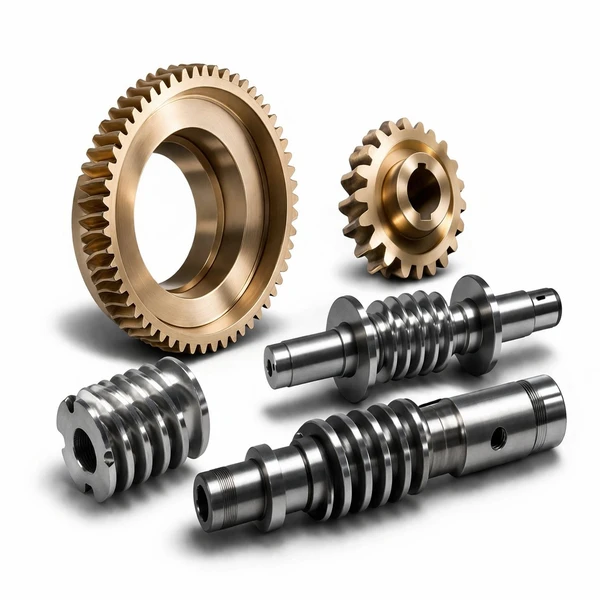
This is the regulatory reality that distinguishes medical worm gears from general industrial worm gears. The engineering requirements are often identical. The documentation requirements are categorically different — and the documentation requirements must be specified at procurement, not requested retrospectively when a regulatory body asks for them.
Čo táto príručka zahŕňa: ISO 13485 quality system requirements as they apply to gear component procurement; ISO 10993-1 biocompatibility grouping for worm gear components in different contact categories; cleanroom compatibility specification by ISO 14644 class; precision requirements for specific medical equipment applications; and the documentation package structure that satisfies regulatory audit without retrospective effort.
ISO 13485 in Gear Component Procurement — What the Standard Actually Requires
ISO 13485:2016 is a quality management system standard specifically for medical device design, development, and manufacture. Unlike ISO 9001, which accepts process-based quality management with flexibility in how conformance is demonstrated, ISO 13485 requires documented evidence for specific activities — including the qualification of purchased components and the maintenance of traceability records throughout the supply chain.
Supplier Qualification
Under ISO 13485 clause 7.4.1, medical device manufacturers must evaluate and select suppliers based on their ability to supply product in accordance with requirements. For worm gear suppliers, this typically means an initial audit questionnaire, quality manual review, and documented approval — not simply placing a purchase order. Korea Ever-Power provides an ISO 13485 supplier questionnaire response, quality manual excerpt, and process capability data for bore machining on request for initial qualification.
Incoming Inspection Protocol
Clause 7.4.3 requires that purchased product is verified against specified requirements. For worm gear components, this means confirming bore diameter to H7 tolerance (CMM measurement), surface roughness on functional surfaces (for cleanroom or food/pharma applications), and material identity. Korea Ever-Power’s CMM report provides all dimensional verification data in a format that can be directly attached to the receiving inspection record without additional measurement.
Component Traceability
Clause 7.5.9 requires the device manufacturer to maintain traceability of the product from raw material to finished device through unique identifiers. For worm gear components, this means the mill heat number on the material certificate must be traceable from the component installed in the device back to the original steel mill’s test certificate. Korea Ever-Power provides this full traceability chain — our material certificate references the mill’s original documentation, not a restatement of composition without heat number.
CAPA Documentation
If a worm gear component is involved in a non-conformance or complaint, ISO 13485 requires a corrective and preventive action (CAPA) investigation with documented root cause analysis. Korea Ever-Power supports CAPA investigations by providing production records, inspection data, and raw material certificates for the specific batch in question — typically within 24 hours of request for orders within our 5-year document retention period.
Biocompatibility Grouping Under ISO 10993-1 — Which Category Applies to Your Application
ISO 10993-1 categorises medical device components by contact duration and contact type, then specifies the biological evaluation tests required for each category. For worm gear components, the critical question is whether the component is in direct contact with patients or patient fluids, in indirect contact through a sterilisable barrier, or in non-contact positions within the device.
Drive components inside sealed housings — motors, gearboxes, bearing assemblies — that have no path of contact with the patient, patient fluids, or the patient care environment.
No biocompatibility testing required. Material certificate and ISO 13485 documentation sufficient.
Components that contact a reusable instrument or device that is subsequently sterilised, or components in contact with surfaces that may contact the patient environment indirectly.
ISO 10993-1 Group II. Cytotoxicity (ISO 10993-5) and sensitisation testing typically required. SS316 and ZCuSn10Pb1 tin bronze both have established biocompatibility reference data.
Gear components integrated into surgical instruments that enter body cavities, or drive components whose lubricant may contact wound surfaces.
ISO 10993-1 Group III. Full biocompatibility evaluation required. SS316L material, dry or biocompatible lubricant, and additional cleanability validation.
The majority of pharmaceutical worm gear applications — mixing drives, filling machine drives, conveyor drives within pharmaceutical production areas — fall into Group A or Group B. The documentation required is therefore primarily ISO 13485 quality system documentation and material traceability, not a full biocompatibility test program. Specifying Group C documentation for a Group A application adds cost and lead time without regulatory benefit; failing to specify Group B documentation for a Group B application creates an audit vulnerability.
Cleanroom Compatibility — What ISO 14644 Class Changes in Gear Specification
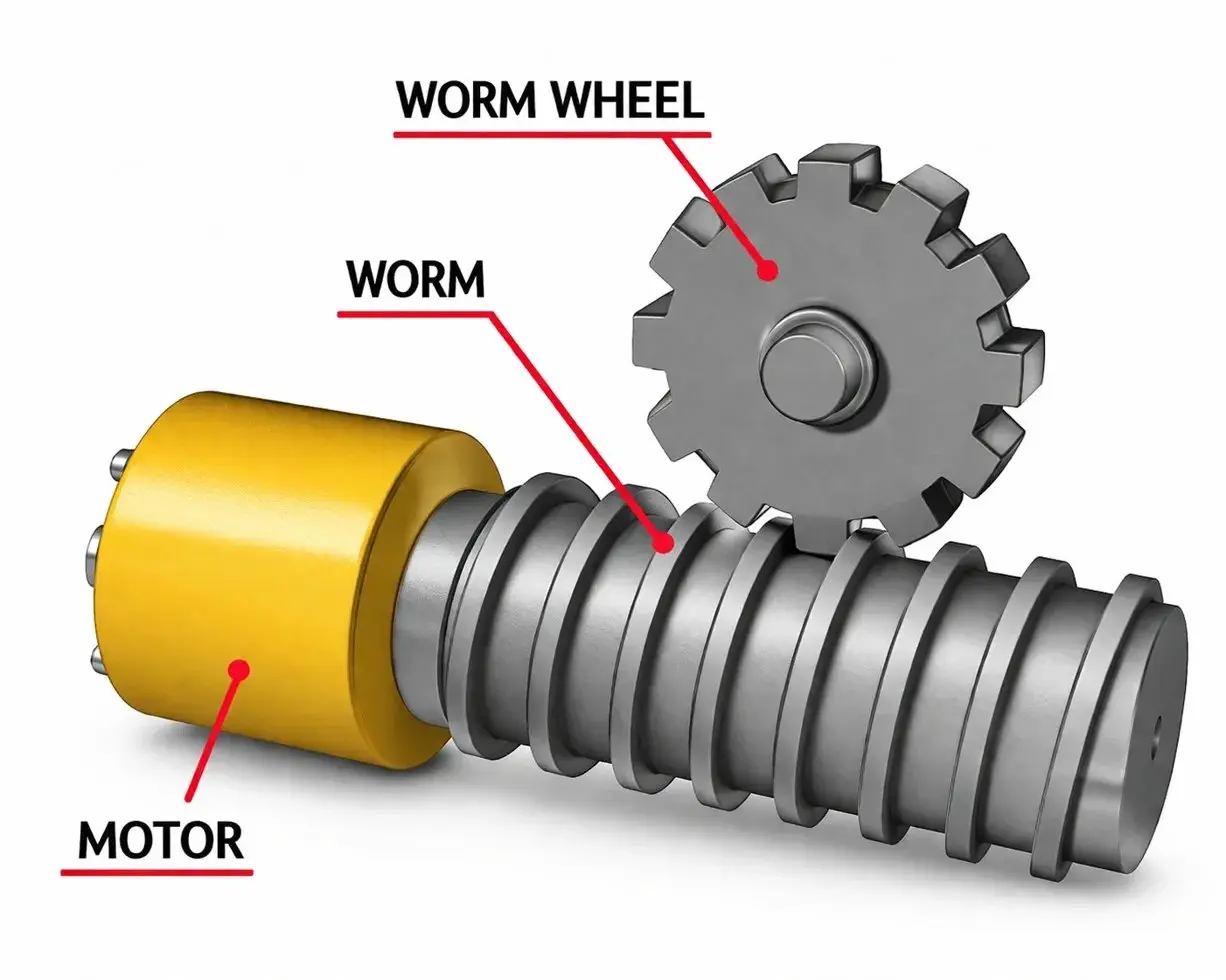
The cleanroom classification of a pharmaceutical or medical device production environment directly determines what specifications a worm gear drive must meet. The critical parameters that change by class are: particle generation from moving surfaces, lubricant outgassing, and surface cleanability.
| ISO Class | Equivalent | Gear Surface Req. | Mazivo | Particle Risk |
|---|---|---|---|---|
| ISO 5 | Class 100 | Ra ≤ 0,4 µm elektrolyticky leštené | Dry or white mineral oil | Eliminated — fully enclosed drive |
| ISO 6 | Class 1,000 | Ra ≤ 0,4 µm | Low-outgassing PAO | Minimised with lip seal |
| ISO 7 | Class 10,000 | Ra ≤ 0,8 µm | PAO or white mineral | Controlled with IP54+ sealing |
| ISO 8 | Class 100,000 | Ra ≤ 1,6 µm | Standard non-EP mineral or PAO | Standard sealed housing |
Medical and Pharmaceutical Applications — Mapped to Gear Specification
Surgical Robot Joint Drives
Worm gear joints in surgical robots must provide self-locking when the joint drive is de-energised — the robot arm must hold its position without motor holding torque to enable safe surgical positioning. Single-start worm at ratio 60:1–120:1, SS316 shaft, ZCuSn10Pb1 or SS316 wheel depending on contact category. Positional repeatability ±0.05° typically required. Duplex worm gear for joints requiring backlash compensation after thousands of cycles.
Pharmaceutical Mixing and Blending Drives
Drum blenders, paddle mixers, and tumble blenders in pharmaceutical production operate under GMP requirements. The drive documentation must support the batch record — motor serial number, gearbox identity, and gear material certificate are traceable to each production batch. Stainless steel worm shaft (SS316) with tin bronze wheel for standard GMP environments; full SS316 gear set for direct-contact applications. Validated cleaning procedure documentation available on request.
Laboratory Automation and Liquid Handling
Automated pipetting systems, centrifuge positioning drives, and multi-axis liquid handling robots require compact worm gear drives with consistent backlash across temperature changes. The laboratory environment often involves exposure to aggressive solvents, acids, and bases — requiring materials and lubricants compatible with the specific chemical environment. SS316 worm shaft is standard; lubricant selection depends on specific chemical exposure.
Medical Imaging Gantry Positioning
CT scanner, PET scanner, and C-arm gantry rotation drives use worm gears for their combination of self-locking (preventing gantry drift when brakes are released), high reduction ratio (reducing motor speed to gantry angular velocity), and compact right-angle drive layout. These are Group A non-contact applications — ISO 13485 documentation is required but biocompatibility testing is not.
Filling and Dispensing Equipment
Pharmaceutical filling lines — both aseptic filling for injectables and non-aseptic filling for oral solids — require worm gear drives that can be cleaned-in-place (CIP) with standard pharmaceutical cleaning agents. NSF H1 lubricant compatibility required for any drive in a product contact zone. Ra ≤ 0.4 µm on all wetted surfaces. Material certificates must reference the European Pharmacopoeia or USP material specifications for SS316.
Rehabilitation and Prosthetic Devices
Power-assist orthotic devices and prosthetic joint actuators require worm gear drives that provide quiet, smooth operation under variable patient loading. Self-locking is safety-critical — the device must hold position if the actuator loses power during patient use. Compact module sizes (M0.5–M1.5), low noise profile, and documented gear life under cyclic loading (ISO 10218 robot lifecycle equivalent).

Specification Challenges in Practice
Four Medical Worm Gear Procurement Cases — The Documentation Gap and How It Was Closed
Situácia: A Korean startup developing a CE-marked laparoscopic surgical positioning system received a notified body query during their CE MDR technical file review. The query: the worm gear component in their robotic arm drive chain had a material certificate stating ‘Stainless Steel AISI 316’ without a mill heat number or molybdenum content measurement, and no biocompatibility grouping record. The gears had been operating flawlessly in testing for 14 months.
Riešenie: Korea Ever-Power re-issued the component documentation with: mill heat number traceable to the original steel mill test certificate; elemental analysis confirmation of Mo 2.14% (confirming SS316 grade, not SS304 mislabelled); ISO 10993-1 Group B biocompatibility grouping reference (non-sterile contact surface in a reusable instrument); and hardness certification to exclude any post-delivery heat treatment. CE MDR notified body query was closed without a formal non-conformance.
Situácia: A Korean contract pharmaceutical manufacturer building custom blending lines for a Japanese pharmaceutical company was required under their customer’s Quality Agreement to provide batch-level traceability for all production equipment components with material specifications — including the worm gear drives on their drum blenders. Each production batch (each drum blend) had to be linked to the specific gear set installed in the drive, with the gear set linked to a material certificate.
Riešenie: Korea Ever-Power assigned unique component identifiers (engraved on shaft body, not painted or labeled) to each worm gear set in the supply program. The material certificates were cross-referenced to component identifiers in a supplier qualification document maintained by Korea Ever-Power for 7 years. The pharmaceutical OEM’s ERP system linked batch records to component identifiers at installation, satisfying the customer’s Quality Agreement requirement.
Situácia: A Japanese manufacturer of hospital automated dispensing systems discovered, 2 years into production, that their standard non-EP mineral oil for the worm gear drives was no longer available in the specific grade specified in their 510(k) device history record. Substituting a different oil — even a functionally equivalent one — required a documented change control process and potentially a 510(k) change notification.
Riešenie: Korea Ever-Power provided a technical equivalence report for three alternative lubricant specifications (one PAO synthetic and two mineral oil alternatives), including worm gear compatibility data (sliding velocity compatibility, bronze wheel chemical compatibility, viscosity-temperature data) and a statement that the gear component specification was unchanged. The manufacturer’s quality team used this technical report to support a Class II design change without 510(k) resubmission.
Situácia: A Korean manufacturer of automated pharmaceutical compounding systems was required by their pharmaceutical customer to validate that their worm gear drives were compatible with ISO 14644 Class 7 cleanroom operation. The customer’s concern was not primarily corrosion or food safety — it was particle generation from gear mesh wear products and outgassing from lubricant vapour.
Riešenie: Korea Ever-Power provided: SS316 shaft with Ra ≤ 0.4 µm electropolished flanks (minimising wear particle generation); NSF H1 PAO low-outgassing lubricant specification with vapour pressure data at 40°C and 60°C; and sealed housing configuration (dual-lip FKM seals) preventing any particulate or lubricant vapour migration from the drive housing. The validation report prepared by the equipment builder used this data to satisfy the ISO 7 cleanroom qualification protocol.
Produkty Ever-Power v Kórei
Medical and Pharmaceutical Worm Gear Products



Medical & Pharmaceutical FAQ
Worm Gear in Medical Devices — Questions from Quality Engineers and Procurement
Specify Your Medical Device Worm Gear Component
Provide your regulatory pathway (CE MDR, FDA, ISO 13485, GMP), ISO 10993 contact category, cleanroom class if applicable, gear specification, and documentation requirements. Korea Ever-Power confirms documentation availability and specification before order placement — same-day response. NDA executed before any drawing submission.
Redaktor: Cxm