Application Engineering Guide

Worm Gear Drives in Robotics and Industrial Automation — Precision, Self-Locking, and the Backlash Specification

Why automation engineers choose worm gear drives despite their efficiency penalty — and the backlash, repeatability, and dynamic load specifications that determine whether the robot performs to its rated accuracy over its design lifecycle.

±0.03°
Angular repeatability
300:1
Max single-stage ratio
Self-lock
Safety function
DIN5
Precision class
⚙ Korea Ever-Power Worm Gear Co., Ltd📍 Ansan-si, Gyeonggi-do, Korea📧 [email protected]

The Precision Paradox: Why Robots Use Worm Gears Despite Their Efficiency Penalty

Any mechanical engineer evaluating drive options for a robot joint will encounter an apparent contradiction: worm gear drives have mechanical efficiency of 50–75%, while helical gear trains achieve 92–96%. In energy-conscious automation design, this difference looks damning. Yet worm gear joints appear throughout industrial and surgical robotics, collaborative robot arms, SCARA systems, and automated positioning equipment. The reason is not that automation engineers overlook the efficiency penalty — it is that they are solving for a set of requirements where worm gear drives provide three properties that no other compact, single-stage gear type simultaneously delivers.

The first is self-locking behaviour. A robot joint that self-locks when the drive is de-energised does not require a brake to hold its position under gravity loading. This is a mechanical safety function that becomes critical in collaborative robot (cobot) applications under ISO/TS 15066, in surgical robots under CE MDR, and in any robotic application where the robot arm must hold a position after an emergency stop without relying on active braking. A mechanical self-lock is fail-safe; an electromechanical brake is fail-soft and adds mechanical complexity.
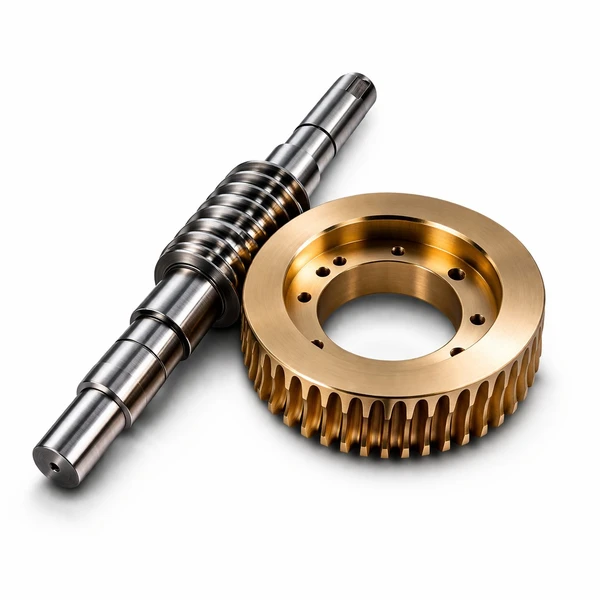
worm and wheel 1

The second is high single-stage ratio. A servo motor running at 3,000 RPM driving a robot joint that moves at 15 RPM requires a 200:1 reduction. A single worm gear stage covers this entire range. Three stages of helical gearing would be required for the same ratio — tripling the mechanical component count in a space-constrained robot joint. The third property is right-angle compact layout, which resolves the geometric constraint of bringing motor torque into a joint axis from the lateral direction — a constraint that appears repeatedly in robot arm and positioner mechanical design.

The efficiency penalty in context: For a robot joint that moves for an average of 2 hours per 8-hour shift (25% duty cycle) at 500 W mechanical output, the worm gear’s 35% additional efficiency loss versus a helical gear train represents approximately 175 W extra heat generation during operation — or about 350 Wh per shift. At Korean industrial electricity rates (approximately ₩90/kWh), this is approximately ₩32 per shift, or ₩8,000 per year. Against the design and manufacturing cost of a more complex multi-stage helical joint, this energy cost rarely justifies the complexity increase for low-to-medium duty robotic applications.


Repeatability, Accuracy, and Backlash — What the Specification Numbers Actually Mean

Worm gear tooth contact geometry for robotic precision positioning backlash measurement

The tooth contact geometry at the worm-wheel mesh — where backlash is created and where it can be adjusted in a duplex worm configuration.

Robot arm specification sheets list two closely related but technically distinct parameters that are frequently confused when selecting worm gear drives for automation. Repeatability is the ability to return to the same position from the same direction after multiple cycles — measured by the scatter of repeated position commands. Accuracy is the ability to reach a commanded position that is different from a previously taught position — affected by calibration, kinematics model errors, and gear geometry errors.

Backlash affects both, but differently. It primarily affects bidirectional repeatability — the scatter when approaching the same position from alternating directions (clockwise and counterclockwise). A standard worm gear with 0.05–0.10 mm backlash at the pitch cylinder introduces angular dead zone that directly translates to bidirectional repeatability error. For a 60 mm pitch radius worm wheel, 0.08 mm backlash = 4.6 arc-minutes = 0.077° of angular dead zone.

For pick-and-place automation where the robot always approaches from the same direction (unidirectional), this backlash creates no repeatability penalty. For welding robots, inspection systems, and any application requiring bidirectional accuracy, backlash must be controlled — either by specifying a duplex worm gear with adjustable backlash, or by implementing software backlash compensation in the robot controller.

Robot / System Type Backlash Requirement Direction Approach Gear Recommendation Ratio Typical
Pick-and-place (palletising) < 0.15 mm acceptable Unidirectional Standard worm gear, DIN8 20:1 – 80:1
Welding / assembly SCARA < 0.05 mm Bidirectional Duplex worm, DIN6–DIN7 60:1 – 120:1
Vision-guided inspection < 0.02 mm Bidirectional + stops Duplex worm DIN5, software comp. 80:1 – 200:1
Collaborative robot (cobot) < 0.08 mm Bidirectional Duplex worm, DIN6 40:1 – 100:1
Solar / antenna tracking < 0.10 mm Primarily unidirect. Standard or duplex worm 80:1 – 300:1
Automated test positioner < 0.01 mm Bidirectional Duplex worm DIN5 + encoder feedback 100:1 – 300:1

Dynamic Loading in Automation — Acceleration Torques, Inertia, and Duty Cycle

The rated torque of a worm gear set is its continuous running torque capacity under steady-state conditions. In robotic and automation applications, the actual instantaneous torque during acceleration and deceleration phases is the critical specification — not the running torque. A robot joint that carries a 10 kg payload at constant velocity produces the torque required to support the payload against gravity. The same joint accelerating from rest to full speed in 0.2 seconds produces an acceleration torque that may be 3–5× the running torque.

Peak Torque Estimation for Robot Joint Drive
T_peak = T_gravity + T_inertia = (F_payload × r_arm × cos θ) + (J_total × α)
T_gravity = payload gravitational torque at maximum arm extension and angle θ from horizontal
J_total = total rotational inertia at the joint (payload + arm structure + gear reflected inertia)
α = joint angular acceleration (rad/s²) — determined by robot controller velocity profile
Example: 5 kg payload at 0.5 m radius, 45° angle, 300°/s² acceleration → T_peak ≈ 17.4 + 22.3 = 39.7 Nm peak vs 11.8 Nm gravity running torque — 3.4× dynamic amplification

For automation worm gear specifications, the service factor applied to the rated torque must account for this dynamic amplification. A general industrial service factor of 1.5 is inadequate for high-cycle robotic applications. The correct approach is to calculate the peak torque directly and select the gear module to ensure the peak torque is within the gear set’s overload capacity (typically 2× the continuous rated torque for short-duration peaks).

Duty Cycle Calculation

Automation drives rarely run at constant load. The RMS torque over the complete motion cycle is the correct specification basis for thermal sizing, while the peak torque determines mechanical strength requirements. For a pick-and-place robot with 80% of cycle time at 30% of peak torque and 20% at 100% of peak torque, the RMS torque is approximately 47% of peak — significantly different from both the peak and the running values.

Reflected Inertia

The motor shaft sees the load inertia reflected through the gear ratio squared (J_reflected = J_load / i²). A high gear ratio dramatically reduces the reflected inertia — a 100:1 worm gear reduces the load inertia seen by the motor by 10,000×. This is why high-ratio worm gears enable small servo motors to accelerate large payloads — the inertia matching is favorable even though the efficiency is moderate.

Stiffness and Resonance

Torsional stiffness of the gear mesh affects the natural frequency of the robot arm under dynamic loading. A stiffer mesh (higher Hertz contact stiffness, which increases with module and contact pattern quality) raises the natural frequency, reducing the risk of resonance within the operating speed range. Korea Ever-Power’s documented contact pattern (≥70% face width) directly contributes to predictable mesh stiffness.


Collaborative Robots and ISO/TS 15066 — Self-Locking as a Safety Function

ISO/TS 15066:2016 specifies requirements for collaborative robot applications where the robot operates in shared workspace with human workers. A key safety parameter is the behaviour of the robot when the safety system commands a stop — particularly in vertical-axis joints where gravity loading will cause the arm to drop if the drive does not hold its position.

In collaborative robot designs using worm gear joints, the inherent self-locking behaviour of a single-start worm at ratio 20:1 and above provides a mechanical position-holding function that does not depend on power, motor holding torque, or electromechanical brakes. This simplifies the safety architecture: the worm gear’s self-locking is a passive, non-power-dependent safety function that can be included in the safety function analysis under IEC 62061 or ISO 13849. The self-locking worm gear joint contributes to achieving PLd (Performance Level d) safety function ratings for position holding in applicable configurations.

Critical specification requirement for cobot self-locking: The self-locking function must be verified at maximum operating temperature with the actual specified lubricant — not at ambient laboratory conditions. A cobot joint drive operating at 68°C housing temperature with low-viscosity synthetic oil may not satisfy the self-locking condition that the same drive satisfies at 25°C with standard mineral oil. Request self-locking calculation at specified operating temperature as part of the design verification documentation. Korea Ever-Power provides this calculation as standard for single-start worm gear sets ordered for safety-function applications.

Automation Engineering in Practice

Four Robotic Worm Gear Specifications — Precision, Safety, and Custom Ratio Solutions

Ulsan, Korea · Automotive Assembly Robot OEM
SCARA Joint Drive — Custom Ratio for Servo Motor Speed Matching

Challenge: A Korean manufacturer of SCARA robots for automotive body welding applications needed a worm gear ratio that matched their specific servo motor operating point. The optimal motor speed for their torque-speed curve was 2,800 RPM; the required joint output speed was 72 RPM. The required ratio was 38.9:1 — not available in any standard catalog. Ordering the nearest catalog ratio (40:1) would have required de-rating the servo motor operating point by 2.75% — acceptable for continuous operation but causing measurable accuracy degradation in high-cycle welding path trajectories.

Solution: Korea Ever-Power manufactured a Level 3 semi-custom worm gear set: z2 = 39-tooth wheel on standard M5 hobbing tooling, matched to a single-start worm shaft ground to the precise 39:1 geometry. The non-standard ratio required no new tooling — only a different index gear setting on the hobbing machine. Lead time: 5 weeks for the first batch. The robot met its path accuracy specification (±0.04 mm at joint) without servo motor re-sizing.

✓ Custom ratio 39:1 · No new tooling · ±0.04 mm path accuracy achieved · 5-week lead time
Ho Chi Minh City, Vietnam · Electronics Pick-and-Place
High-Cycle Wear Failure — Material Upgrade Prevents 6-Month Replacement Cycle

Challenge: A Vietnamese electronics contract manufacturer operating 24/7 pick-and-place assembly lines was replacing worm wheels every 5–7 months on their high-speed component placement robots. The cycle rate was 380 cycles per minute across 22-hour production days — approximately 500,000 tooth mesh contacts per 8-hour shift. CMM analysis of failed wheels showed progressive abrasive wear consistent with inadequate hardness differential: the shaft was C45 induction-hardened (surface hardness 48 HRC at inspection), and the bronze wheel had reached the clearance limit before visible scuffing occurred.

Solution: Korea Ever-Power upgraded: C45 induction-hardened shaft → 40Cr through-hardened at 54 HRC, same module and bore dimensions. The additional 6 HRC surface hardness approximately doubled the hardness differential against the tin bronze wheel, directly improving wear resistance proportional to the hardness differential squared. Same bore, same module, week-for-week drop-in replacement with documentation confirming material upgrade.

✓ 40Cr upgrade · Drop-in replacement · Wear life >18 months (verified) · No modification required
Singapore · Semiconductor Wafer Handling Robot
Precision Gantry Drive — Repeatability Requirement ±0.02 mm Over Temperature Range

Challenge: A semiconductor equipment manufacturer designing a wafer handling gantry for a 200 mm fab required worm gear drives for the θ-axis (rotational positioning) with bidirectional repeatability of ±0.02 mm at the wafer carrier (equivalent to ±0.019° at the 60 mm pitch radius worm wheel). The challenge was maintaining this specification across the temperature range 20°C–40°C within the equipment enclosure — standard worm gear backlash increases with temperature as differential thermal expansion changes the mesh geometry.

Solution: Korea Ever-Power supplied duplex worm gear sets (adjustable backlash) calibrated to zero backlash at 30°C median operating temperature. The duplex configuration allows backlash to be re-adjusted if thermal cycling causes drift — without removing the gear set from the robot. The equipment manufacturer’s qualification testing confirmed ±0.018° bidirectional repeatability across the full temperature range, meeting the ±0.019° specification with margin.

✓ Duplex worm · ±0.018° bidirectional repeatability · Temperature-stable · Specification met with margin
Gyeonggi-do, Korea · Collaborative Robot Integrator
Cobot Arm Joint — Self-Locking Safety Function Documentation for CE Certification

Challenge: A Korean cobot integrator was preparing the CE technical file for a new 6-DoF collaborative robot under the Machinery Directive 2006/42/EC and ISO/TS 15066. The safety function analysis for wrist joint position holding under ISO 13849 required a performance level (PL) assessment for the mechanical self-locking function of the worm gear drive. The integrator needed documented evidence that the worm gear’s self-locking behaviour satisfied the conditions required for a PLd contribution.

Solution: Korea Ever-Power provided a formal self-locking verification document for the specific gear set: lead angle calculation at the specified pitch geometry; friction coefficient range at operating temperature (25°C–70°C) with the specified lubricant; self-locking safety margin at worst-case temperature (70°C, minimum friction scenario); and confirmation that the self-locking function is a passive, non-power-dependent mechanism. This document was accepted by the notified body as supporting evidence for the PLd safety function assignment.

✓ PLd self-locking function documented · CE technical file accepted · Notified body query closed

Korea Ever-Power Products

Worm Gear Products for Robotics and Automation

Duplex Worm Gear — Robotic Joint Drive
Precision · Backlash Adjustable · DIN5–7
Duplex Worm Gear — Robotic Joint Drive
The definitive specification for robot and automation applications requiring bidirectional positional accuracy across the system’s operating lifetime. The dual-lead worm shaft — where the left and right thread flanks have slightly different lead values — allows backlash to be controlled by adjusting the axial position of the worm shaft within its housing: sliding the shaft toward the wheel brings a thicker section of the worm thread into mesh, reducing the clearance between worm thread and wheel tooth to near-zero. In a 6-DoF robot operating 20 hours per day, the mechanical backlash of a standard worm gear joint will grow from its initial specification (typically 0.03–0.08 mm) to 0.20–0.35 mm over 12–18 months as the wheel tooth flanks wear during high-cycle operation. The duplex worm allows this backlash to be corrected in a 15-minute maintenance procedure — axial shaft shift — without removing the gear set from the robot or replacing any components. Readjustment is possible 4–6 times over the gear set’s service life. Self-locking behaviour is fully maintained through the adjustment range for single-start configurations, preserving the safety function. Precision class DIN5 to DIN7 depending on specification; contact pattern ≥ 70% documented. Available in SS316 for cleanroom and food-adjacent automation applications. Formal self-locking verification document available for CE Machinery Directive and cobot safety function submissions.
BacklashAdjustable from near-zero — no part replacement
Precision classDIN5, DIN6, or DIN7
Self-lockingPreserved through adjustment range
Readjustment4–6 cycles over service life
CE supportSelf-locking safety function document

View Specifications →

Alloy Steel Worm Set — Custom Automation Specification
Custom Ratio · High Precision · Multi-Start
Alloy Steel Worm Set — Custom Automation Specification
Standard catalog ratios (5, 7.5, 10, 15, 20, 25, 30, 40:1…) are defined by the most common industrial applications. Robotic and automation systems are frequently designed around servo motor operating points and kinematic requirements that fall between catalog ratios — 37:1, 43:1, 67:1, 84:1. Korea Ever-Power manufactures any integer ratio from 5:1 to 300:1 at standard module sizes (M0.5 to M10) as a Level 3 semi-custom specification, without new tooling and with lead times comparable to catalog supply on reorder. Multi-start configurations (z1=2 or z1=4) are available where efficiency improvement is required alongside a specific ratio — for example, a 20:1 four-start set at 85% efficiency instead of a 20:1 single-start set at 68% efficiency. The alloy steel worm shaft (40Cr through-hardened to 50–56 HRC, or SCM415 carburized to 58–62 HRC for high-cycle precision applications) and ZCuSn10Pb1 tin bronze wheel are the standard material pair. Every set includes CMM dimensional inspection report, contact pattern photograph (≥70% confirmed), and material certificates. For automation supply programs with recurring orders of the same specification, blanket order arrangements with fixed pricing and 2–3 week call-off lead times are available.
Ratio rangeAny integer 5:1 – 300:1
Multi-startz1=1, 2, or 4 available
ModuleM0.5 – M10
Lead time3–5 weeks standard, 2 weeks reorder
Supply programBlanket order available

View Specifications →

Servo-Mount Worm Gear Reducer for Automation
Enclosed Reducer · Servo Flange Mount
Servo-Mount Worm Gear Reducer for Automation
For automation and robotics applications requiring a complete enclosed drive assembly — motor flange mount, IP54 or IP65 housing, pre-filled lubricant, output shaft or hollow bore — Korea Ever-Power’s servo-compatible worm gear reducers provide precision gear sets in housing configurations designed for direct servo motor mounting. The worm gear set within the reducer meets the same precision standards (DIN6–DIN7 as standard, DIN5 on request), material specifications, and documentation requirements as bare gear sets. The housing is aluminium alloy (lightweight for robot arm integration) with optional anodised or coated finish for cleanroom compatibility. Input coupling accommodates IEC 56 through IEC 132 servo motor frame sizes. Output configurations: solid shaft, hollow bore, and flange-mount. For multi-axis robot positioners and gantry automation systems, the identical gear set in reducer housing configuration simplifies mechanical integration while maintaining the specification quality required for robot accuracy. For integrated worm gear reducer specifications for automation and positioner applications, see our site: wormgearreduer.top
HousingAluminium, IP54 or IP65
Motor mountIEC 56 – IEC 132
OutputSolid shaft, hollow bore, flange
PrecisionDIN6–DIN7 standard, DIN5 on request
DocumentationSame as bare gear set standard

View Specifications →

Robotics & Automation FAQ

Worm Gear in Robots and Automation — Questions from Mechanical and Controls Engineers

How is worm gear backlash measured, and what is the relationship between the number on the datasheet and the position error I will see in my robot?+

Backlash in worm gear sets is typically measured as the angular movement of the output shaft when the input shaft is held stationary and the output shaft is rotated alternately in both directions by a known torque — the angular difference between the two positions is the backlash angle. This angle is then reported as a linear value at the pitch cylinder (backlash angle × pitch radius). The relationship between this value and robot position error depends on how the robot approaches the target: unidirectional approaches (always from the same direction) see essentially zero backlash penalty; bidirectional approaches see the full backlash as dead zone. For a worm wheel with 60 mm pitch radius, 0.08 mm backlash = 4.6 arc-minutes = 0.077° angular dead zone. At a robot tool center point 500 mm from the joint, this translates to approximately 0.67 mm TCP position error — significant for precise assembly but acceptable for many material handling applications.

Can I implement backlash compensation in software rather than using a duplex worm gear?+

Yes, software backlash compensation is effective for many automation applications. The robot controller stores the known backlash value for each joint and adds a pre-compensation move before any direction reversal — moving past the target by the backlash distance in the approach direction, then reversing to the target. This eliminates the bidirectional repeatability error for quasi-static positioning. Limitations: (1) Software compensation works for known constant backlash; if backlash grows with wear, the compensation value must be updated regularly; (2) Dynamic compensation is more complex and less effective at high speeds; (3) The compliance in the gear mesh still exists even when the average position error is compensated — vibration from rapid direction reversals is not eliminated by software compensation. For high-cycle applications where backlash growth over thousands of hours is a concern, a duplex worm gear that can be mechanically re-adjusted is the more robust long-term solution.

What gear ratio should I use for a servo motor running at 3,000 RPM driving a robot joint that needs to move at maximum 90 RPM?+

Required ratio: 3,000 ÷ 90 = 33.3:1. The nearest standard catalog ratios are 30:1 and 36:1. At 30:1, the joint maximum speed would be 100 RPM — 11% faster than the servo speed limit. At 36:1, the joint maximum speed would be 83.3 RPM — 7.5% slower than required. Neither is ideal. Korea Ever-Power can manufacture a 33:1 ratio (z2 = 33 teeth, single-start worm) as a Level 3 semi-custom specification without new tooling, matching your exact servo motor and joint speed requirements. At order placement, provide the module (or the centre distance and shaft diameters) and we confirm the geometry at 33:1 before proceeding.

How do I account for worm gear efficiency in my servo motor torque budget calculation?+

The worm gear efficiency appears in two places in the torque budget. For driving direction (motor driving the load), the output torque available at the joint is T_output = T_motor × gear_ratio × η, where η is the forward efficiency. A 50:1 gear set at 65% efficiency with a 1 Nm motor produces 32.5 Nm at the joint (not 50 Nm). For the speed change, the joint speed = motor speed ÷ gear ratio. For power budget: input power = output power ÷ η, so the motor must provide more power than the load requires. In servo motor sizing software, if the software does not include worm gear efficiency in its calculation, multiply the required joint torque by (1/η) to find the required motor torque contribution, and multiply the heat generated in the gearbox by (1-η) × P_input to find the thermal load.

We need to change the gear ratio on an existing robot joint without changing the motor or the housing. Is this possible?+

Yes, if the new ratio uses a wheel tooth count that fits within the same housing centre distance. For a single-start worm (z1=1), changing the ratio from 40:1 to 35:1 requires changing the wheel from 40 teeth to 35 teeth. The wheel pitch diameter changes proportionally — a 35-tooth wheel at M5 has d2 = 35 × 5 = 175 mm vs 200 mm for the 40-tooth wheel. The centre distance changes from (d1 + d2)/2 = (50 + 200)/2 = 125 mm to (50 + 175)/2 = 112.5 mm — requiring a modified housing or shim arrangement. If the housing has adjustment provision (which many positioner and robot designs do), the ratio change is feasible within the same housing. Provide your existing gear set dimensions (module, current tooth count, shaft diameters, centre distance), current and required ratios, and Korea Ever-Power will confirm whether the ratio change is achievable in the existing housing before any design modification work.

What is the expected service life of a worm gear joint in a high-cycle assembly robot?+

Service life depends primarily on: wheel material, contact pattern quality, lubrication, and the ratio of actual torque to rated torque. For a correctly specified alloy steel shaft + ZCuSn10Pb1 bronze wheel set running at 60–70% of rated torque in continuous operation at 400 cycles/minute (approximately 14 million cycles per shift): the wheel tooth flank wear should remain within specification for 8,000–15,000 operating hours if lubrication is correct and running-in is completed. Key factors that shorten this: operation above 80% of rated torque (dramatically accelerates pitting fatigue); EP-additive lubricant causing corrosive attack; operating temperature above 80°C (accelerates lubricant degradation and increases friction); and shock loading from abrupt motor starts under full load (use soft-start motor control for high-cycle automation drives). We recommend oil analysis sampling every 2,000 hours to track wear particle count as an early warning of wear rate acceleration.

How do I specify a worm gear set for a collaborative robot application where the self-locking behaviour is a documented safety function under ISO 13849?+

The specification must include: (1) gear ratio and start count that produce a lead angle below the friction angle at worst-case temperature and lubricant conditions — not just at ambient; (2) the lubricant specification (ISO VG grade and type) used in the self-locking calculation; (3) the maximum expected housing temperature under worst-case thermal conditions; and (4) the required self-locking safety margin (typically ρ’ – λ ≥ 1.5°). Korea Ever-Power provides a formal self-locking verification document covering these parameters for single-start worm gear sets ordered for safety-function applications. This document includes the lead angle calculation, friction coefficient data at the specified temperature range, friction angle at worst-case temperature, and the resulting safety margin. The document is formatted for direct inclusion in the ISO 13849 safety function analysis as supporting evidence.

What is the noise level of a worm gear drive in a collaborative robot, and how can it be minimised?+

Worm gear drives are inherently quieter than equivalent-ratio helical gear trains at the same module, because the worm-wheel tooth contact is a sliding contact with gradual tooth engagement rather than the impact-dominated tooth engagement of spur gears. Typical noise levels for correctly specified, well-lubricated worm gear drives at moderate operating speeds (500–1500 RPM worm shaft) are 55–70 dB(A) at 1 metre, lower than most collaborative robot operational environments. Noise reduction measures: (1) Increase module size slightly to reduce tooth contact stress (lower contact frequency noise); (2) Improve contact pattern quality — a ≥70% contact pattern as verified in Korea Ever-Power’s contact pattern photograph produces significantly less mesh noise than a point-contact mismatched gear set; (3) Ensure correct lubricant viscosity — low-viscosity oil at high temperature produces more boundary-contact noise than adequate-viscosity oil; (4) Nylon or POM plastic worm wheels reduce noise significantly for very low load applications at the cost of torque capacity.

Specify Your Robotic Worm Gear Drive

Provide robot type, joint axis, required ratio (or motor speed + joint speed), backlash requirement, repeatability specification, duty cycle, and any safety function documentation requirements. Korea Ever-Power returns a complete specification with custom ratio confirmation and lead time within one working day.

Editor: Cxm