The Precision Paradox: Why Robots Use Worm Gears Despite Their Efficiency Penalty
Any mechanical engineer evaluating drive options for a robot joint will encounter an apparent contradiction: worm gear drives have mechanical efficiency of 50–75%, while helical gear trains achieve 92–96%. In energy-conscious automation design, this difference looks damning. Yet worm gear joints appear throughout industrial and surgical robotics, collaborative robot arms, SCARA systems, and automated positioning equipment. The reason is not that automation engineers overlook the efficiency penalty — it is that they are solving for a set of requirements where worm gear drives provide three properties that no other compact, single-stage gear type simultaneously delivers.
The first is self-locking behaviour. A robot joint that self-locks when the drive is de-energised does not require a brake to hold its position under gravity loading. This is a mechanical safety function that becomes critical in collaborative robot (cobot) applications under ISO/TS 15066, in surgical robots under CE MDR, and in any robotic application where the robot arm must hold a position after an emergency stop without relying on active braking. A mechanical self-lock is fail-safe; an electromechanical brake is fail-soft and adds mechanical complexity.
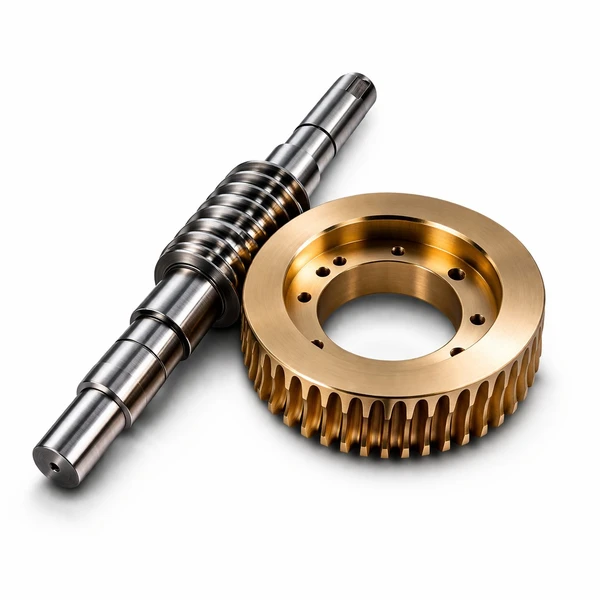
The second is high single-stage ratio. A servo motor running at 3,000 RPM driving a robot joint that moves at 15 RPM requires a 200:1 reduction. A single worm gear stage covers this entire range. Three stages of helical gearing would be required for the same ratio — tripling the mechanical component count in a space-constrained robot joint. The third property is right-angle compact layout, which resolves the geometric constraint of bringing motor torque into a joint axis from the lateral direction — a constraint that appears repeatedly in robot arm and positioner mechanical design.
The efficiency penalty in context: For a robot joint that moves for an average of 2 hours per 8-hour shift (25% duty cycle) at 500 W mechanical output, the worm gear’s 35% additional efficiency loss versus a helical gear train represents approximately 175 W extra heat generation during operation — or about 350 Wh per shift. At Korean industrial electricity rates (approximately ₩90/kWh), this is approximately ₩32 per shift, or ₩8,000 per year. Against the design and manufacturing cost of a more complex multi-stage helical joint, this energy cost rarely justifies the complexity increase for low-to-medium duty robotic applications.
Repeatability, Accuracy, and Backlash — What the Specification Numbers Actually Mean

Robot arm specification sheets list two closely related but technically distinct parameters that are frequently confused when selecting worm gear drives for automation. Repeatability is the ability to return to the same position from the same direction after multiple cycles — measured by the scatter of repeated position commands. Accuracy is the ability to reach a commanded position that is different from a previously taught position — affected by calibration, kinematics model errors, and gear geometry errors.
Backlash affects both, but differently. It primarily affects bidirectional repeatability — the scatter when approaching the same position from alternating directions (clockwise and counterclockwise). A standard worm gear with 0.05–0.10 mm backlash at the pitch cylinder introduces angular dead zone that directly translates to bidirectional repeatability error. For a 60 mm pitch radius worm wheel, 0.08 mm backlash = 4.6 arc-minutes = 0.077° of angular dead zone.
For pick-and-place automation where the robot always approaches from the same direction (unidirectional), this backlash creates no repeatability penalty. For welding robots, inspection systems, and any application requiring bidirectional accuracy, backlash must be controlled — either by specifying a duplex worm gear with adjustable backlash, or by implementing software backlash compensation in the robot controller.
| Robot / System Type | Backlash Requirement | Direction Approach | Gear Recommendation | Ratio Typical |
|---|---|---|---|---|
| Pick-and-place (palletising) | < 0.15 mm acceptable | Unidirectional | Standard worm gear, DIN8 | 20:1 – 80:1 |
| Welding / assembly SCARA | < 0.05 mm | Bidirectional | Duplex worm, DIN6–DIN7 | 60:1 – 120:1 |
| Vision-guided inspection | < 0.02 mm | Bidirectional + stops | Duplex worm DIN5, software comp. | 80:1 – 200:1 |
| Collaborative robot (cobot) | < 0.08 mm | Bidirectional | Duplex worm, DIN6 | 40:1 – 100:1 |
| Solar / antenna tracking | < 0.10 mm | Primarily unidirect. | Standard or duplex worm | 80:1 – 300:1 |
| Automated test positioner | < 0.01 mm | Bidirectional | Duplex worm DIN5 + encoder feedback | 100:1 – 300:1 |
Dynamic Loading in Automation — Acceleration Torques, Inertia, and Duty Cycle
The rated torque of a worm gear set is its continuous running torque capacity under steady-state conditions. In robotic and automation applications, the actual instantaneous torque during acceleration and deceleration phases is the critical specification — not the running torque. A robot joint that carries a 10 kg payload at constant velocity produces the torque required to support the payload against gravity. The same joint accelerating from rest to full speed in 0.2 seconds produces an acceleration torque that may be 3–5× the running torque.
J_total = total rotational inertia at the joint (payload + arm structure + gear reflected inertia)
α = joint angular acceleration (rad/s²) — determined by robot controller velocity profile
Example: 5 kg payload at 0.5 m radius, 45° angle, 300°/s² acceleration → T_peak ≈ 17.4 + 22.3 = 39.7 Nm peak vs 11.8 Nm gravity running torque — 3.4× dynamic amplification
For automation worm gear specifications, the service factor applied to the rated torque must account for this dynamic amplification. A general industrial service factor of 1.5 is inadequate for high-cycle robotic applications. The correct approach is to calculate the peak torque directly and select the gear module to ensure the peak torque is within the gear set’s overload capacity (typically 2× the continuous rated torque for short-duration peaks).
Duty Cycle Calculation
Automation drives rarely run at constant load. The RMS torque over the complete motion cycle is the correct specification basis for thermal sizing, while the peak torque determines mechanical strength requirements. For a pick-and-place robot with 80% of cycle time at 30% of peak torque and 20% at 100% of peak torque, the RMS torque is approximately 47% of peak — significantly different from both the peak and the running values.
Reflected Inertia
The motor shaft sees the load inertia reflected through the gear ratio squared (J_reflected = J_load / i²). A high gear ratio dramatically reduces the reflected inertia — a 100:1 worm gear reduces the load inertia seen by the motor by 10,000×. This is why high-ratio worm gears enable small servo motors to accelerate large payloads — the inertia matching is favorable even though the efficiency is moderate.
Stiffness and Resonance
Torsional stiffness of the gear mesh affects the natural frequency of the robot arm under dynamic loading. A stiffer mesh (higher Hertz contact stiffness, which increases with module and contact pattern quality) raises the natural frequency, reducing the risk of resonance within the operating speed range. Korea Ever-Power’s documented contact pattern (≥70% face width) directly contributes to predictable mesh stiffness.
Collaborative Robots and ISO/TS 15066 — Self-Locking as a Safety Function
ISO/TS 15066:2016 specifies requirements for collaborative robot applications where the robot operates in shared workspace with human workers. A key safety parameter is the behaviour of the robot when the safety system commands a stop — particularly in vertical-axis joints where gravity loading will cause the arm to drop if the drive does not hold its position.
In collaborative robot designs using worm gear joints, the inherent self-locking behaviour of a single-start worm at ratio 20:1 and above provides a mechanical position-holding function that does not depend on power, motor holding torque, or electromechanical brakes. This simplifies the safety architecture: the worm gear’s self-locking is a passive, non-power-dependent safety function that can be included in the safety function analysis under IEC 62061 or ISO 13849. The self-locking worm gear joint contributes to achieving PLd (Performance Level d) safety function ratings for position holding in applicable configurations.
Critical specification requirement for cobot self-locking: The self-locking function must be verified at maximum operating temperature with the actual specified lubricant — not at ambient laboratory conditions. A cobot joint drive operating at 68°C housing temperature with low-viscosity synthetic oil may not satisfy the self-locking condition that the same drive satisfies at 25°C with standard mineral oil. Request self-locking calculation at specified operating temperature as part of the design verification documentation. Korea Ever-Power provides this calculation as standard for single-start worm gear sets ordered for safety-function applications.
Automation Engineering in Practice
Four Robotic Worm Gear Specifications — Precision, Safety, and Custom Ratio Solutions
Challenge: A Korean manufacturer of SCARA robots for automotive body welding applications needed a worm gear ratio that matched their specific servo motor operating point. The optimal motor speed for their torque-speed curve was 2,800 RPM; the required joint output speed was 72 RPM. The required ratio was 38.9:1 — not available in any standard catalog. Ordering the nearest catalog ratio (40:1) would have required de-rating the servo motor operating point by 2.75% — acceptable for continuous operation but causing measurable accuracy degradation in high-cycle welding path trajectories.
Solution: Korea Ever-Power manufactured a Level 3 semi-custom worm gear set: z2 = 39-tooth wheel on standard M5 hobbing tooling, matched to a single-start worm shaft ground to the precise 39:1 geometry. The non-standard ratio required no new tooling — only a different index gear setting on the hobbing machine. Lead time: 5 weeks for the first batch. The robot met its path accuracy specification (±0.04 mm at joint) without servo motor re-sizing.
Challenge: A Vietnamese electronics contract manufacturer operating 24/7 pick-and-place assembly lines was replacing worm wheels every 5–7 months on their high-speed component placement robots. The cycle rate was 380 cycles per minute across 22-hour production days — approximately 500,000 tooth mesh contacts per 8-hour shift. CMM analysis of failed wheels showed progressive abrasive wear consistent with inadequate hardness differential: the shaft was C45 induction-hardened (surface hardness 48 HRC at inspection), and the bronze wheel had reached the clearance limit before visible scuffing occurred.
Solution: Korea Ever-Power upgraded: C45 induction-hardened shaft → 40Cr through-hardened at 54 HRC, same module and bore dimensions. The additional 6 HRC surface hardness approximately doubled the hardness differential against the tin bronze wheel, directly improving wear resistance proportional to the hardness differential squared. Same bore, same module, week-for-week drop-in replacement with documentation confirming material upgrade.
Challenge: A semiconductor equipment manufacturer designing a wafer handling gantry for a 200 mm fab required worm gear drives for the θ-axis (rotational positioning) with bidirectional repeatability of ±0.02 mm at the wafer carrier (equivalent to ±0.019° at the 60 mm pitch radius worm wheel). The challenge was maintaining this specification across the temperature range 20°C–40°C within the equipment enclosure — standard worm gear backlash increases with temperature as differential thermal expansion changes the mesh geometry.
Solution: Korea Ever-Power supplied duplex worm gear sets (adjustable backlash) calibrated to zero backlash at 30°C median operating temperature. The duplex configuration allows backlash to be re-adjusted if thermal cycling causes drift — without removing the gear set from the robot. The equipment manufacturer’s qualification testing confirmed ±0.018° bidirectional repeatability across the full temperature range, meeting the ±0.019° specification with margin.
Challenge: A Korean cobot integrator was preparing the CE technical file for a new 6-DoF collaborative robot under the Machinery Directive 2006/42/EC and ISO/TS 15066. The safety function analysis for wrist joint position holding under ISO 13849 required a performance level (PL) assessment for the mechanical self-locking function of the worm gear drive. The integrator needed documented evidence that the worm gear’s self-locking behaviour satisfied the conditions required for a PLd contribution.
Solution: Korea Ever-Power provided a formal self-locking verification document for the specific gear set: lead angle calculation at the specified pitch geometry; friction coefficient range at operating temperature (25°C–70°C) with the specified lubricant; self-locking safety margin at worst-case temperature (70°C, minimum friction scenario); and confirmation that the self-locking function is a passive, non-power-dependent mechanism. This document was accepted by the notified body as supporting evidence for the PLd safety function assignment.
Korejské produkty Ever-Power
Worm Gear Products for Robotics and Automation


Často kladené otázky k robotice a automatizaci
Šnekové převody v robotech a automatizaci – otázky od strojních a řídicích inženýrů
Specifikujte svůj robotický šnekový převodový pohon
Uveďte typ robota, osu kloubu, požadovaný převodový poměr (nebo otáčky motoru + otáčky kloubu), požadavek na vůli, specifikaci opakovatelnosti, pracovní cyklus a veškeré požadavky na dokumentaci bezpečnostních funkcí. Korea Ever-Power vrátí kompletní specifikaci s potvrzením vlastního převodového poměru a dodací lhůtou do jednoho pracovního dne.
Střihač: Cxm