The Bearing Failure Two Months After the Gear Set Was Replaced
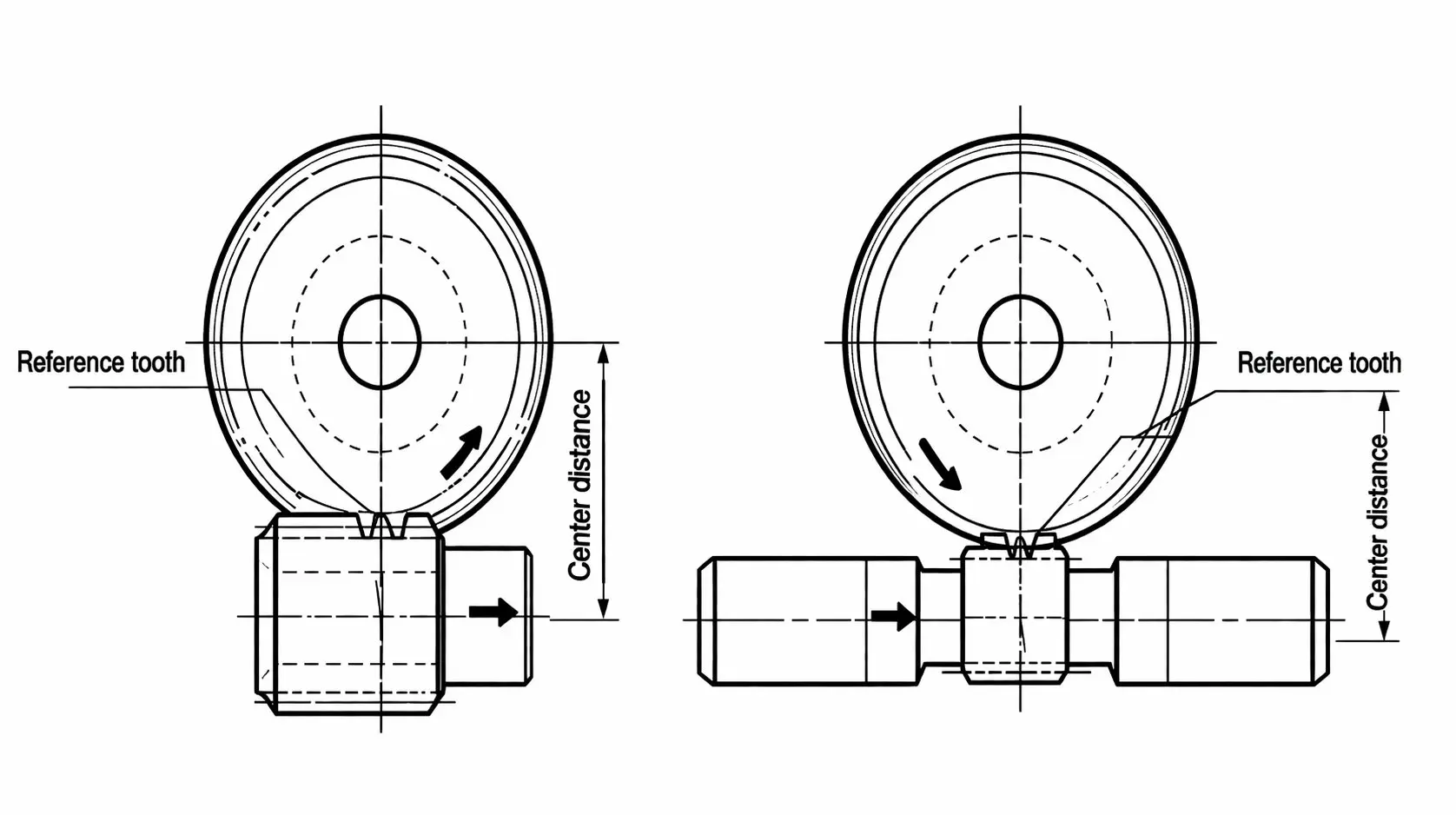
A food processing plant replaced the worm gear set on a conveyor corner drive in March. In May, the drive failed again — same symptoms, same noise profile. The maintenance team ordered another gear set and, while waiting for delivery, disassembled the drive to confirm the failure mode. The worm wheel tooth flanks were pristine — barely touched since the March installation. The worm shaft bearings had failed: the fixed bearing outer race had a spall fracture consistent with axial overload fatigue.
Investigation revealed: the conveyor used a V-belt connection from the motor to the worm shaft, with a 2.5 kN belt tension pulling radially on the shaft overhang. The maintenance team had replaced the gear set but not the bearings — and had not recalculated whether the existing bearings (standard deep groove ball bearings, 6206 series) could handle the combined radial-plus-axial loading. Standard deep groove ball bearings handle axial load as approximately 30% of their radial load rating. The combined bearing load on this shaft exceeded the 6206 rating by 1.8x. The bearing was destined to fail whether the gear set was replaced or not.
The core issue: Worm gear shafts carry both radial loads (from gear mesh tangential force, external belt or chain tension) and high axial (thrust) loads (from the helical mesh reaction force that tries to push the worm shaft out along its axis). Deep groove ball bearings are inadequate for worm shaft applications except in the lightest duty. Angular contact ball bearings or tapered roller bearings — in a fixed-float or back-to-back arrangement to handle bidirectional thrust — are the correct specification for the worm shaft in all but the lightest applications.

The Worm Shaft Axial Thrust — Why It Is So Large
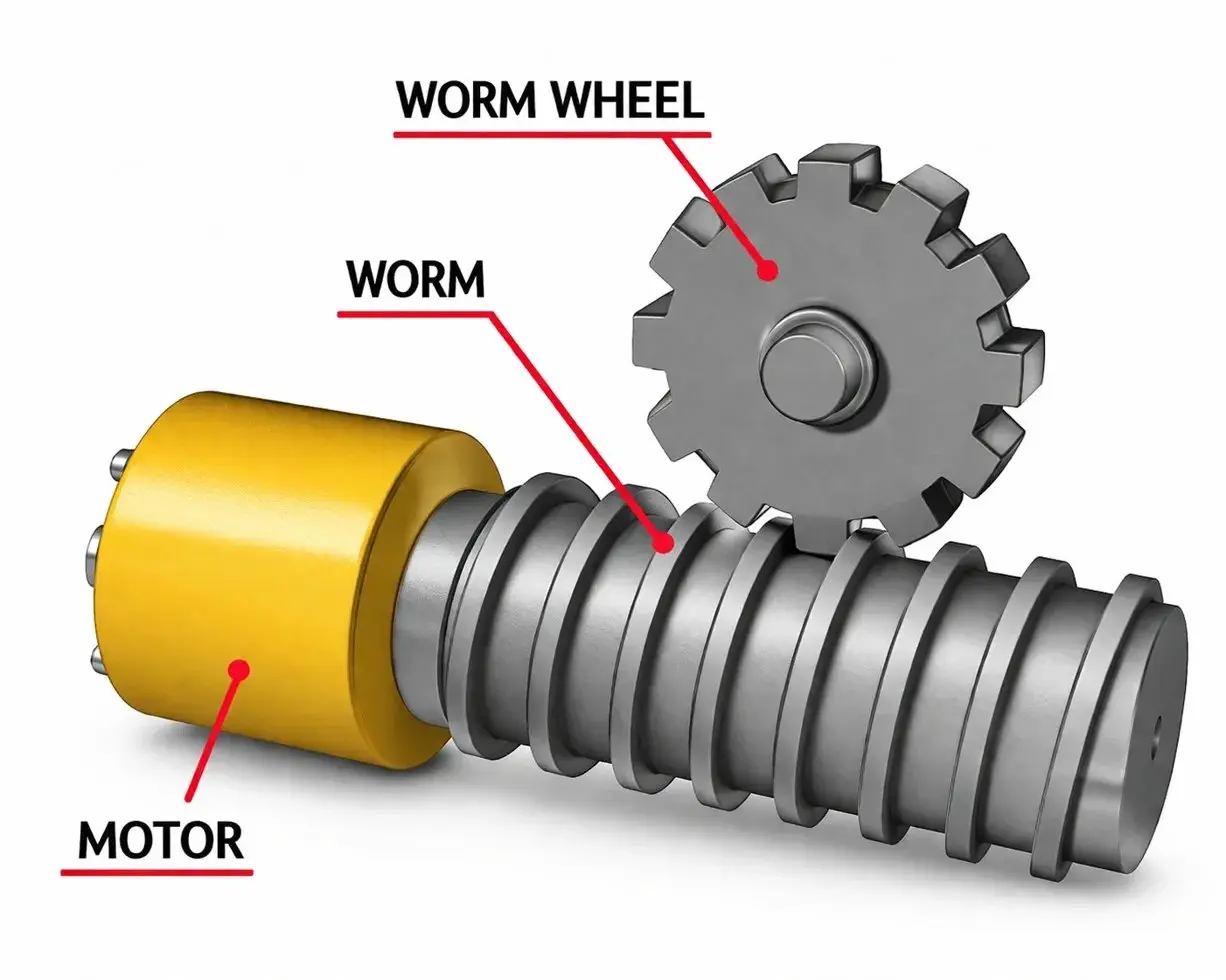
In a worm gear drive, the tooth contact force at the mesh is resolved into three components acting on each shaft: tangential (torque-producing), radial (separating force perpendicular to pitch cylinder), and axial (thrust force along the shaft axis). In a helical gear pair, the axial thrust is typically 20-40% of the tangential force. In a worm gear drive, the relationship is fundamentally different and much more severe for the worm shaft.
The critical insight: for a 50:1 ratio worm drive (q=12), the axial thrust on the worm shaft is 4.17 times the tangential force on the worm shaft. Since most engineers calculate bearing loads from the shaft torque and pitch radius (giving the tangential force), they calculate only 24% of the actual bearing axial load. A worm shaft bearing sized for the tangential force alone is undersized for axial load by a factor of 4. This is the most common worm gear bearing design error.
Bearing Type Selection — Worm Shaft vs Wheel Shaft
Worm Shaft — Fixed Bearing
The worm shaft fixed bearing must carry both the radial mesh force and the full bidirectional axial thrust. Angular contact ball bearings mounted back-to-back (DB arrangement) or face-to-face (DF arrangement) provide this combined load capability. The contact angle (typically 25-40 degrees) determines the ratio of axial to radial capacity — higher contact angle provides greater axial capacity. For most worm shaft applications, 30 degrees or 40 degrees contact angle angular contact bearings are appropriate.
Worm Shaft — Float Bearing
The float bearing on the non-thrust end of the worm shaft carries only the radial load component from the mesh and any external overhung load. It allows axial thermal expansion of the shaft without developing axial constraint force. Standard deep groove ball bearings are appropriate for the float position because no axial load is transmitted here. The float bearing housing bore is typically sized to allow a small free axial movement (0.3-0.8 mm) to accommodate thermal expansion.
Wheel Shaft — Both Bearings
The worm wheel shaft carries the output torque radially and the mesh reaction radial force (Fr2). The axial force on the wheel shaft (Fa2) is equal to Fr1, the radial force on the worm shaft — typically small relative to the wheel shaft radial bearing capacity. Standard deep groove ball bearings are adequate for wheel shaft applications in most cases. For high-output-torque applications (M8+ module, D3 duty), cylindrical roller bearings may be preferred for their higher radial load capacity.
Worm Shaft — External Load Addition
When the worm shaft is driven from a motor via V-belt or chain, the belt/chain tension adds a radial force to the shaft overhang that can exceed the mesh radial force. This external force must be added vectorially to the mesh radial force for bearing load calculation. Belt tension acts perpendicular to the belt span; mesh radial force acts along the shaft-to-shaft line. The resultant depends on the angle between them. For worst case, add them linearly: F_bearing = F_belt + F_radial_mesh.
Bearing Lifetime Calculation — L10 Hours for Worm Shaft Application
The ISO bearing lifetime calculation (L10 — the lifetime at which 10% of identical bearings are expected to fail from fatigue) requires the equivalent dynamic bearing load P, which combines the radial and axial components for angular contact bearings.
Worked Example: 50:1 Worm Drive, 3 kW, 1450 RPM Input
z1=1, z2=50, m=4, d1=48mm, d2=200mm, lambda=1.52 deg, efficiency 62%
T2 = 3000 x 0.62 / (29.0 x pi/30) = 3000 x 0.62 / 3.036 = 612 Nm
Fa1 = 2T2/d2 = 2 x 612 / 0.200 = 6,120 N
Ft1 = 2T1/d1 = 2 x (3000/3.036×0.62)/(0.048 x 2) = ??? Let T1=P/(omega1) = 3000/(1450x2pi/60) = 19.75 Nm; Ft1 = 2×19.75/0.048 = 823 N
6120/823 = 7.4x — worm shaft axial is 7.4 times tangential
Fr=1200N (mesh + belt), Fa=6120N; from catalog X=0.35, Y=0.57: P = 0.35×1200 + 0.57×6120 = 420 + 3488 = 3908 N
L10 = (32500/3908)^3 = 578 million rev; L10h = 578e6/(60×1450) = 6644 hours
Incorrectly sized for radial only: P_wrong = Fr = 1200N; L10h_wrong = (28100/1200)^3/(60×1450) = apparent 56,000 hours — but the real Fa=6120N overloads 6210 completely: 6210 axial capacity ~30% of C0=16500N = 4950N — 6120N exceeds this
Five Common Worm Gear Bearing Specification Errors
| Error | What Goes Wrong | Correct Approach |
|---|---|---|
| Deep groove ball bearings on worm shaft | DGBB can handle only 30% of radial rating as axial. Worm shaft axial can be 4-7x radial. Bearing overloads in axial direction — spall fatigue in weeks to months. | Angular contact ball bearings (back-to-back pair) or tapered roller bearings on the fixed (thrust) bearing position. |
| Forgetting belt or chain tension in radial load | V-belt tension can be 1,500-4,000 N radial on the shaft overhang. If not included, bearing Fr is dramatically underestimated. | Add belt tension force vector to mesh radial force. Use tight-side + slack-side belt tension sum for worst case. |
| Sizing both worm shaft bearings as fixed bearings | Two fixed bearings on the worm shaft create axial constraint that fights thermal expansion. As shaft heats, both bearings are axially preloaded — accelerating fatigue. | One fixed (thrust) bearing + one floating bearing. Float bearing allows axial thermal expansion. |
| Using catalog torque rating to estimate bearing load | Catalog output torque rating is the rated torque at rated conditions. Actual peak torques (start-up, overload) can be 2-3x higher and produce proportionally higher bearing loads. | Calculate bearing load at peak operating torque (running torque x service factor), not rated catalog torque. |
| Ignoring bearing type when replacing a failed bearing | A failed bearing that was incorrectly specified will fail again with the same incorrect specification replacement. Replacing like-for-like perpetuates the design error. | When replacing a failed bearing, verify that the original specification was correct before ordering the replacement. If the failure occurred prematurely, the original specification may be the root cause. |
Precision Manufacturing for Reliable Shaft and Bearing Performance
 |
 |
 |
 |
Кореја Евер-Пауер
Products with Bearing Load Data for Correct Bearing Selection


Bearing FAQ
Worm Gear Bearing Selection — Questions from Mechanical Design Engineers
Get Bearing Load Data for Your Worm Gear Application
Specify input power, motor speed, gear ratio, mounting configuration, and external loads. Korea Ever-Power provides the bearing load data (worm shaft axial thrust, radial load at both bearing positions) to support your bearing selection calculation.
Уредник: Cxm