!
Wissensreihe · Grundlagen der Schneckengetriebe
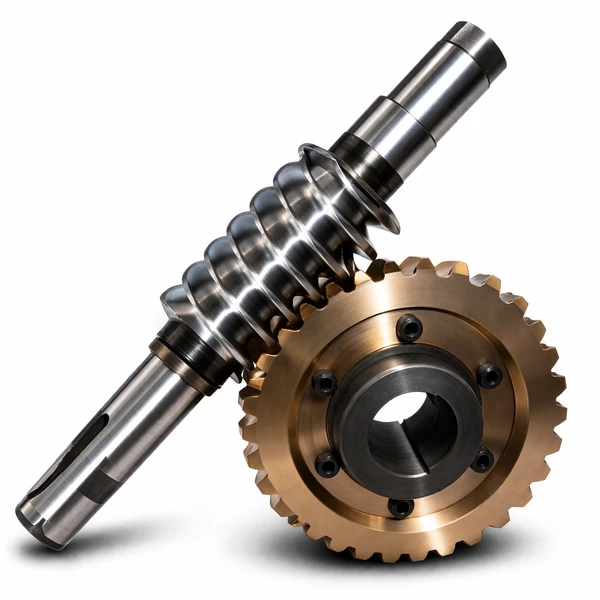
Schneckengetriebe Failure Diagnosis — Five Modes, How to Tell Them Apart, and What Each Means for Your Specification
A worm wheel that wore out in three months and one that lasted five years can look almost identical at first inspection. The difference is in the failure mode — and the failure mode tells you exactly what the specification got wrong.
① Abrasive Wear
② Adhesive Scuffing
③ Pitting Fatigue
④ Tooth Fracture
⑤ Corrosive Wear
Why Worm Gear Failures Are Different
Worm gear drives fail differently from other gear types, and the difference matters for diagnosis. In a worm gear drive, the fundamental asymmetry of the mesh creates a failure hierarchy: almost every failure mode expresses itself primarily or exclusively in the worm wheel tooth flank, not the worm shaft thread.
The reason is sliding contact mechanics. The worm thread slides along the wheel tooth face across the full face width on every revolution — the sliding distance per revolution at the mesh contact is orders of magnitude higher than in any equivalent-ratio helical gear pair. In a correct pairing, the wheel tooth face wears slowly and controllably. When either material or lubrication is wrong, the sliding contact becomes an adhesive or abrasive mechanism that produces a specific, identifiable damage pattern. Reading that pattern correctly is the first step in writing a corrected specification.
Before disassembling a failed gear set, record: (1) the oil colour and any metallic odour from the drain plug; (2) the housing temperature at shutdown; (3) the operating history (continuous or intermittent, any unusual loads or events); (4) the time from installation to failure. These four data points often narrow the failure mode to one or two candidates before you have even seen the tooth flanks.
Five Failure Modes — Identification, Cause, and Remedy
1
Failure Mode 01
Abrasive Wear — The Slow Erosion
Progressive · Controllable
👁 What You See
- 👁Uniform material removal across tooth flank — not random
- 👁Fine grooves or scratches running parallel to the sliding direction (tooth profile direction)
- 👁Smooth, matte surface texture — no sharp edges or crater formations
- 👁Metallic grey/brown powder in drained oil
⚠ Root Causes
- ⚠Hard contamination particles in lubricant (metal debris, casting sand, external grit)
- ⚠Inadequate hardness differential — shaft and wheel materials too close in hardness
- ⚠Running-in debris not removed at first oil change
- ⚠Lubricant viscosity too low — inadequate film thickness
✓ Specification Remedy
- ✓Inspect and replace shaft seal; install oil filler with breather filter
- ✓Change oil at 50–100 hours after installation — do not skip this step
- ✓Verify shaft hardness by testing, not just datasheet
- ✓Upgrade to next shaft hardness level if differential is insufficient
⚙ Key diagnostic tell: Abrasive wear produces smooth directional grooves. Run your fingernail across the surface — smooth in one direction, rough in the other. If the damage looks smooth, progressive, and uniformly distributed, contamination or hardness differential is the cause — not loading or lubrication chemistry.
2
Failure Mode 02
Adhesive Scuffing — The Sudden Seizure
Rapid · Often Catastrophic
👁 What You See
- 👁Torn, pulled, or smeared metal areas on tooth flanks — not smooth grooves
- 👁Metal transfer patches: material from one surface deposited on the other
- 👁Rough, irregular surface texture with torn edges — opposite of abrasive wear
- 👁Blue/brown heat discolouration on shaft thread flanks (temper colours)
- 👁Oil smells burned; may be darkened or with metallic sheen
⚠ Root Causes
- ⚠Lubricant film breakdown — flash temperature at contact point exceeds adhesion threshold
- ⚠Wrong lubricant: EP-additive oil attacking bronze; NSF H1 without adequate viscosity
- ⚠Severe thermal overload — oil viscosity collapsed
- ⚠Oil level too low — intermittent lubrication starvation during mesh rotation
✓ Specification Remedy
- ✓Check and correct oil level immediately — scuffing can initiate in seconds at low oil
- ✓Verify lubricant is non-EP (no sulfur-based EP additives with bronze wheel)
- ✓Calculate thermal equilibrium temperature — if above lubricant spec, specify PAO or improve cooling
- ✓For NSF H1 applications: verify sliding velocity below 4 m/s
⚙ Key diagnostic tell: Scuffing damage looks violent — torn and pulled metal, not polished. If you find heat discolouration on the shaft thread, thermal scuffing is confirmed. If no heat discolouration but still torn metal, lubricant chemistry (EP additive on bronze) or oil starvation is more likely.
3
Failure Mode 03
Pitting Fatigue — The Surface Crater Problem
Progressive · Load-Limited
👁 What You See
- 👁Small, hemispherical craters on tooth flank — typically 0.5–3 mm diameter
- 👁Sharp crater edges (vs smooth edges of abrasive wear)
- 👁Craters concentrated in the pitch line area of the tooth face — maximum Hertz contact stress zone
- 👁Progressive: early pitting shows isolated craters; advanced pitting shows merged craters
- 👁Metallic chips in oil, sometimes angular (fracture debris, not wear particles)
⚠ Root Causes
- ⚠Contact stress exceeding material surface fatigue limit — overload, underspecified module
- ⚠Repeated impact loading (DOL motor starts, cyclic shock) initiating sub-surface cracks
- ⚠Material inclusions in wheel alloy — non-metallic inclusions act as stress concentration sites
- ⚠Inadequate contact pattern (point contact vs line contact) — concentrates load on small area
✓ Specification Remedy
- ✓Increase module size — reduces contact Hertz stress; typically one step up is sufficient
- ✓Switch to ZCuAl10Fe3 bronze if shock loading is the cause — higher yield strength
- ✓Verify contact pattern ≥ 70% face width — poor contact concentrates load and accelerates pitting
- ✓Add soft-start motor controller to eliminate impulse overload at motor start
⚙ Distinguishing pitting from abrasive wear: Run your fingernail across the damaged surface. Abrasive wear has directional grooves — smooth in one direction. Pitting craters feel rough in all directions and have sharp edges. This 5-second tactile test is more reliable than visual inspection alone on a dirty, oil-contaminated wheel.
4
Failure Mode 04
Tooth Fracture — The Sudden Catastrophic Failure
Sudden · Catastrophic
👁 What You See
- 👁One or more complete teeth missing from wheel; broken pieces in oil pan
- 👁Fracture surface has two zones: smooth ‘fatigue’ zone and rough, granular ‘final fracture’ zone
- 👁Beach marks (concentric curved lines) on fatigue zone — indicate cyclic crack growth
- 👁Sudden: no preceding gradual noise increase; drive locks or vibrates violently
- 👁Drive may jam from tooth fragments
⚠ Root Causes
- ⚠Severe single-event overload exceeding bending yield strength at tooth root
- ⚠Bending fatigue from repeated loading at or near yield — crack initiates at root fillet and propagates
- ⚠Advanced pitting that extended to tooth root — pitting craters provide stress concentration
- ⚠Case-core interface fracture: carburized shaft case too thin, fractures at interface under high bending
✓ Specification Remedy
- ✓For single-event overload: identify and eliminate overload source before replacing gear
- ✓For bending fatigue: increase module; ZCuAl10Fe3 has superior bending fatigue resistance
- ✓For shaft case fracture: specify SCM415 with post-carburize case depth verification ≥ 0.8 mm
- ✓Inspect all remaining wheel teeth for early fatigue marks before reassembly
⚙ Investigate before replacing: Look at the fracture surface. A large smooth zone with beach marks = fatigue crack growth over many cycles = the drive was overloaded repeatedly. A nearly all-granular fracture surface with no smooth zone = single overload event — find what caused the sudden excessive torque before ordering replacement.
5
Failure Mode 05
Corrosive Wear — The Chemical Attack
Progressive · Chemistry-Dependent
👁 What You See
- 👁Dark brown, black, or green staining on tooth flanks
- 👁Pitting that follows grain boundary structure of the wheel alloy (intergranular attack)
- 👁Deposits of corrosion product in oil — green = copper compounds from bronze attack
- 👁Accelerated attack at crevices, keyways, and areas of oil stagnation
- 👁Oil discoloured dark green-black with visible metallic deposits
⚠ Root Causes
- ⚠EP-additive gear oil reacting with copper in bronze wheel (copper sulfide formation)
- ⚠Water ingress through damaged seal — forms electrolyte for galvanic corrosion
- ⚠Wrong stainless grade for environment (SS304 in chloride environment)
- ⚠Lubricant oxidation from overheating — degraded oil becomes acidic
✓ Specification Remedy
- ✓Immediately replace EP-additive oil with worm-gear-specific non-EP oil (‘yellow metal compatible’)
- ✓Inspect and replace shaft seal; identify water ingress path
- ✓For marine/food environments: upgrade to SS316 shaft and appropriate wheel material
- ✓Drain oil and check for green deposits — if present, corrosive attack has been active
⚙ The EP oil test: If you drain the oil and it has a green tint or visible green-black deposits, EP additive attack on the bronze is almost certainly the cause. The copper sulfide reaction products are distinctly green. Confirm by checking the oil specification — if it contains sulfur-based EP additives and the wheel is tin bronze or manganese brass, corrosive attack is confirmed.
Oil Analysis as an Early Warning System
Every worm gear failure mode produces a distinctive oil contamination signature before it reaches visible tooth damage. Oil analysis — periodic sampling and particle count testing — is the most cost-effective diagnostic tool available for worm drives in continuous service.
Elevated copper particles + fine iron
Abrasive wear in progress. Contamination is accelerating wheel material removal. Change oil, check seal, verify shaft hardness.
Sudden copper particle spike + oil darkening
Scuffing event has occurred or is occurring. Stop the drive immediately. Inspect tooth flanks before resuming operation.
Angular metallic chips (>100 µm) appearing
Pitting craters producing fracture chips. Overload or contact pattern issue. Inspect tooth flanks at next maintenance window — do not wait.
Green colour / increased acid number
Corrosive attack active. Change oil immediately regardless of interval. Verify lubricant specification — almost certainly EP-additive contamination or water ingress.
Rapid Triage — Matching Symptom to Failure Mode
| Observation at Inspection |
Wahrscheinlichster Fehlermodus |
Dringlichkeit |
Erste Überprüfung |
| Smooth directional grooves on tooth face |
Abrasive wear |
Medium |
Check oil for metallic debris; inspect shaft seal |
| Torn, pulled metal; rough irregular surface |
Adhesive scuffing |
⚠ High — stop drive |
Check oil level; check lubricant for EP additives; check housing temperature |
| Small sharp-edged craters at pitch line |
Pitting fatigue |
Medium |
Verify contact pattern; check for shock loads in operating history |
| Missing tooth / broken tooth fragment |
Tooth fracture |
⚠ High — replace before run |
Inspect fracture surface for fatigue beach marks vs overload; remove all fragments |
| Green/black staining; intergranular texture |
Corrosive wear |
Medium |
Drain oil and check for green deposits; verify lubricant specification |
| Zunehmender Lärmpegel über Wochen |
Abrasive wear or advanced pitting |
Lower urgency |
Oil sample analysis; plan inspection within next 200 operating hours |
| Sudden noise with vibration; no prior warning |
Tooth fracture or severe scuffing |
⚠ High — stop immediately |
Do not attempt restart; inspect for fragments before any test run |
| Drive runs hot but looks undamaged visually |
Thermal overload — pre-scuffing |
⚠ High — intervene now |
Check lubricant viscosity grade vs operating temperature; consider multi-start efficiency improvement |
Never restart a drive after tooth fracture without removing all fragments. A single bronze tooth fragment in the housing will circulate in the oil, score both tooth flanks of all remaining wheel teeth, and initiate abrasive wear that produces more fragments. After tooth fracture, fully flush the housing, replace the oil, and run at 20% load for 30 minutes while monitoring housing temperature before returning to full load.
Korea Ever-Power Produkte
Replacement Worm Gears — Specified to Prevent Repeat Failure

Replacement · Documentation Included
Schneckenradsatz aus legiertem Stahl
For the replacement of failed worm gear sets in industrial conveyor, agricultural, and automation drives, the key requirement is documented hardness — not just a material designation. A replacement shaft that is nominally 40Cr but has not been adequately through-hardened will reproduce the abrasive wear or scuffing failure that destroyed the original. Korea Ever-Power includes a hardness measurement certificate (Rockwell HRC, measured at 3 points along the thread zone) with every alloy steel worm shaft — not relying on heat treatment process records alone. The ZCuSn10Pb1 wheel includes material composition certificate confirming tin content, lead content, and copper content to the GB/T 1176 standard. When ordering to replace a failed gear set, provide the failure description and we confirm whether the original specification was adequate or recommend an upgrade to prevent recurrence.
Spezifikation ansehen / anfordern →
Contact Pattern Verified · Replacement
Cylindrical Worm Wheel — Replacement Supply
When the failure analysis shows premature pitting fatigue — particularly craters concentrated in a narrow band at the pitch line rather than distributed across the tooth face — the root cause is frequently poor contact pattern rather than overload. Point contact from a mismatched hobbing cutter concentrates the full tooth load on a fraction of the face width, raising the Hertz contact stress to 3–5× the nominal design value. Korea Ever-Power precision-hobs replacement worm wheels with a cutter profile matched to your specific worm geometry (provide the worm shaft lead, module, and pitch diameter), then tests the contact pattern on an assembly rig before shipment. Contact coverage percentage is photographed and included in the delivery documentation.
Spezifikation ansehen / anfordern →
Custom · Failure Analysis Support
Failure-Driven Specification Review
For applications with a history of repeated worm gear failures where the root cause has not been definitively identified, Korea Ever-Power offers a specification review based on your failure description. Send us: the failed gear set dimensions (or the original order specification), photographs of the failed tooth surfaces, the oil specification currently used, the operating temperature range, the duty cycle (hours per day, starting frequency), and any unusual operating events that preceded failure. We identify the most probable failure mode from your description, check the original specification against the duty conditions, and provide a written specification recommendation for the replacement that addresses the identified root cause. This service is available at no charge for replacement orders and for serious enquiries from engineers specifying new machines on similar duty.
Spezifikation ansehen / anfordern →
Failure Diagnosis FAQ
Worm Gear Failure — Questions from Maintenance and Design Engineers
My worm wheel wears visibly every year and needs replacement. Is this normal, and how do I know if I’m getting acceptable wear life?+
Annual visible wear is not normal for a correctly specified worm gear set in normal industrial duty. A properly specified and lubricated set should exhibit measurable tooth flank wear of approximately 0.01–0.03 mm over 5,000 operating hours — typically years rather than months before replacement is required. If you are replacing the wheel annually, one or more specification parameters is wrong: hardness differential, lubricant type, lubricant contamination, or overloading. The correct approach is not to accept annual replacement as normal maintenance but to identify the accelerated wear mechanism and correct it — wear particle count in oil samples at 500-hour intervals will show whether the wear rate is stable (acceptable) or increasing (problem requiring intervention).
How do I distinguish between the worm shaft and worm wheel being the source of damage if both show wear marks?+
In a correctly specified drive, the shaft is always the harder surface and the wheel is the wearing surface. Wear marks on the shaft thread flanks are abnormal and indicate either (a) abrasive contamination abrading both surfaces simultaneously, or (b) hardness differential reversal — the shaft has not been adequately hardened. Check shaft hardness with a portable Rockwell tester. If the shaft is below specification hardness, hardness differential failure is confirmed. The shaft damage will typically show directional wear marks parallel to the thread helix, while wheel damage shows marks parallel to the tooth face sliding direction.
Can a worm gear drive recover from early pitting if the operating conditions are improved?+
Sometimes, but the conditions for recovery are specific. Early pitting — isolated craters not yet merged, no craters deeper than approximately 0.5 mm, confined to the pitch line area — can stabilise if the load is reduced to below the Hertz fatigue limit. In practice, this means reducing torque to approximately 60–70% of the value that caused pitting. More commonly, early pitting provides the crack initiation sites for progressive pitting fatigue, and the pitting rate accelerates. If pitting is detected early during a scheduled oil analysis review, use the opportunity to plan a gear replacement before the next maintenance interval — do not wait for pitting to become a tooth fracture event.
What is the correct oil to use for a worm gear drive, and why does this come up so often in failure analysis?+
The correct oil is an ISO VG 220–460 mineral gear oil or synthetic PAO oil specifically described as ‘suitable for worm gears,’ ‘bronze compatible,’ or ‘suitable for yellow metals.’ These designations confirm the formulation does not include sulfur-based Extreme Pressure (EP) additives — which react with the copper content of bronze and brass worm wheels to form copper sulfide corrosion products. This issue appears so often in failure analysis because standard industrial gear oil — the oil in the maintenance store for the helical gear trains on the same production line — typically contains sulfur-based EP additives and is entirely appropriate for helical gears. Maintenance personnel who refill a worm gear drive from the same container they use for helical gear reducers introduce EP additives that begin corrosive attack on the bronze wheel. Always label worm gear drives clearly with the specific oil specification required.
Is it safe to continue running a drive that I suspect has early scuffing? How quickly does scuffing progress?+
Do not continue running a drive with suspected active scuffing. Scuffing is a thermally-activated adhesive mechanism with a positive feedback character — each scuffing event increases surface roughness, which increases local temperature in subsequent mesh contacts, which makes further scuffing easier. The progression from initial scuffing marks to catastrophic failure can be hours to days depending on load, speed, and lubricant condition. Stop the drive, check oil level, drain oil and inspect for torn metallic debris, check housing temperature. If the oil showed significant metallic debris or the housing is hot, do not restart until the tooth flanks are inspected and the root cause identified.
What is the difference between pitting caused by overload and pitting caused by poor contact pattern?+
The distribution of the pitting craters tells the story. Overload-driven pitting tends to be distributed across the contact band of most or all teeth, with approximately uniform crater density — the load is distributed across all teeth, and all teeth are equally stressed above the fatigue limit. Poor contact pattern-driven pitting, by contrast, is concentrated in a narrow band corresponding to the actual contact zone (which is narrower than the design contact zone), and may be particularly severe on the entry side of the tooth face. If you see pitting in a band narrower than half the tooth face width, contact pattern is the likely contributor even if overload is also present.
After a tooth fracture failure, what checks should I do on the replacement gear set before returning the machine to production?+
Before and during startup after tooth fracture replacement: (1) Thoroughly flush the housing with clean oil and drain — do not simply top up; (2) Inspect the worm shaft thread visually for scoring from impact or circulating fragments — if the shaft shows significant thread damage, replace the shaft too; (3) At reassembly, manually rotate the gear set through several full wheel rotations and confirm no metallic contact noise; (4) Fill with fresh oil to the correct level; (5) Start at 20% load and hold for 30 minutes while monitoring housing temperature; (6) Increase to 50% load for 1 hour, check temperature again; (7) Confirm full load operation for 2 hours before returning to production.
My worm gear drive makes a noise that gets louder when the ambient temperature drops (winter mornings). Is this a failure mode?+
This is almost certainly a lubricant viscosity problem, not a mechanical failure mode. At low ambient temperatures, standard mineral gear oil viscosity increases dramatically — ISO VG 460 mineral oil at 5°C may have a viscosity 5–8× higher than at operating temperature. This high-viscosity cold oil creates significant viscous drag as the worm thread churns through it, and the uneven resistance produces noise and vibration. If the noise resolves within 10–20 minutes of running as the oil warms up, the gears themselves are not damaged. Switch to synthetic PAO ISO VG 220 which remains more fluid at low temperatures. If the noise does not resolve as the drive warms up, or if it has been getting progressively louder over weeks regardless of temperature, investigate for abrasive wear or early pitting.
Replace a Failed Gear Set with the Right Specification
Describe the failure mode you observed. Korea Ever-Power identifies the specification change that prevents recurrence and provides a replacement set with documented hardness, contact pattern, and material certificates — so the investigation is complete before the next failure cycle starts.
Herausgeber: Cxm