Worm Gear vs Helical Gear — Which Drive Type Is Right for Your Application?
Both gear types are used in industrial drives worldwide. Choosing the wrong one costs money — not immediately, but over months of operation as motor bills, heat problems, or inadequate self-locking reveal the mismatch between specification and application. This guide gives you the data to make the right choice the first time.
The Actual Cost of Selecting the Wrong Gear Type
A conveyor system builder in Incheon specified a helical gear reducer for a 40:1 reduction application primarily because the procurement team was more familiar with helical gear suppliers. Six months after installation, they were dealing with two problems simultaneously: the motor was running hot because they had not accounted for the efficiency advantage that justified helical gear selection at that ratio, and the conveyor was creeping backwards when the motor was off because helical gears at 40:1 do not self-lock. A separate electromagnetic brake had to be designed and retrofitted to every drive in the system.
The moral is not that helical gears are bad choices for conveyors — they are often excellent choices. The moral is that the selection process relied on familiarity with a product rather than on the specific requirements of the application. The wrong gear type was chosen because nobody asked the three questions that determine the correct answer: What is the required ratio? Is self-locking required? What shaft layout does the machine need? Answering these three questions before selecting a gear type prevents the kind of expensive retrofit that this conveyor builder experienced.
This guide answers those questions systematically, with data and specific scenarios, for engineers choosing between worm gear and helical gear drives. Worm gear sets from Korea Ever-Power cover the full range of applications where worm drives are the technically correct choice.
One Fundamental Difference That Explains Everything Else
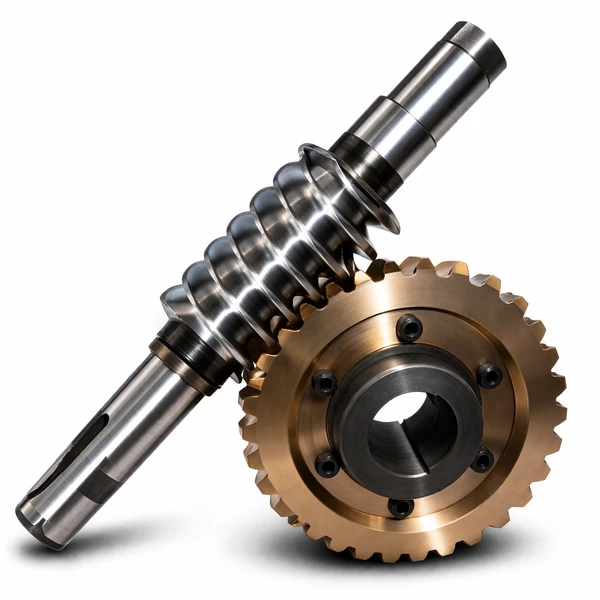
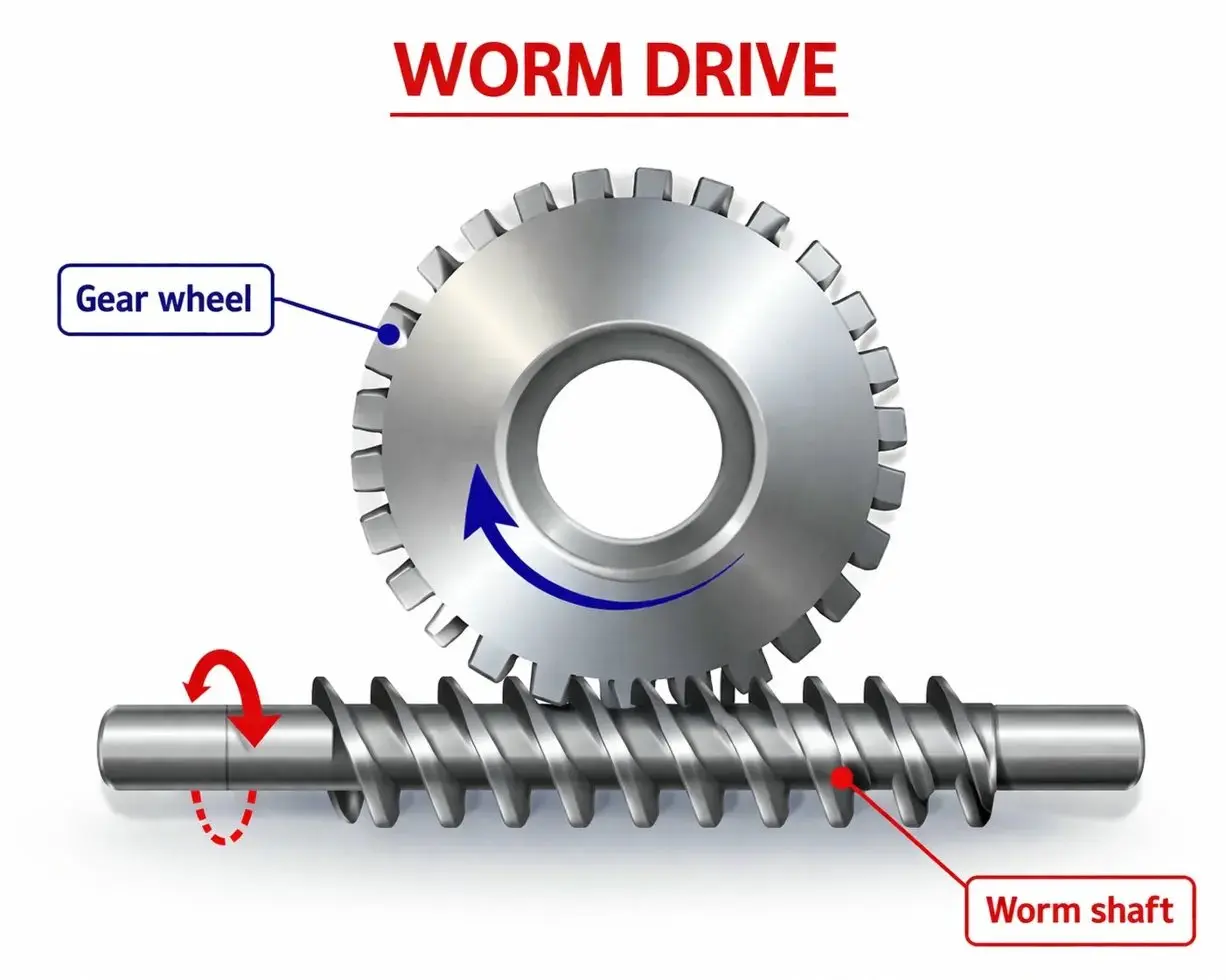
The difference between worm gear and helical gear drives at the tooth mesh contact is not a matter of degree — it is a matter of kind. Helical gears transmit force through rolling contact: the tooth surfaces roll against each other as the gears rotate, with sliding velocity near the pitch point theoretically zero and increasing toward the tooth tip and root. Worm gears transmit force through sliding contact: the worm thread surface slides across the wheel tooth face continuously, at velocities from 0.5 to 15 m/s depending on the application.
This single mechanical difference — rolling vs sliding — is the source of every other performance distinction between the two gear types. Sliding contact generates more friction than rolling contact at the same load → worm drives are less efficient and run hotter. Sliding contact between mismatched materials causes less wear than sliding between identical materials → worm drives require a bronze wheel against a steel worm, while helical gears can use steel against steel. The geometry of the sliding contact at the worm mesh creates a force component that resists reverse rotation → worm drives self-lock at appropriate lead angles, helical gears do not. None of these properties are design choices; they all follow from the fundamental contact mechanics.
Efficiency — The Numbers Are Honest, Not Marketing
Helical gear efficiency in a properly designed and lubricated drive is typically 97–99% per reduction stage. For a two-stage helical gearbox achieving 40:1, total efficiency is approximately 94–98%. These numbers reflect the rolling contact mechanics — very little energy is lost to friction.
Worm gear efficiency at the same 40:1 ratio is approximately 72–82%, depending on lead angle, surface finish, lubricant, and worm material. This reflects the sliding contact — the same geometric reason that enables self-locking also generates friction losses. The difference of 15–25 percentage points in efficiency sounds modest in percentage terms but has real consequences in continuous-duty applications.
Worked Example — Efficiency Cost Over One Year
Application: continuous 24-hour conveyor drive, 40:1 ratio, 5.5 kW mechanical output requirement.
■ Helical gearbox at 96% efficiency: required motor input = 5.5 ÷ 0.96 = 5.73 kW
■ Worm gear drive at 78% efficiency: required motor input = 5.5 ÷ 0.78 = 7.05 kW
Difference: 1.32 kW additional power consumption continuously
At 0.10 USD/kWh for 8,000 annual operating hours: 1,056 USD additional energy cost per year, per drive. On a 20-drive conveyor system, this is 21,120 USD/year. The worm drive system costs more to run by the price of a mid-size conveyor gearbox every single year.
This example is precisely why specifying a worm drive for a continuous-duty high-power conveyor purely because it achieves 40:1 in one stage is an expensive mistake. A two-stage helical planetary gearbox achieves 40:1 at 96% efficiency. The second stage adds size and cost, but those are typically recovered in energy savings within 18 months on a continuous-duty 5 kW drive. The worm drive is the correct choice here only if space for a two-stage unit is not available, or if self-locking is a non-negotiable requirement that overrides the energy cost.
Ratio Range — Where Worm Gears Win Without Argument
A single-stage helical gear pair achieves a practical reduction ratio of 3:1 to 10:1 with reasonable efficiency and tooth geometry. Above 10:1, the size mismatch between the large wheel and small pinion becomes awkward — the large wheel grows in proportion to the ratio while the pinion must remain small enough for adequate tooth strength, making the gearbox increasingly large and unbalanced. Two-stage helical gearboxes extend the practical range to 50:1 to 100:1, but require the footprint for two reduction stages.
A single-stage worm gear set achieves 5:1 to 300:1 in a single stage with a compact right-angle layout that is entirely independent of the ratio magnitude. A 100:1 worm gear set occupies essentially the same housing volume as a 20:1 set at the same module — the ratio changes only the wheel tooth count, not the physical scale. For any application requiring a reduction above 30:1 in a single stage, the worm gear is the compact solution. For ratios above 60:1 in a single stage, the worm gear has no practical competitor in mainstream mechanical drive technology.
| Ratio Required | Single-Stage Helical | Single-Stage Worm | Verdict |
|---|---|---|---|
| 3:1 to 8:1 | Yes — standard design | Possible but inefficient — lead angle is steep | Helical gear preferred unless 90° layout needed |
| 10:1 to 20:1 | Possible — pinion becomes small | Yes — efficient range, self-locking begins | Either type — depends on layout and self-locking need |
| 25:1 to 60:1 | Requires two stages | Yes — single stage, compact, self-locking reliable | Worm gear — unless high power efficiency is critical |
| Above 60:1 | Three stages required | Yes — single stage to 300:1 | Worm gear — no practical single-stage alternative |
Self-Locking — The Requirement That Settles Many Selection Debates Immediately
If the application requires the driven load to hold position when the motor is de-energized — without a separate brake, without motor holding current, without a ratchet mechanism — the selection debate between worm and helical is often over immediately. Helical gears do not self-lock. Their rolling contact, high efficiency, and symmetric tooth profile mean that any torque applied to the output shaft will back-drive the gearbox through to the motor with minimal friction resistance. A helical drive holding a load at rest requires motor holding torque or a separate brake.
A single-start worm drive at ratios above approximately 15:1–20:1, with appropriate lubrication, will self-lock under the majority of industrial operating conditions. This property directly serves several application categories:
Manual hoists and overhead lifting: releasing the hand chain must not allow the suspended load to lower uncontrolled. Worm drive self-locking provides this safety without any additional mechanical brake on manual hoists with ratios above 20:1.
Solar tracker drives: when the motor is off (night, maintenance, power outage), the wind load on the panel array must not rotate the tracker to an uncontrolled position. Self-locking prevents this without motor holding current — an important energy and safety consideration on utility-scale installations.
Medical positioning tables and robotic joints: the load position must be maintained if power is lost without causing the table or arm to fall under gravity. Self-locking provides this safety as a mechanical property, independent of the control system state.
Agricultural implement depth and row-spacing adjustment: the implement position must hold against field vibration and soil resistance loads without holding current from a battery-powered controller. Self-locking ensures position retention regardless of controller state.
Korea Ever-Power Manufacturing
 |
 |
 |
 |
Noise and Vibration — A Surprising Advantage for Worm Drives
Engineers accustomed to thinking of worm drives as inefficient and thermally demanding are sometimes surprised to learn that they typically produce less mesh noise than helical gears at equivalent power levels. The reason is the same sliding contact that causes the efficiency loss: the continuous sliding between worm thread and wheel tooth keeps multiple load-sharing contacts active throughout each rotation, averaging out the transmission error that generates noise peaks.
In a helical gear set, each tooth engagement involves a loading cycle — the tooth comes into contact, bends slightly under load, then exits contact and springs back. Even in a well-made helical gear, this loading-unloading cycle generates a small force impulse at the mesh frequency that propagates as noise and vibration through the housing. At high rotational speeds, this mesh frequency can enter the audible range and produce a characteristic gear whine.
Worm gear mesh noise, by contrast, is generally characterized as a smooth hum rather than a tonal whine, and its amplitude is typically 3–8 dB lower than a comparable helical gear set at the same peripheral velocity. For applications in noise-sensitive environments — food processing areas, office building HVAC systems, medical facilities, consumer appliances — this acoustic advantage is a legitimate selection factor in favor of the worm drive, independent of ratio and efficiency considerations.
Shaft Layout and Packaging — The 90-Degree Constraint
Both gear types have a preferred shaft arrangement that follows from their geometry. Helical gears are optimized for parallel-shaft configurations — both input and output shafts run in the same direction, at a center distance set by the gear pitch radii. Crossed-helical configurations (helical gears on 90-degree crossing shafts) are possible but produce only point contact and are limited to light-load applications.
Worm gear drives are designed specifically for 90-degree shaft crossing — this is not a limitation, it is a geometry that enables the right-angle drive arrangement that many machine designs require. When a machine layout demands that the motor and the output shaft run at 90 degrees to each other, a worm drive accomplishes this in a single stage, at high ratio, with self-locking, in a compact housing. A helical gear equivalent requires a bevel gear stage to achieve the angle change, plus one or more additional helical stages for the ratio — larger, more complex, and more expensive.
The practical implication: in machine tool rotary table drives, solar tracker drives, agricultural implement drives, conveyor corner drives, and any mechanical system where the motor and driven shaft need to be perpendicular — the worm drive is architecturally correct in a way that helical gears simply are not without adding complexity.
Side-by-Side Comparison — 12 Factors That Determine the Correct Choice
| Factor | Worm Gear | Helical Gear |
|---|---|---|
| Contact type | Sliding — worm thread slides across wheel tooth | Rolling — teeth roll against each other |
| Single-stage efficiency | 60–90% (lower at high ratio) | 95–99% |
| Single-stage ratio range | 5:1 to 300:1 | 3:1 to 10:1 (practical limit for single stage) |
| Self-locking | Yes — at ratios above ~15:1 with standard lubrication | No — external brake required to hold load |
| Shaft angle | 90° (standard) — right-angle drive | Parallel shafts — inline drive |
| Noise level | Low — smooth hum, 3–8 dB quieter than helical at same speed | Moderate — mesh frequency tone at higher speeds |
| Heat generation | High — friction losses convert to heat; thermal rating often limits power | Low — minimal heat generation even at full rated load |
| Wheel material | Bronze required (sliding contact demands dissimilar materials) | Steel on steel acceptable (rolling contact) |
| Power density (kW per kg) | Lower — bronze wheel and sliding mechanics limit load per unit size | Higher — rolling contact and hardened steel allow higher load |
| Compact single-stage packaging above 30:1 | Yes — ratio increase adds only wheel teeth, not stages | No — requires multiple stages for high ratio |
| Backlash adjustment capability | Yes — duplex worm allows backlash restoration without replacement | Limited — requires bearing adjustment or shims |
| Best continuous-duty application | High-ratio right-angle drives; self-locking required; noise sensitive | High-efficiency continuous drives; parallel shaft; high power density |
Seven Real Scenarios — With a Clear Verdict on Each
Scenario 1 — CNC Fourth-Axis Rotary Table
Requirements: 40:1 ratio, right-angle layout, DIN6–DIN7 accuracy, self-locking for powered-off position hold, compact package inside the rotary table housing
Verdict: Worm gear. The combination of right-angle layout, high ratio in a single stage, self-locking position hold, and compact packaging cannot be achieved with a helical gear in the same envelope. A two-stage helical planetary could achieve the ratio but would require a separate brake and would not fit in the rotary table housing without extensive redesign. The worm gear’s efficiency loss at 40:1 (approximately 5–8 watts on a typical table servo motor) is inconsequential compared to the design simplicity.
Scenario 2 — 18.5 kW Continuous Paper Machine Roll Drive
Requirements: 15:1 ratio, parallel shaft layout, 18.5 kW continuous, 24/7 operation, maximum energy efficiency, no self-locking requirement
Verdict: Helical gear. At 15:1 ratio and 18.5 kW continuous on a parallel shaft, the worm drive would consume approximately 3.7 kW additional power relative to a 98% efficient helical gearbox (worm at 80% efficiency = 4.6 kW loss vs 0.37 kW loss for helical). Over 8,000 annual hours at 0.10 USD/kWh, that is 3,328 USD per year in avoidable energy cost — and a thermally stressed gearbox that needs more cooling. There is no design benefit to the worm gear here. Use a helical gear.
Scenario 3 — Solar Tracker Azimuth Drive
Requirements: 80:1 ratio, right-angle layout, self-locking to resist wind loads when motor is off, outdoor 25-year service life
Verdict: Worm gear. A single-stage 80:1 worm drive in a compact right-angle housing with verified self-locking at site temperature extremes is the only viable solution. A helical gear alternative at 80:1 would require three stages, a separate brake system for wind load holding, and a more complex housing — all for 5–10% better efficiency on a drive that operates at very low power (0.2–2 kW typical for a tracker row). The efficiency premium is not worth the added complexity and cost.
Scenario 4 — Electric Vehicle Auxiliary Motor Drive
Requirements: 8:1 ratio, parallel shaft preferred, maximum efficiency (battery range impact), high cycle count, 15-year automotive service life
Verdict: Helical gear. In battery electric applications, every percentage point of drivetrain efficiency directly translates to vehicle range. A worm gear at 8:1 achieves approximately 88–92% efficiency — already lower than a helical gear’s 97–99%. For an auxiliary motor drawing 3 kW peak, that 7–10% efficiency difference translates to longer battery discharge on every duty cycle. Helical planetary gearsets dominate EV auxiliary drive design for exactly this reason.
Scenario 5 — Manual Chain Hoist, 1 Ton Capacity
Requirements: 30:1 ratio, compact housing, self-locking to prevent load drop when operator releases the chain, right-angle chain input to vertical lift output
Verdict: Worm gear. Manual hoist design is one of the oldest and most validated applications for worm drives. Self-locking at 30:1 is reliable and provides the primary load-holding safety function. A helical gear equivalent at 30:1 in a single stage is mechanically impractical, and adding a ratchet or brake mechanism to a helical multi-stage design adds cost, weight, and potential failure modes. The worm hoist has been the standard design for over a century because the application requirements match the worm gear’s properties precisely.
Scenario 6 — Precision Packaging Machine Feed Drive
Requirements: 20:1 ratio, parallel shaft preferred, low backlash, frequent start-stop cycles at 60 cycles/minute, moderate power 1.5 kW, noise-sensitive production floor
Verdict: Depends on layout constraint. At 20:1 and 1.5 kW with frequent start-stop, the worm drive’s self-locking could actually interfere with smooth start-stop motion if the inertial energy regeneration during deceleration needs to feed back through the gearbox. Helical planetary at 20:1 is available, efficient, and handles regenerative energy properly. However, if the machine layout requires a right-angle arrangement, the worm gear remains the compact single-stage answer — at 1.5 kW, the efficiency difference costs approximately 60–90 USD/year at typical Korean industrial electricity prices, which most system designers would accept for the layout simplicity.
Scenario 7 — Medical Patient Positioning Table Lift Drive
Requirements: 50:1 ratio, right-angle layout, self-locking must hold patient weight when power is cut, stainless steel for cleanroom compatibility, very quiet operation
Verdict: Worm gear — strongly preferred. This is a case where four worm gear properties align simultaneously with the application: high ratio (50:1) in single stage, right-angle shaft layout for the column drive geometry, self-locking as a safety-critical feature for patient protection, stainless steel availability for hygienic environments, and low noise for the medical facility environment. No helical gear alternative matches all four requirements simultaneously in a comparable package. SS316 worm gears with electropolished tooth flanks at DIN7 serve this application directly.

When the application analysis points to a worm drive, Korea Ever-Power manufactures the complete range from M1 to M12 in standard and custom configurations. For complete enclosed drive units, worm gear reducers are available as sealed ready-to-mount units with the same worm gear precision internally. For bare gear components, the full worm gear product range covers all standard modules and materials.

Frequently Asked Questions
Need Help Confirming the Right Drive Type for Your Application?
Send your required ratio, power level, shaft layout, and whether self-locking is a requirement. We will confirm whether a worm gear set is the right choice and provide a specification recommendation with pricing within one working day.
Editor: Cxm