The Hidden Cost of “Good Enough” Catalog Specification
When a machine designer selects a catalog worm gear set, the constraint is not the gear — it is the catalog. Standard catalogs cover ratios from 5:1 to 100:1 in discrete steps (typically 5, 7.5, 10, 15, 20, 25, 30, 40, 50, 60, 80, 100:1) at standard module sizes (M1, 1.25, 1.5, 2, 2.5, 3, 4, 5, 6, 8, 10). The nearest catalog ratio to a design requirement is rarely exact. The designer accepts the difference and moves on.
The hidden cost appears in service. A designer who required 25:1 but accepted 20:1 because it was in stock has a drive running 25% slower output than designed — the load requires proportionally more torque at this lower speed. If the original motor was sized for 25:1 efficiency and the accepted ratio has 8% lower efficiency at 20:1, the motor may be borderline undersized. In continuous operation, this is the difference between a drive that meets its thermal specification and one that runs 12–15°C hotter than designed, shortening lubricant life and approaching the scuffing threshold in summer operating conditions.
The correct framing for this decision: “Custom” does not mean “expensive” and “standard” does not mean “cheap.” The correct question is: what is the total cost of the specification over the product lifetime, including development time, replacement frequency, efficiency losses, and service disruption? A custom gear set that fits the application precisely and lasts 10 years is cheaper than a catalog set that misses the operating point and requires replacement every 3 years.
Four Levels of Customisation — Not a Binary Choice
The decision is not “catalog vs fully custom.” There are four meaningfully different levels of specification, with different cost, lead time, and technical implications. Most requirements that appear to be “custom” actually sit at Level 2 — a small modification to a standard product that carries almost none of the cost of full custom tooling.
The majority of “custom” requirements — non-standard bore diameter, non-standard keyway, metric-to-inch bore conversion, surface treatment change, left-hand thread — fall into Level 2 or Level 3. These carry no tooling cost and only modest lead time premium over catalog. The assumption that “any deviation from catalog = expensive custom” leads to unnecessary compromises that reduce machine performance for the full product lifetime.
What Catalog Constraints Actually Cost
| Catalog Limitation | Design Compromise | Hidden Operational Cost | Level 2/3 Solution |
|---|---|---|---|
| Nearest ratio is 8% from target | Output speed 8% low; motor torque 8% high | Motor overloading at thermal margin; potential efficiency loss | Level 3: Non-standard tooth count on standard hob |
| Bore sizes: 20, 25, 30 mm only | Shaft undersized or coupling bushing added | Coupling bushing = additional cost, alignment complication, failure point | Level 2: Custom bore diameter machined to H7 |
| Module M4 next above requirement | Oversized gear set, larger housing | Increased housing cost, weight, footprint — multiplied across production quantity | Level 3: Intermediate module on existing grinding equipment |
| No left-hand thread available | Machine layout requires redesign | Redesign engineering hours, prototype test cycle, delayed launch | Level 2/3: Left-hand thread on existing grinder, same module |
| Carbon steel only; need SS316 | Added corrosion protection system | Sealed housing, replacement coatings, shortened inspection interval | Level 3: SS316 shaft on existing grinding equipment |
| No documentation package | Internal test to confirm properties | In-house testing cost for each production batch; CE/HACCP documentation gaps | Level 2: Material certificate + CMM report added to standard order |
What Customisation Actually Costs — And When It Pays

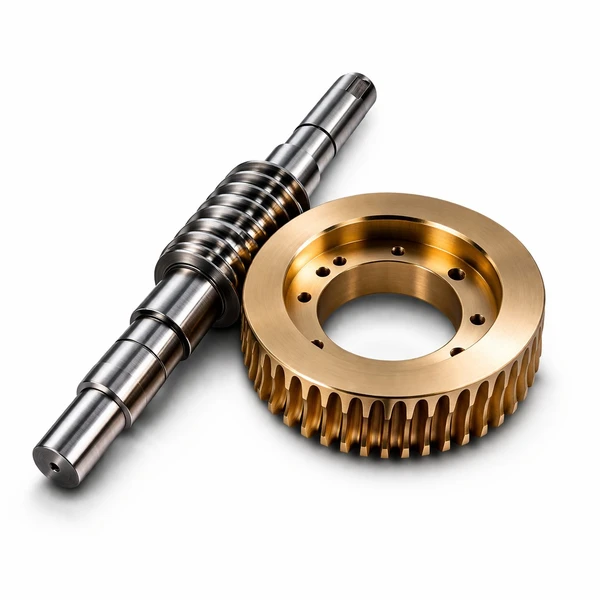
The cost components of a mukautettu matovaihde break down as: material premium, machining setup, tooling (if new tooling required), and inspection documentation.
- Level 2 modifications (custom bore, keyway, surface treatment): 15–30% additional cost per piece. No tooling amortisation.
- Level 3 semi-custom (non-standard ratio, non-standard material): 30–60% premium for small quantities, reducing to 15–25% at 50 pieces or above.
- Level 4 full custom (new module, unique profile): tooling costs amortised over committed order quantity. At 100 pieces the per-piece cost approaches Level 3 premium.
For production quantities — 20, 50, 100 machines — the leverage increases substantially because every adaptation cost, efficiency loss, and replacement cycle multiplies by the production quantity. A designer who specifies Level 3 custom for a production program of 100 machines saves the adaptation cost across the full run, and the efficiency loss savings compound annually across 100 operating drives.
IP Protection and NDA in Custom Worm Gear Supply
For machine builders and OEMs, a custom gear specification often carries intellectual property concerns. The gear geometry — particularly a non-standard ratio, unique pressure angle, or proprietary module — may be a design element that should not be available to competitors through the gear supplier’s standard catalog. This concern must be addressed before drawings are submitted.
Salassapitosopimus ennen piirustuksen lähettämistä
Korea Ever-Power executes NDAs before receiving any customer drawings or specifications. The NDA covers: gear geometry data, application descriptions, machine type identification, and production quantities. The NDA is executed by company signatory, not by individual engineer, and is retained permanently. This is a standard process for OEM supply programs — request NDA at initial enquiry, before any technical discussion involving drawings.
Part Number Confidentiality
Custom gear sets are assigned internal part numbers that correspond to the customer’s specification but do not reveal the machine application or customer identity. Production documentation, shipping labels, and packing lists use internal part numbers only. No application description or customer identification appears on any document that travels with the goods through the supply chain.
Exclusivity Agreements
For Level 4 fully custom specifications where the customer has paid tooling costs, exclusivity on the produced tooling is available by agreement — the tooling remains in Korea Ever-Power’s facility but is used exclusively for the customer’s orders and not shared with other customers. Tooling ownership can be assigned to the customer with transfer possible upon contract termination.
Supply Program Structures — Sample, Qualification, and Production
For OEM machine builders integrating a custom worm gear into a product line, the supply program follows three phases. Understanding the phase structure prevents the most common procurement problem: ordering production quantities before sample qualification is complete.
Minimum order quantity: Level 2 modified standard: minimum 5 pieces. Level 3 semi-custom: minimum 10 pieces. Level 4 full custom: minimum 20–50 pieces for tooling amortisation. Sample quantities of 1–3 pieces are available at all levels at sample pricing — always request sample pricing explicitly before production commitment.
Korea Ever-Power
Custom and Standard Worm Gear Products


OEM Specification FAQ
Custom Worm Gear Supply — Questions from Machine Builders and Procurement
Discuss Your Custom Worm Gear Requirement
Send your application parameters — ratio, module, bore, material, environment, quantity, and timeline. Korea Ever-Power returns a specification recommendation, customisation level classification, quotation, and lead time within one working day. NDA executed before drawing submission as standard process.
Toimittaja: Cxm