Guide d'ingénierie d'application

Worm Gear Drives in Robotics and Industrial Automation — Precision, Self-Locking, and the Backlash Specification

Why automation engineers choose worm gear drives despite their efficiency penalty — and the backlash, repeatability, and dynamic load specifications that determine whether the robot performs to its rated accuracy over its design lifecycle.

±0.03°
Angular repeatability
300:1
Max single-stage ratio
Self-lock
Safety function
DIN5
classe de précision
⚙ Korea Ever-Power Worm Gear Co., Ltd📍 Ansan-si, Gyeonggi-do, Corée📧 [email protected]

The Precision Paradox: Why Robots Use Worm Gears Despite Their Efficiency Penalty

Any mechanical engineer evaluating drive options for a robot joint will encounter an apparent contradiction: worm gear drives have mechanical efficiency of 50–75%, while helical gear trains achieve 92–96%. In energy-conscious automation design, this difference looks damning. Yet worm gear joints appear throughout industrial and surgical robotics, collaborative robot arms, SCARA systems, and automated positioning equipment. The reason is not that automation engineers overlook the efficiency penalty — it is that they are solving for a set of requirements where worm gear drives provide three properties that no other compact, single-stage gear type simultaneously delivers.

The first is self-locking behaviour. A robot joint that self-locks when the drive is de-energised does not require a brake to hold its position under gravity loading. This is a mechanical safety function that becomes critical in collaborative robot (cobot) applications under ISO/TS 15066, in surgical robots under CE MDR, and in any robotic application where the robot arm must hold a position after an emergency stop without relying on active braking. A mechanical self-lock is fail-safe; an electromechanical brake is fail-soft and adds mechanical complexity.
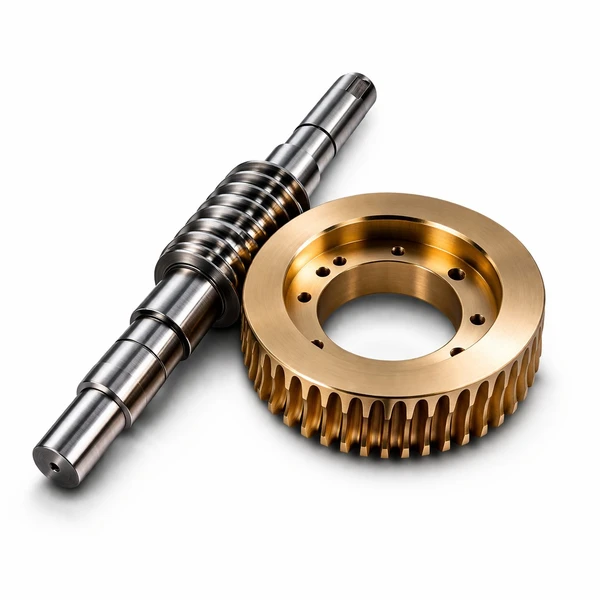
vis sans fin et roue 1

The second is high single-stage ratio. A servo motor running at 3,000 RPM driving a robot joint that moves at 15 RPM requires a 200:1 reduction. A single worm gear stage covers this entire range. Three stages of helical gearing would be required for the same ratio — tripling the mechanical component count in a space-constrained robot joint. The third property is right-angle compact layout, which resolves the geometric constraint of bringing motor torque into a joint axis from the lateral direction — a constraint that appears repeatedly in robot arm and positioner mechanical design.

The efficiency penalty in context: For a robot joint that moves for an average of 2 hours per 8-hour shift (25% duty cycle) at 500 W mechanical output, the worm gear’s 35% additional efficiency loss versus a helical gear train represents approximately 175 W extra heat generation during operation — or about 350 Wh per shift. At Korean industrial electricity rates (approximately ₩90/kWh), this is approximately ₩32 per shift, or ₩8,000 per year. Against the design and manufacturing cost of a more complex multi-stage helical joint, this energy cost rarely justifies the complexity increase for low-to-medium duty robotic applications.


Repeatability, Accuracy, and Backlash — What the Specification Numbers Actually Mean

Géométrie de contact des dents d'engrenage à vis sans fin pour la mesure du jeu de positionnement de précision robotique

The tooth contact geometry at the worm-wheel mesh — where backlash is created and where it can be adjusted in a duplex worm configuration.

Robot arm specification sheets list two closely related but technically distinct parameters that are frequently confused when selecting worm gear drives for automation. Repeatability is the ability to return to the same position from the same direction after multiple cycles — measured by the scatter of repeated position commands. Accuracy is the ability to reach a commanded position that is different from a previously taught position — affected by calibration, kinematics model errors, and gear geometry errors.

Backlash affects both, but differently. It primarily affects bidirectional repeatability — the scatter when approaching the same position from alternating directions (clockwise and counterclockwise). A standard worm gear with 0.05–0.10 mm backlash at the pitch cylinder introduces angular dead zone that directly translates to bidirectional repeatability error. For a 60 mm pitch radius worm wheel, 0.08 mm backlash = 4.6 arc-minutes = 0.077° of angular dead zone.

For pick-and-place automation where the robot always approaches from the same direction (unidirectional), this backlash creates no repeatability penalty. For welding robots, inspection systems, and any application requiring bidirectional accuracy, backlash must be controlled — either by specifying a duplex worm gear with adjustable backlash, or by implementing software backlash compensation in the robot controller.

Robot / System Type Backlash Requirement Direction Approach Gear Recommendation Ratio Typical
Pick-and-place (palletising) < 0.15 mm acceptable Unidirectional Standard worm gear, DIN8 20:1 – 80:1
Welding / assembly SCARA < 0.05 mm Bidirectional Duplex worm, DIN6–DIN7 60:1 – 120:1
Vision-guided inspection < 0.02 mm Bidirectional + stops Duplex worm DIN5, software comp. 80:1 – 200:1
Collaborative robot (cobot) < 0.08 mm Bidirectional Duplex worm, DIN6 40:1 – 100:1
Solar / antenna tracking < 0.10 mm Primarily unidirect. Standard or duplex worm 80:1 – 300:1
Automated test positioner < 0.01 mm Bidirectional Duplex worm DIN5 + encoder feedback 100:1 – 300:1

Dynamic Loading in Automation — Acceleration Torques, Inertia, and Duty Cycle

The rated torque of a worm gear set is its continuous running torque capacity under steady-state conditions. In robotic and automation applications, the actual instantaneous torque during acceleration and deceleration phases is the critical specification — not the running torque. A robot joint that carries a 10 kg payload at constant velocity produces the torque required to support the payload against gravity. The same joint accelerating from rest to full speed in 0.2 seconds produces an acceleration torque that may be 3–5× the running torque.

Peak Torque Estimation for Robot Joint Drive
T_peak = T_gravity + T_inertia = (F_payload × r_arm × cos θ) + (J_total × α)
T_gravity = payload gravitational torque at maximum arm extension and angle θ from horizontal
J_total = total rotational inertia at the joint (payload + arm structure + gear reflected inertia)
α = joint angular acceleration (rad/s²) — determined by robot controller velocity profile
Example: 5 kg payload at 0.5 m radius, 45° angle, 300°/s² acceleration → T_peak ≈ 17.4 + 22.3 = 39.7 Nm peak vs 11.8 Nm gravity running torque — 3.4× dynamic amplification

For automation worm gear specifications, the service factor applied to the rated torque must account for this dynamic amplification. A general industrial service factor of 1.5 is inadequate for high-cycle robotic applications. The correct approach is to calculate the peak torque directly and select the gear module to ensure the peak torque is within the gear set’s overload capacity (typically 2× the continuous rated torque for short-duration peaks).

Duty Cycle Calculation

Automation drives rarely run at constant load. The RMS torque over the complete motion cycle is the correct specification basis for thermal sizing, while the peak torque determines mechanical strength requirements. For a pick-and-place robot with 80% of cycle time at 30% of peak torque and 20% at 100% of peak torque, the RMS torque is approximately 47% of peak — significantly different from both the peak and the running values.

Reflected Inertia

The motor shaft sees the load inertia reflected through the gear ratio squared (J_reflected = J_load / i²). A high gear ratio dramatically reduces the reflected inertia — a 100:1 worm gear reduces the load inertia seen by the motor by 10,000×. This is why high-ratio worm gears enable small servo motors to accelerate large payloads — the inertia matching is favorable even though the efficiency is moderate.

Stiffness and Resonance

Torsional stiffness of the gear mesh affects the natural frequency of the robot arm under dynamic loading. A stiffer mesh (higher Hertz contact stiffness, which increases with module and contact pattern quality) raises the natural frequency, reducing the risk of resonance within the operating speed range. Korea Ever-Power’s documented contact pattern (≥70% face width) directly contributes to predictable mesh stiffness.


Collaborative Robots and ISO/TS 15066 — Self-Locking as a Safety Function

ISO/TS 15066:2016 specifies requirements for collaborative robot applications where the robot operates in shared workspace with human workers. A key safety parameter is the behaviour of the robot when the safety system commands a stop — particularly in vertical-axis joints where gravity loading will cause the arm to drop if the drive does not hold its position.

In collaborative robot designs using worm gear joints, the inherent self-locking behaviour of a single-start worm at ratio 20:1 and above provides a mechanical position-holding function that does not depend on power, motor holding torque, or electromechanical brakes. This simplifies the safety architecture: the worm gear’s self-locking is a passive, non-power-dependent safety function that can be included in the safety function analysis under IEC 62061 or ISO 13849. The self-locking worm gear joint contributes to achieving PLd (Performance Level d) safety function ratings for position holding in applicable configurations.

Critical specification requirement for cobot self-locking: The self-locking function must be verified at maximum operating temperature with the actual specified lubricant — not at ambient laboratory conditions. A cobot joint drive operating at 68°C housing temperature with low-viscosity synthetic oil may not satisfy the self-locking condition that the same drive satisfies at 25°C with standard mineral oil. Request self-locking calculation at specified operating temperature as part of the design verification documentation. Korea Ever-Power provides this calculation as standard for single-start worm gear sets ordered for safety-function applications.

Automation Engineering in Practice

Four Robotic Worm Gear Specifications — Precision, Safety, and Custom Ratio Solutions

Ulsan, Korea · Automotive Assembly Robot OEM
SCARA Joint Drive — Custom Ratio for Servo Motor Speed Matching

Challenge: A Korean manufacturer of SCARA robots for automotive body welding applications needed a worm gear ratio that matched their specific servo motor operating point. The optimal motor speed for their torque-speed curve was 2,800 RPM; the required joint output speed was 72 RPM. The required ratio was 38.9:1 — not available in any standard catalog. Ordering the nearest catalog ratio (40:1) would have required de-rating the servo motor operating point by 2.75% — acceptable for continuous operation but causing measurable accuracy degradation in high-cycle welding path trajectories.

Solution: Korea Ever-Power manufactured a Level 3 semi-custom worm gear set: z2 = 39-tooth wheel on standard M5 hobbing tooling, matched to a single-start worm shaft ground to the precise 39:1 geometry. The non-standard ratio required no new tooling — only a different index gear setting on the hobbing machine. Lead time: 5 weeks for the first batch. The robot met its path accuracy specification (±0.04 mm at joint) without servo motor re-sizing.

✓ Custom ratio 39:1 · No new tooling · ±0.04 mm path accuracy achieved · 5-week lead time
Ho Chi Minh City, Vietnam · Electronics Pick-and-Place
High-Cycle Wear Failure — Material Upgrade Prevents 6-Month Replacement Cycle

Challenge: A Vietnamese electronics contract manufacturer operating 24/7 pick-and-place assembly lines was replacing worm wheels every 5–7 months on their high-speed component placement robots. The cycle rate was 380 cycles per minute across 22-hour production days — approximately 500,000 tooth mesh contacts per 8-hour shift. CMM analysis of failed wheels showed progressive abrasive wear consistent with inadequate hardness differential: the shaft was C45 induction-hardened (surface hardness 48 HRC at inspection), and the bronze wheel had reached the clearance limit before visible scuffing occurred.

Solution: Korea Ever-Power upgraded: C45 induction-hardened shaft → 40Cr through-hardened at 54 HRC, same module and bore dimensions. The additional 6 HRC surface hardness approximately doubled the hardness differential against the tin bronze wheel, directly improving wear resistance proportional to the hardness differential squared. Same bore, same module, week-for-week drop-in replacement with documentation confirming material upgrade.

✓ 40Cr upgrade · Drop-in replacement · Wear life >18 months (verified) · No modification required
Singapore · Semiconductor Wafer Handling Robot
Precision Gantry Drive — Repeatability Requirement ±0.02 mm Over Temperature Range

Challenge: A semiconductor equipment manufacturer designing a wafer handling gantry for a 200 mm fab required worm gear drives for the θ-axis (rotational positioning) with bidirectional repeatability of ±0.02 mm at the wafer carrier (equivalent to ±0.019° at the 60 mm pitch radius worm wheel). The challenge was maintaining this specification across the temperature range 20°C–40°C within the equipment enclosure — standard worm gear backlash increases with temperature as differential thermal expansion changes the mesh geometry.

Solution: Korea Ever-Power supplied duplex worm gear sets (adjustable backlash) calibrated to zero backlash at 30°C median operating temperature. The duplex configuration allows backlash to be re-adjusted if thermal cycling causes drift — without removing the gear set from the robot. The equipment manufacturer’s qualification testing confirmed ±0.018° bidirectional repeatability across the full temperature range, meeting the ±0.019° specification with margin.

✓ Duplex worm · ±0.018° bidirectional repeatability · Temperature-stable · Specification met with margin
Gyeonggi-do, Korea · Collaborative Robot Integrator
Cobot Arm Joint — Self-Locking Safety Function Documentation for CE Certification

Challenge: A Korean cobot integrator was preparing the CE technical file for a new 6-DoF collaborative robot under the Machinery Directive 2006/42/EC and ISO/TS 15066. The safety function analysis for wrist joint position holding under ISO 13849 required a performance level (PL) assessment for the mechanical self-locking function of the worm gear drive. The integrator needed documented evidence that the worm gear’s self-locking behaviour satisfied the conditions required for a PLd contribution.

Solution: Korea Ever-Power provided a formal self-locking verification document for the specific gear set: lead angle calculation at the specified pitch geometry; friction coefficient range at operating temperature (25°C–70°C) with the specified lubricant; self-locking safety margin at worst-case temperature (70°C, minimum friction scenario); and confirmation that the self-locking function is a passive, non-power-dependent mechanism. This document was accepted by the notified body as supporting evidence for the PLd safety function assignment.

✓ PLd self-locking function documented · CE technical file accepted · Notified body query closed

Produits Ever-Power de Corée

Worm Gear Products for Robotics and Automation

Duplex Worm Gear — Robotic Joint Drive
Precision · Backlash Adjustable · DIN5–7
Duplex Worm Gear — Robotic Joint Drive
The definitive specification for robot and automation applications requiring bidirectional positional accuracy across the system’s operating lifetime. The dual-lead worm shaft — where the left and right thread flanks have slightly different lead values — allows backlash to be controlled by adjusting the axial position of the worm shaft within its housing: sliding the shaft toward the wheel brings a thicker section of the worm thread into mesh, reducing the clearance between worm thread and wheel tooth to near-zero. In a 6-DoF robot operating 20 hours per day, the mechanical backlash of a standard worm gear joint will grow from its initial specification (typically 0.03–0.08 mm) to 0.20–0.35 mm over 12–18 months as the wheel tooth flanks wear during high-cycle operation. The duplex worm allows this backlash to be corrected in a 15-minute maintenance procedure — axial shaft shift — without removing the gear set from the robot or replacing any components. Readjustment is possible 4–6 times over the gear set’s service life. Self-locking behaviour is fully maintained through the adjustment range for single-start configurations, preserving the safety function. Precision class DIN5 to DIN7 depending on specification; contact pattern ≥ 70% documented. Available in SS316 for cleanroom and food-adjacent automation applications. Formal self-locking verification document available for CE Machinery Directive and cobot safety function submissions.
ContrecoupAdjustable from near-zero — no part replacement
classe de précisionDIN5, DIN6, or DIN7
AutobloquantPreserved through adjustment range
Readjustment4 à 6 cycles au cours de la durée de vie
CE supportSelf-locking safety function document

Voir les spécifications →

Alloy Steel Worm Set — Custom Automation Specification
Custom Ratio · High Precision · Multi-Start
Alloy Steel Worm Set — Custom Automation Specification
Standard catalog ratios (5, 7.5, 10, 15, 20, 25, 30, 40:1…) are defined by the most common industrial applications. Robotic and automation systems are frequently designed around servo motor operating points and kinematic requirements that fall between catalog ratios — 37:1, 43:1, 67:1, 84:1. Korea Ever-Power manufactures any integer ratio from 5:1 to 300:1 at standard module sizes (M0.5 to M10) as a Level 3 semi-custom specification, without new tooling and with lead times comparable to catalog supply on reorder. Multi-start configurations (z1=2 or z1=4) are available where efficiency improvement is required alongside a specific ratio — for example, a 20:1 four-start set at 85% efficiency instead of a 20:1 single-start set at 68% efficiency. The alloy steel worm shaft (40Cr through-hardened to 50–56 HRC, or SCM415 carburized to 58–62 HRC for high-cycle precision applications) and ZCuSn10Pb1 tin bronze wheel are the standard material pair. Every set includes CMM dimensional inspection report, contact pattern photograph (≥70% confirmed), and material certificates. For automation supply programs with recurring orders of the same specification, blanket order arrangements with fixed pricing and 2–3 week call-off lead times are available.
Plage de ratiosAny integer 5:1 – 300:1
Multi-startz1 = 1, 2 ou 4 disponibles
ModuleM0,5 – M10
Délai de mise en œuvreDélai standard : 3 à 5 semaines, délai de réapprovisionnement : 2 semaines
Programme d'approvisionnementCommande groupée disponible

Voir les spécifications →

Réducteur à vis sans fin à montage servo pour automatisation
Réducteur fermé · Montage sur bride servo
Réducteur à vis sans fin à montage servo pour automatisation
Pour les applications d'automatisation et de robotique nécessitant un ensemble d'entraînement complet et fermé (montage à bride moteur, boîtier IP54 ou IP65, lubrification pré-remplie, arbre de sortie ou alésage creux), les réducteurs à vis sans fin compatibles servo de Korea Ever-Power offrent des engrenages de précision dans des boîtiers conçus pour le montage direct de servomoteurs. L'engrenage à vis sans fin intégré au réducteur répond aux mêmes normes de précision (DIN6-DIN7 en standard, DIN5 sur demande), aux mêmes spécifications de matériaux et aux mêmes exigences de documentation que les engrenages nus. Le boîtier est en alliage d'aluminium (léger pour l'intégration dans les bras robotisés) avec une finition anodisée ou revêtue en option pour une compatibilité en salle blanche. L'accouplement d'entrée accepte les servomoteurs de tailles IEC 56 à IEC 132. Configurations de sortie : arbre plein, alésage creux et montage à bride. Pour les positionneurs de robots multiaxes et les systèmes d'automatisation de portiques, l'engrenage identique intégré au boîtier du réducteur simplifie l'intégration mécanique tout en maintenant la qualité de spécification requise pour la précision du robot. Pour les spécifications des réducteurs à vis sans fin intégrés pour les applications d'automatisation et de positionnement, consultez notre site : wormgearreduer.top
LogementAluminium, IP54 ou IP65
Support moteurCEI 56 – CEI 132
SortirArbre plein, alésage creux, bride
PrécisionNorme DIN6–DIN7, DIN5 sur demande
DocumentationIdentique au kit d'engrenages nus standard

Voir les spécifications →

FAQ sur la robotique et l'automatisation

Engrenages à vis sans fin en robotique et automatisation — Questions des ingénieurs en mécanique et en contrôle

Comment mesure-t-on le jeu d'un engrenage à vis sans fin, et quel est le lien entre la valeur indiquée sur la fiche technique et l'erreur de position que je constaterai sur mon robot ?+

Le jeu dans les engrenages à vis sans fin est généralement mesuré par le déplacement angulaire de l'arbre de sortie lorsque l'arbre d'entrée est maintenu immobile et que l'arbre de sortie est mis en rotation alternativement dans les deux sens par un couple connu. La différence angulaire entre les deux positions correspond à l'angle de jeu. Cet angle est ensuite exprimé sous forme de valeur linéaire au niveau du cylindre primitif (angle de jeu × rayon primitif). La relation entre cette valeur et l'erreur de position du robot dépend de la manière dont celui-ci s'approche de la cible : les approches unidirectionnelles (toujours dans la même direction) n'entraînent pratiquement aucune pénalité de jeu ; les approches bidirectionnelles, quant à elles, considèrent le jeu total comme une zone morte. Pour une roue à vis sans fin de rayon primitif de 60 mm, un jeu de 0,08 mm correspond à 4,6 minutes d'arc, soit une zone morte angulaire de 0,077°. Au niveau du centre de l'outil du robot, à 500 mm de l'articulation, cela se traduit par une erreur de position TCP d'environ 0,67 mm, significative pour un assemblage de précision mais acceptable pour de nombreuses applications de manutention.

Puis-je implémenter la compensation du jeu dans un logiciel plutôt que d'utiliser un engrenage à vis sans fin duplex ?+

Oui, la compensation logicielle du jeu est efficace pour de nombreuses applications d'automatisation. Le contrôleur du robot mémorise la valeur de jeu connue pour chaque articulation et ajoute un mouvement de précompensation avant tout changement de direction : le robot dépasse la cible de la distance de jeu dans le sens d'approche, puis revient à la cible. Ceci élimine l'erreur de répétabilité bidirectionnelle pour le positionnement quasi-statique. Limitations : (1) La compensation logicielle fonctionne pour un jeu constant connu ; si le jeu augmente avec l'usure, la valeur de compensation doit être mise à jour régulièrement ; (2) La compensation dynamique est plus complexe et moins efficace à haute vitesse ; (3) La souplesse de l'engrènement persiste même après compensation de l'erreur de position moyenne : les vibrations dues aux changements de direction rapides ne sont pas éliminées par la compensation logicielle. Pour les applications à cycles élevés où l'augmentation du jeu sur des milliers d'heures est un problème, un engrenage à vis sans fin duplex, réajustable mécaniquement, constitue la solution la plus robuste à long terme.

Quel rapport de transmission dois-je utiliser pour un servomoteur tournant à 3 000 tr/min et entraînant une articulation de robot qui doit se déplacer à un maximum de 90 tr/min ?+

Rapport de réduction requis : 3 000 ÷ 90 = 33,3:1. Les rapports de réduction standard les plus proches sont 30:1 et 36:1. À 30:1, la vitesse maximale de l’articulation serait de 100 tr/min, soit 111 TP3T de plus que la limite de vitesse du servomoteur. À 36:1, la vitesse maximale de l’articulation serait de 83,3 tr/min, soit 7,51 TP3T de moins que la vitesse requise. Aucune de ces valeurs n’est idéale. Korea Ever-Power peut fabriquer un rapport de 33:1 (z2 = 33 dents, vis sans fin à un seul pas) en tant que spécification semi-personnalisée de niveau 3, sans outillage supplémentaire, répondant précisément à vos exigences en matière de servomoteur et de vitesse d’articulation. Lors de votre commande, veuillez indiquer le module (ou l’entraxe et les diamètres des arbres) et nous confirmerons la géométrie à 33:1 avant de procéder à la fabrication.

Comment puis-je prendre en compte le rendement de l'engrenage à vis sans fin dans le calcul du budget de couple de mon servomoteur ?+

Le rendement de l'engrenage à vis sans fin intervient à deux reprises dans le calcul du couple. Pour le sens d'entraînement (moteur entraînant la charge), le couple de sortie disponible à l'articulation est T_output = T_motor × gear_ratio × η, où η est le rendement direct. Un engrenage 50:1 avec un rendement de 65% et un moteur de 1 Nm produit 32,5 Nm à l'articulation (et non 50 Nm). Pour la variation de vitesse, la vitesse de l'articulation est égale à la vitesse du moteur divisée par le rapport d'engrenage. Pour le calcul de la puissance : la puissance d'entrée est égale à la puissance de sortie divisée par η ; le moteur doit donc fournir plus de puissance que celle requise par la charge. Dans les logiciels de dimensionnement de servomoteurs, si le rendement de l'engrenage à vis sans fin n'est pas pris en compte dans le calcul, il faut multiplier le couple requis à l'articulation par (1/η) pour obtenir la contribution du moteur au couple, et multiplier la chaleur générée dans le réducteur par (1-η) × P_input pour obtenir la charge thermique.

Nous devons modifier le rapport de transmission d'une articulation de robot existante sans changer le moteur ni le boîtier. Est-ce possible ?+

Oui, si le nouveau rapport utilise un nombre de dents de roue compatible avec le même entraxe. Pour une vis sans fin à un seul filet (z1=1), passer d'un rapport de 40:1 à 35:1 implique de remplacer la roue de 40 dents par une roue de 35 dents. Le diamètre primitif de la roue change proportionnellement : une roue de 35 dents en M5 a un diamètre primitif d2 = 35 × 5 = 175 mm, contre 200 mm pour une roue de 40 dents. L'entraxe passe de (d1 + d2)/2 = (50 + 200)/2 = 125 mm à (50 + 175)/2 = 112,5 mm, ce qui nécessite une modification du carter ou un système de cales. Si le carter est réglable (ce qui est le cas pour de nombreux positionneurs et robots), la modification du rapport est possible sans changer le carter. Veuillez fournir les dimensions de votre train d'engrenages actuel (module, nombre de dents actuel, diamètres d'arbre, entraxe), les rapports actuels et requis, et Korea Ever-Power confirmera si le changement de rapport est réalisable dans le carter existant avant toute modification de conception.

Quelle est la durée de vie prévue d'un engrenage à vis sans fin dans un robot d'assemblage à cycle élevé ?+

La durée de vie dépend principalement du matériau de la roue, de la qualité du contact, de la lubrification et du rapport entre le couple réel et le couple nominal. Pour un arbre en acier allié correctement spécifié et une roue en bronze ZCuSn10Pb1 fonctionnant à un couple nominal de 60 à 70% en continu à 400 cycles/minute (environ 14 millions de cycles par poste), l'usure des flancs de dents de la roue devrait rester conforme aux spécifications pendant 8 000 à 15 000 heures de fonctionnement si la lubrification est correcte et le rodage terminé. Les principaux facteurs qui réduisent cette durée de vie sont : un fonctionnement au-delà de 80% du couple nominal (qui accélère considérablement la fatigue par piqûres) ; un lubrifiant contenant des additifs EP provoquant une corrosion ; une température de fonctionnement supérieure à 80 °C (qui accélère la dégradation du lubrifiant et augmente le frottement) ; et les chocs dus aux démarrages brusques du moteur à pleine charge (utiliser un système de démarrage progressif pour les entraînements automatisés à cycles élevés). Nous recommandons d'effectuer une analyse d'huile toutes les 2 000 heures afin de contrôler le nombre de particules d'usure et de détecter précocement une accélération du taux d'usure.

Comment spécifier un ensemble d'engrenages à vis sans fin pour une application de robot collaboratif où le comportement autobloquant est une fonction de sécurité documentée selon la norme ISO 13849 ?+

Le cahier des charges doit inclure : (1) le rapport de réduction et le nombre de filets permettant d’obtenir un angle d’hélice inférieur à l’angle de frottement dans les conditions de température et de lubrification les plus défavorables – et non pas seulement à température ambiante ; (2) la spécification du lubrifiant (grade et type ISO VG) utilisé pour le calcul de l’autoblocage ; (3) la température maximale prévue du carter dans les conditions thermiques les plus défavorables ; et (4) la marge de sécurité requise pour l’autoblocage (généralement ρ’ – λ ≥ 1,5°). Korea Ever-Power fournit un document de vérification de l’autoblocage couvrant ces paramètres pour les engrenages à vis sans fin à un seul filet commandés pour les applications de sécurité. Ce document inclut le calcul de l’angle d’hélice, les données du coefficient de frottement dans la plage de températures spécifiée, l’angle de frottement à la température la plus défavorable et la marge de sécurité qui en résulte. Il est formaté pour être directement intégré à l’analyse de sécurité selon la norme ISO 13849, à titre de preuve justificative.

Quel est le niveau sonore d'un entraînement par engrenage à vis sans fin dans un robot collaboratif, et comment peut-on le minimiser ?+

Les réducteurs à vis sans fin sont intrinsèquement plus silencieux que les trains d'engrenages hélicoïdaux à rapport équivalent, à module égal, car le contact entre les dents de la vis sans fin et de la roue dentée est un contact glissant avec un engrènement progressif, contrairement à l'engrènement par impact des engrenages droits. Le niveau sonore typique des réducteurs à vis sans fin correctement spécifiés et bien lubrifiés, à des vitesses de fonctionnement modérées (arbre de vis sans fin de 500 à 1 500 tr/min), est de 55 à 70 dB(A) à 1 mètre, inférieur à celui de la plupart des environnements opérationnels de robots collaboratifs. Mesures de réduction du bruit : (1) Augmenter légèrement la taille du module pour réduire les contraintes de contact entre les dents (et donc le bruit de fréquence de contact) ; (2) Améliorer la qualité du profil de contact : un profil de contact ≥ 70%, vérifié par la photographie du profil de contact d'Ever-Power en Corée, produit un bruit d'engrènement nettement inférieur à celui d'un engrenage à contact ponctuel non apparié ; (3) Garantir une viscosité de lubrifiant appropriée : une huile à faible viscosité à haute température génère davantage de bruit de contact limite qu'une huile à viscosité adéquate. (4) Les roues à vis sans fin en nylon ou en plastique POM réduisent considérablement le bruit pour les applications à très faible charge au prix de la capacité de couple.

Spécifiez votre entraînement par vis sans fin robotisé

Veuillez indiquer le type de robot, l'axe de l'articulation, le rapport de réduction souhaité (ou la somme des vitesses du moteur et de l'articulation), le jeu requis, les spécifications de répétabilité, le facteur de marche et toute documentation relative aux fonctions de sécurité. Korea Ever-Power vous fournira un cahier des charges complet, la confirmation du rapport de réduction personnalisé et le délai de livraison sous 24 heures ouvrables.

Éditeur : Cxm