η

Knowledge Series · B4 · Worm Gear Fundamentals

Schneckengetriebe Effizienz — Why the Range Is 40–90% and Which Variables You Control

The five variables that determine where in that range your drive actually operates — and which three of them you can engineer — with formulas and worked examples.

5
Variables that determine η
3
Variables you can engineer
η%
Formula derived here

Why the Efficiency Question Matters More Than the Ratio Question

A mechanical engineer specifying a worm gear drive typically focuses on ratio, torque capacity, and mounting envelope. Efficiency is often treated as a footnote. This is a specification mistake that shows up as thermal failure six months into operation.

Consider a conveyor drive: 3 kW input, 50:1 ratio, continuous operation 18 hours per day. At 75% efficiency, 750 W of electrical power becomes heat in the gear housing — continuously, for 18 hours. At 55% efficiency, that number is 1,350 W. The 600 W difference is roughly equivalent to a 600 W space heater running inside the gear housing. The consequence is not just wasted electricity. It is housing temperature 15–20°C higher than expected, lubricant viscosity 40% lower than the design point, and a self-reinforcing cycle that ends in scuffing failure at the mesh.

The short answer: Lead angle is the dominant variable. Lubricant and sliding velocity follow. At a given ratio, lead angle is fixed by the start count of the worm — a multi-start worm at 20:1 achieves 78–82% efficiency while a single-start worm at 20:1 achieves 65–72%. If efficiency matters to your application, the first specification question is: how many starts can the drive accommodate at the required ratio?


The Fundamental Efficiency Formula — Derived from First Principles

Worm gear transmission efficiency is determined entirely by what happens at the mesh contact between the worm thread flank and the worm wheel tooth face. The efficiency derivation follows directly from the mechanics of an inclined plane with friction.

Worm-Drive Efficiency (worm driving the wheel)
η = tan λ / tan( λ + ρ’ )
λ = lead angle at the pitch cylinder (degrees) — the angle the worm thread helix makes with the axial plane
ρ’ = effective friction angle (degrees) = arctan[ μ ÷ cos(αₙ) ]
μ = friction coefficient at the mesh contact — depends on sliding velocity, lubricant, material, temperature
αₙ = normal pressure angle, typically 20° — cos(20°) = 0.940
Back-Drive Efficiency (wheel driving the worm)
η_back = tan( λ − ρ’ ) / tan λ
When λ < ρ’ : η_back is negative — the drive is self-locking; the wheel cannot back-drive the worm
When λ = ρ’ : η_back = 0 — the drive is at the self-locking threshold
When λ > ρ’ : η_back is positive — the wheel can back-drive the worm; self-locking does not apply

The Five Variables — Three Controllable, Two Fixed

λ
Vorhaltewinkel
Set by start count (z1) and pitch diameter. Controllable via multi-start worm.
★ Controllable
μ
Friction Coeff.
Determined by lubricant type, sliding velocity, material pairing. Partly controllable.
★ Controllable
v_s
Sliding Velocity
Affects μ through lubrication regime. Controllable via operating speed selection.
★ Controllable
αₙ
Druckwinkel
Standard 20°. Effect on efficiency is secondary — cos(20°) = 0.940. Minor influence.
i
Übersetzungsverhältnis
Fixed by application speed requirement. Determines lead angle at given z1. Not freely variable.

Cards with purple border are variables you can influence through specification decisions.


Lead Angle in Practice: The Start Count Decision

Worm gear lead angle geometry: single-start vs multi-start

Single-start worm (z1=1) produces a shallow lead angle; multi-start produces a steeper angle at the same pitch diameter — the primary lever for improving efficiency.

Lead Angle Calculation
λ = arctan[ ( z1 × m ) / ( π × d1 ) ]

At a ratio of 20:1 with a Module 4 worm (d1 = 48 mm):

  • z1 = 1 (Single-start): λ increases from 1.52° to 6.06° → η ≈ 62–68%
  • z1 = 2 (Double-start): λ increases from 1.52° to 6.06° → η ≈ 72–78%
  • z1 = 4 (Four-start): λ increases from 1.52° to 6.06° → η ≈ 82–87%

A four-start worm drive at 20:1 requires a 80-tooth wheel versus the 20-tooth single-start equivalent. Higher efficiency via multi-start worm requires a larger wheel diameter — the trade-off is housing size and component cost.

How Sliding Velocity and Lubrication Interact

The friction coefficient μ is not constant. It changes with sliding velocity through the lubrication regime shift from boundary lubrication (high μ) to full hydrodynamic lubrication (low μ). This is why catalog efficiency figures are stated at “rated speed” — at reduced speeds, the drive drops into boundary lubrication and efficiency falls.

Sliding Velocity Formula
v_s = ( π × d1 × n1 ) / ( 60 × 1000 × cos λ ) [m/s]
d1 = worm pitch diameter (mm), n1 = worm shaft speed (RPM)Example: d1=48mm, n1=1450 RPM → v_s ≈ 3.65 m/s (transition regime)
Sliding Velocity Lubrication Regime μ (mineral oil) μ (PAO synthetic) ρ’ approx.
v_s < 0.5 m/s Boundary lubrication 0.10–0.14 0.08–0.12 6.1°–8.5°
0.5 – 2.0 m/s Mixed-film lubrication 0.07–0.10 0.05–0.08 4.3°–6.1°
2.0 – 6.0 m/s Transition to EHD 0.04–0.07 0.03–0.06 1.8°–4.3°
6.0 – 15.0 m/s Elastohydrodynamic 0.02–0.04 0.02–0.03 1.2°–2.4°
v_s > 15.0 m/s Full EHD / thermal limit 0.02–0.03 0.01–0.02 0.6°–1.8°

The Thermal Feedback Loop — Why Efficiency Degrades Over Time

The interaction between efficiency, temperature, and lubricant viscosity creates a positive feedback loop that most efficiency calculations ignore. Understanding it explains why a drive that met thermal specifications at installation gradually runs hotter year by year.

Power Input
Motor drives worm at rated speed and torque
🔥
Heat Generated
(1−η) × P_in becomes thermal power in housing
🌡
Temperature Rise
Housing equilibrates at T = T_ambient + ΔT
💧
Viscosity Drop
Oil viscosity reduces ~40–60% per 15°C rise
📉
Efficiency Drops
Lower viscosity → higher μ → lower η → more heat

Thermal calculation is mandatory for continuous-duty worm drives. Calculate housing thermal equilibrium: T_housing = T_ambient + Q_loss / (h × A_housing), where Q_loss = (1 − η) × P_in. If T_housing exceeds 90°C with mineral oil or 100°C with synthetic oil, specify a larger housing, forced air cooling, or a drive with higher efficiency (multi-start worm). Do not assume the drive will “run itself in” to a cooler operating point.


Efficiency by Configuration — Where Different Drives Actually Fall

Single-start · 80:1 · mineral oil
52–58%
Single-start · 40:1 · mineral oil
60–68%
Single-start · 20:1 · mineral oil
68–74%
Single-start · 40:1 · PAO synthetic
66–72%
Double-start · 20:1 · mineral oil
76–82%
Four-start · 20:1 · mineral oil
84–88%
Four-start · 10:1 · PAO synthetic
90–93%

Worked Example: Calculating Efficiency for a Specific Drive

50:1 Ratio · 1450 RPM Input · Module 4 · Single-Start Worm
1
Worm geometryz1 = 1, z2 = 50, m = 4 mm, d1 = 48 mm (q = 12)
λ = arctan(1 × 4 / π × 48) = arctan(0.0265) = 1.52°
2
Sliding velocity at rated speedv_s = (π × 48 × 1450) / (60,000 × cos 1.52°) = 3.64 m/s
Lubrication regime: transition (mixed → EHD)
3
Friction coefficient at v_s = 3.64 m/sμ ≈ 0.055 (ISO VG 460 mineral oil at 60°C housing temperature)
4
Effective friction angleρ’ = arctan(0.055 / cos 20°) = arctan(0.0585) = 3.35°
5
Forward efficiencyη = tan(1.52°) / tan(4.87°) = 0.02654 / 0.08520 = 31.1%
At 60°C housing temperature — illustrates why thermal management is critical at high ratios.
6
If double-start worm instead (z1 = 2)λ = 3.03° → η = tan(3.03°) / tan(6.38°) = 0.05291 / 0.1116 = 47.4%
A 53% improvement in efficiency — simply by doubling the start count.

Korea Ever-Power Produkte

Products for Efficiency-Driven Worm Gear Applications

Schneckenradsatz aus legiertem Stahl
Multi-Start Available · High Efficiency
Schneckenradsatz aus legiertem Stahl
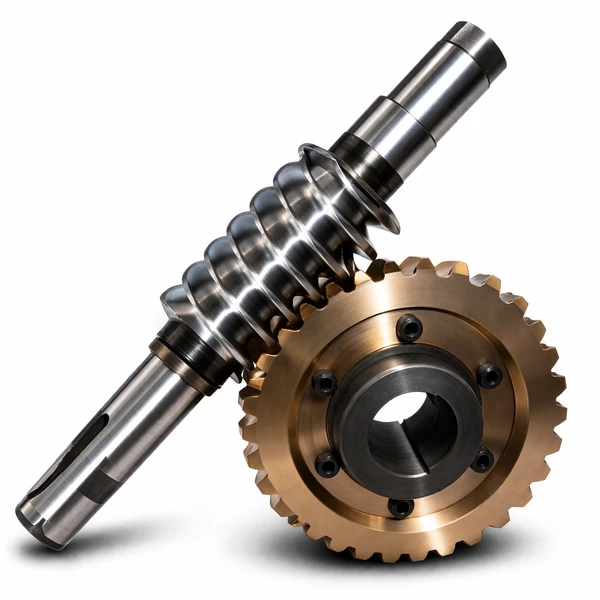
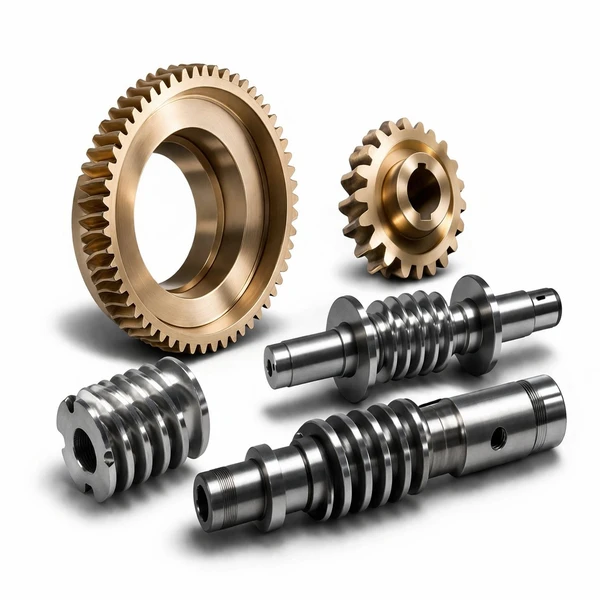
Available in single-start (z1=1) for self-locking applications and multi-start configurations (z1=2, z1=4) for efficiency-critical drives. The alloy steel worm shaft (40Cr or SCM415) provides the surface hardness and thread geometry precision needed for multi-start worm sets — a multi-start worm with inaccurate lead spacing produces differential tooth loading that negates the efficiency improvement. Each multi-start set is tested on a lapping rig to confirm equal contact distribution across all start threads. Specifying multi-start for a 20:1 ratio conveyor drive that previously ran at 65% efficiency can raise efficiency to 80–85%, reducing heat generation by 43% and extending lubricant change intervals significantly.

Spezifikationen ansehen →

Präzisions-Zylinderschneckenrad
Precision Hobbed · Contact Optimised
Präzisions-Zylinderschneckenrad
Worm gear efficiency is not just a function of the geometry on paper — it is a function of actual contact area at the mesh. A worm wheel with insufficient contact pattern concentrates the load on a small tooth face area, increasing Hertz pressure, increasing friction, and reducing effective efficiency below the theoretical prediction. Korea Ever-Power cylindrical worm wheels are hobbed with profile cutters matched to the actual worm geometry, producing documented contact pattern coverage ≥ 70% of tooth face width. The efficiency improvement from correct contact geometry vs mismatched geometry is typically 3–8 percentage points — measurable and meaningful in a continuous-duty drive.

Spezifikationen ansehen →

Custom Worm Gear Set — Efficiency Analysis Included
Custom Specification · Engineering Support
Custom Worm Gear Set — Efficiency Analysis Included
For applications where worm gear efficiency is a primary design parameter — continuous high-power drives, energy-cost-sensitive installations, drives with strict thermal limits — Korea Ever-Power provides efficiency analysis at specification stage, not retrospectively. Provide your input speed, required output speed, continuous power, duty cycle, ambient temperature, and housing envelope. We calculate theoretical efficiency at rated speed and temperature, thermal equilibrium housing temperature, and lubricant recommendation. If results indicate the application is at risk, we propose specification changes — increased start count, synthetic lubricant, housing fin area increase — before the order is confirmed.

Spezifikationen ansehen →

Häufig gestellte Fragen zur Technik

Worm Gear Efficiency — Questions from Drive System Engineers

Can I use synthetic PAO oil to significantly improve worm gear efficiency compared to mineral oil?+

Yes, but the improvement is more useful for thermal management than for efficiency gains. Synthetic PAO oil typically reduces the friction coefficient by 10–20% compared to equivalent-viscosity mineral oil at the same conditions. For a drive operating at 65% efficiency with mineral oil, the same drive with PAO synthetic would achieve approximately 68–71% — a meaningful improvement in thermal loading (roughly 10–15% less heat generation). The larger benefit of PAO in a worm drive is its much better viscosity-temperature characteristic (viscosity index >150 vs ~95 for mineral oil), meaning the drive maintains adequate lubricant film thickness over a wider temperature range.

Why does a catalog list worm gear efficiency as 40–90%? Which end of that range applies to my drive?+

The 40–90% figure covers the entire range of worm gear configurations from single-start, 80:1 ratio, slow speed (close to 40%) to four-start, 10:1 ratio, high sliding velocity with synthetic oil (close to 90%). For a typical industrial drive — single-start, 30:1 to 60:1, 1450 RPM input, standard mineral oil — efficiency falls in the 55–72% range depending on ratio and operating temperature. Calculate your specific case using the formula η = tan λ / tan(λ + ρ’) with the lead angle for your geometry and an estimated friction coefficient from the sliding velocity table.

My worm gear drive runs hotter each year. Is this a sign of failing efficiency?+

Progressive temperature rise over years is almost always caused by increasing friction at the mesh from wear-generated surface roughness, not by fundamental efficiency change. As the worm thread and wheel tooth surfaces wear, the original ground surface finish (Ra 0.4–0.8 µm) degrades to a rougher worn surface. This increases boundary layer friction, shifts the operating point toward lower efficiency, and generates more heat. Replacement of the worm gear set restores the original surface finish and efficiency. If the temperature rise has been steady over 3–5 years, gear replacement is likely overdue.

Is there a point of diminishing returns when optimising for higher worm gear efficiency?+

Yes. Beyond approximately 85–87% efficiency (achievable with a four-start worm at 10:1–15:1 with synthetic oil), further efficiency improvement requires moving away from worm gear architecture entirely. The practical range for worm gear optimisation is 55% to 85%. Below 55%, thermal management problems make the drive unreliable for continuous operation without additional cooling. Above 85%, the multi-start wheel is large and expensive, and the ratio is low enough that helical alternatives may be more cost-effective.

How does efficiency change when a worm drive operates below rated speed — for example, with a variable frequency drive (VFD)?+

Worm gear efficiency generally decreases at reduced speed. Lower shaft speed means lower sliding velocity at the mesh, which means the drive operates in the boundary or mixed lubrication regime rather than the more efficient hydrodynamic regime at rated speed. A drive that achieves 68% efficiency at rated 1450 RPM may achieve only 55–60% at 700 RPM and 45–50% at 200 RPM with the same lubricant. For VFD-controlled worm drives operating frequently at reduced speed, this efficiency loss — and the corresponding increase in heat generation — must be accounted for in the thermal calculation.

Does the direction of load affect the efficiency figure?+

Yes, significantly. The formula for the reverse direction (wheel back-driving the worm) is η_back = tan(λ − ρ’) / tan λ. When λ < ρ’ — the self-locking condition — back-driving is impossible. When λ > ρ’ (non-self-locking), back-drive efficiency is lower than forward efficiency. A drive with 70% forward efficiency will have approximately 40–50% back-drive efficiency at the same conditions. For regenerative load applications, worm gear drives are poor candidates because the back-drive efficiency is too low for effective energy recovery.

How much does correct gear contact pattern affect efficiency in practice?+

More than most engineers expect: approximately 3–8 percentage points. A worm wheel hobbed with the incorrect cutter profile produces point contact rather than line contact at the mesh. The concentrated load at the contact point prevents the development of a hydrodynamic oil film across the face width, keeping the drive in boundary lubrication regime even at speeds where it should be operating in mixed-film regime. This is the reason Korea Ever-Power ships contact pattern photographs with precision worm wheels — a documented ≥70% face width contact confirms the mesh will operate as the efficiency calculation predicts.

If I switch from a single-start to a double-start worm at the same ratio, what changes in the system besides efficiency?+

Three things change. First, the wheel tooth count doubles (from z2 = i to z2 = 2i), making the wheel physically larger — the wheel pitch diameter increases, requiring a larger housing. Second, self-locking behaviour may be lost or reduced: the higher lead angle of the double-start worm may not satisfy the self-locking condition at the operating lubricant and temperature conditions — check the self-locking calculation before switching if load holding is required. Third, the worm thread lead spacing accuracy requirement becomes more critical — a double-start worm with unequal lead spacing produces alternating load pulses as the two starts come into mesh sequentially, showing up as vibration and noise.

Specify a Worm Drive with Confirmed Efficiency

Provide input speed, required output speed, continuous power, duty cycle, and ambient temperature. Korea Ever-Power calculates forward efficiency, thermal equilibrium temperature, and lubricant recommendation at specification stage — before order placement, not after thermal failure.

Herausgeber: Cxm