Produktbeskrivning
Item:CNC Milling machining turning metal transmission mechanical gear OEM/ODM auto engine transmission shaft gear
1. High degree of automation and high production efficiency;
2. Strong adaptability to CNC machining objects. When changing the processing object, in addition to replacing and solving the blank clamping mode, it only needs to be reprogrammed;
3. High machining precision and stable quality. The machining dimensional accuracy is between 0.005 ~ 0.01 mm, which is not affected by the complexity of parts;
Parameter :
| Punkt | CNC Milling machining turning metal transmission mechanical gear OEM/ODM auto engine transmission shaft gear |
| Vikt | Anpassad |
| Dimensionera | Anpassad |
| Material | Aluminum alloy(6063 T5,6061,5052,7075,1060…),Stainless steel(316L,304,303…),Copper,Brass,Bronze,Carbon steel |
| Machined Technology | 3,4,5 Axis CNC Machining,CNC Milling,CNC Turning,Laser Cutting,Die Casting,Cold forging,Aluminum Extrusion,Sheet Metal Fabrication,Stamping,Welding,Friction Stir Welding,Assembling. |
| Ytbehandling | Anodizing,Painting,Powder Coating,electrophoresis,Passivation,Sand Blasting,Plating,Blackening,Polishing… |
| Tolerans | ±0.01MM |
| Ansökan | Electronic products body ,Telecom Chasis,Cover,aerospace structure parts,heat sink,aluminum cooling plate,gear&shaft,bearing,high speed feed through,other OEM/ODM customized machining parts |
Our advantage:
1. Experienced engineering team;
2. Full process QC inspection, complete quality system before, during and after processing;
3. Efficient and rapid response, benign interaction between business and production, and accurately grasp customer requirements;
| Ansökan: | Motor, Elbilar, Motorcykel, Maskiner, Marin, Leksak, Jordbruksmaskiner, Bil |
|---|---|
| Hårdhet: | Härdad tandyta |
| Växelposition: | External Gear |
| Tillverkningsmetod: | Rolling Gear |
| Tandad delform: | Spur Gear |
| Material: | Rostfritt stål |
| Prover: |
US$ 10/Piece
1 styck (minsta beställning) | |
|---|
| Anpassning: |
Tillgänglig
| Anpassad förfrågan |
|---|
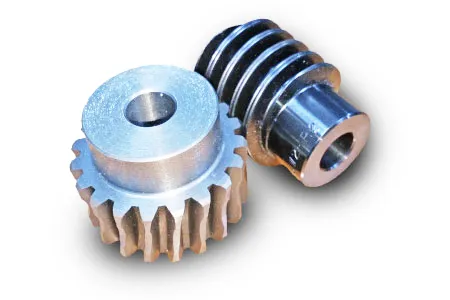
Can you provide examples of machinery that use worm gears?
Worm gears are utilized in various machinery and mechanical systems where precise motion control, high gear reduction ratios, and self-locking capabilities are required. Here are some examples of machinery that commonly use worm gears:
- Hissar: Worm gears are commonly employed in elevator systems to control the vertical movement of the elevator car. The high gear reduction ratio provided by worm gears allows for smooth and controlled lifting and lowering of heavy loads.
- Conveyor systems: Worm gears are used in conveyor systems to drive the movement of belts or chains. The self-locking nature of worm gears helps prevent the conveyor from back-driving when the power is turned off, ensuring that the materials or products being transported stay in place.
- Automotive applications: Worm gears can be found in automotive steering systems. They are often used in the steering gearboxes to convert the rotational motion of the steering wheel into lateral movement of the vehicle’s wheels. Worm gears provide mechanical advantage and precise control for steering operations.
- Milling machines: Worm gears are utilized in milling machines to control the movement of the worktable or the spindle. They offer high torque transmission and accurate positioning, facilitating precise cutting and shaping of materials during milling operations.
- Lifts and hoists: Worm gears are commonly employed in lifting and hoisting equipment, such as cranes and winches. Their high gear reduction ratio allows for the lifting of heavy loads with minimal effort, while the self-locking property prevents the load from descending unintentionally.
- Rotary actuators: Worm gears are used in rotary actuators to convert linear motion into rotary motion. They are employed in various applications, including valve actuators, robotic arms, and indexing mechanisms, where controlled and precise rotational movement is required.
- Packaging machinery: Worm gears find application in packaging machinery, such as filling machines and capping machines. They assist in controlling the movement of conveyor belts, rotating discs, or cam mechanisms, enabling accurate and synchronized packaging operations.
- Printing presses: Worm gears are utilized in printing presses to control the paper feed and the movement of the printing plates. They provide precise and consistent motion, ensuring accurate registration and alignment of the printed images.
These are just a few examples, and worm gears can be found in many other applications, including machine tools, textile machinery, food processing equipment, and more. The unique characteristics of worm gears make them suitable for various industries where motion control, high torque transmission, and self-locking capabilities are essential.
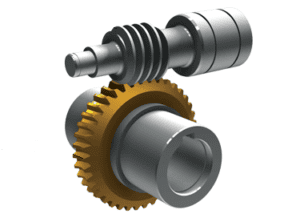
Kan snäckväxlar användas i tunga maskiner och utrustningar?
Ja, snäckväxlar kan användas i tunga maskiner och utrustningar. Här är en detaljerad förklaring av deras lämplighet för sådana tillämpningar:
1. Hög vridmomentöverföring: En av de viktigaste fördelarna med snäckväxlar är deras förmåga att överföra högt vridmoment. Den unika designen av snäckan och snäckhjulet möjliggör effektiv vridmomentgenerering och kraftöverföring. Detta gör snäckväxlar väl lämpade för tunga applikationer som kräver överföring av betydande rotationskrafter.
2. Kompakt storlek: Snäckväxlar erbjuder en kompakt och platsbesparande lösning för tunga maskiner. Deras kompakta design möjliggör överföring av högt vridmoment i ett relativt litet paket. Detta är särskilt fördelaktigt i applikationer där utrymmesbegränsningar eller kompakta designkrav föreligger.
3. Självlåsande funktion: Snäckdrev har en självlåsande egenskap, vilket innebär att snäckan kan förhindra att växelsystemet bakåt roterar. Denna funktion är fördelaktig i tunga maskiner där det är viktigt att bibehålla en fast position eller förhindra att systemet reverserar under belastning. Snäckdrevens självlåsande förmåga ger stabilitet och säkerhet i olika tunga applikationer.
4. Höga utväxlingsförhållanden: Snäckväxlar kan uppnå höga utväxlingsförhållanden, vilket är fördelaktigt i tunga maskiner som kräver exakt hastighetsreducering. De höga utväxlingsförhållandena möjliggör finkontroll av rotationshastighet och vridmoment, vilket gör att växelsystemet kan matcha kraven för tunga belastningar och krävande driftsförhållanden.
5. Hållbar konstruktion: Snäckväxlar tillverkas vanligtvis av robusta material som legerat stål, gjutjärn eller brons. Dessa material erbjuder utmärkt styrka, slitstyrka och hållbarhet, vilket gör att snäckväxlar kan motstå de tunga belastningar och tuffa driftsmiljöer som tunga maskiner möter.
6. Överbelastningsskydd: Snäckdrevens unika design ger ett inneboende överbelastningsskydd. När belastningen överstiger växelns kapacitet orsakar glidningen mellan snäckan och snäckhjulet en hög friktionskraft, vilket begränsar momentöverföringen och förhindrar skador på växelsystemet. Denna överbelastningsskyddsfunktion är värdefull i tunga maskiner där plötsliga belastningstoppar eller oväntade överbelastningar kan uppstå.
7. Brett utbud av tillämpningar: Snäckväxlar används i en mängd olika tunga maskiner och utrustning inom olika branscher. Några exempel inkluderar kranar, vinschar, hissar, gruvmaskiner, byggutrustning, valsverk, tunga transportörer och marina framdrivningssystem. Snäckväxlarnas mångsidighet gör dem lämpliga för en mängd olika tunga tillämpningar.
Det är viktigt att notera att även om snäckväxlar erbjuder flera fördelar för tunga maskiner, finns det vissa saker att tänka på. Dessa inkluderar korrekt smörjning för att minimera friktion och slitage, tillräcklig kylning för att hantera värmegenerering, korrekt inriktning för att säkerställa effektiv kraftöverföring och regelbundet underhåll för att inspektera för tecken på slitage eller skador. Genom att ta itu med dessa faktorer kan snäckväxlar tillförlitligt och effektivt uppfylla kraven från tunga maskiner och utrustning.
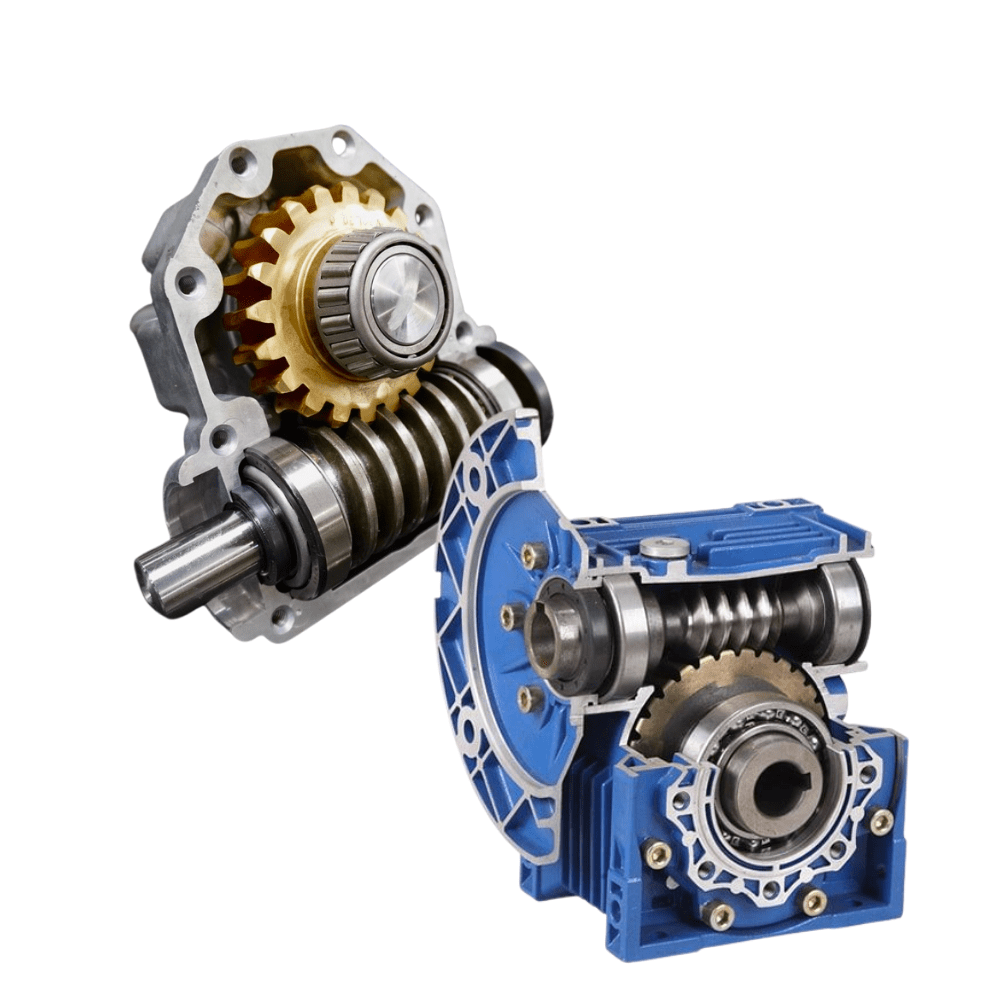
Can you explain the concept of worm and worm wheel in a worm gear?
In a worm gear system, the worm and worm wheel are the two primary components that work together to transmit motion and power. Here’s an explanation of the concept:
Worm:
The worm is a cylindrical shaft with a helical thread wrapped around it. It resembles a screw with a spiral groove. The helical thread is called the worm’s thread or worm thread. The worm is the driving component in the worm gear system.
When the worm rotates, the helical thread engages with the teeth of the worm wheel, causing the worm wheel to rotate. The angle of the helical thread creates a wedging action against the teeth of the worm wheel, resulting in a high gear reduction ratio.
One important characteristic of the worm is its self-locking nature. Due to the angle of the helical thread, the worm can drive the worm wheel, but the reverse is not true. The self-locking feature prevents the worm wheel from backdriving the worm, providing a mechanical brake or holding position in the system.
The worm can be made from various materials such as steel, bronze, or even plastics, depending on the application requirements. It is often mounted on a shaft and supported by bearings for smooth rotation.
Worm Wheel:
The worm wheel, also known as the worm gear, is the driven component in the worm gear system. It is a gear with teeth that mesh with the helical thread of the worm. The teeth on the worm wheel are typically helical and cut to match the angle and pitch of the worm’s thread.
As the worm rotates, its helical thread engages with the teeth of the worm wheel, causing the worm wheel to rotate. The rotation of the worm wheel is in the same direction as the worm’s rotation, but the speed is significantly reduced due to the high gear reduction ratio of the worm gear system.
The worm wheel is usually larger in diameter compared to the worm, allowing for a higher gear reduction ratio. It can be made from materials such as steel, bronze, or cast iron, depending on the application’s torque and durability requirements.
Together, the worm and worm wheel form a compact and efficient gear system that provides high gear reduction and self-locking capabilities. They are commonly used in various applications where precise motion control, high torque, and compactness are required, such as elevators, steering systems, and machine tools.


editor by CX 2023-10-08