Пужни преносник за пољопривредне машине — Водич за издржљивост на терену
Most worm gear failures in farm equipment come down to three things: brittle shaft fracture in rocky soil, corrosion during off-season storage, and grease breakdown in summer heat. This guide explains the material and specification choices that actually prevent these failures in the field — not just on paper.
The Real Cost of a Gear Failure During Planting Season
A rice transplanter with a seized worm gear shaft during the first week of paddy planting season does not get repaired quickly. The closest authorized service center may be 80 km away. The replacement part may need to be ordered from a regional distributor, which takes 5 to 10 days. The machine sits idle in the field. In Jeolla Province, the optimal transplanting window for the main-season crop is approximately 18 days. A 7-day machine downtime inside that window can cost more in yield loss and labor displacement than the value of the entire transplanter’s drive system components.
This kind of failure — a worm shaft fracture on first contact with a submerged stone during paddy preparation — is not a mechanical overload event in the conventional sense. The datasheet torque rating of the worm shaft was not exceeded. What failed was a brittle crack at the case-core boundary of an induction-hardened C45 shaft, a failure mode that appears under impact loads even when steady-state torque is within rating. Understanding this distinction — between sustained torque capacity and impact fracture resistance — is the starting point for specifying agricultural worm gear drives that actually survive field conditions.
Корејски произвођач Ever-Power heavy-duty worm gear sets for agricultural machinery with materials, surface treatments, and lubricant specifications chosen around the three field failure modes that account for the majority of agricultural worm gear replacements in Korean and Southeast Asian rice and vegetable growing regions.

Three Failure Modes That Account for Most Agricultural Worm Gear Replacements
◆ Failure Mode 1 — Brittle Fracture at the Induction Hardening Boundary
C45 medium-carbon steel responds well to induction hardening — the surface achieves 55–58 HRC, which provides good sliding wear resistance at the worm thread. The problem is the transition zone between the hard case and the unhardened core. In this zone, the steel microstructure transitions from hard martensite to softer pearlite/ferrite over a depth of 0.5 to 1.5 mm. Under static loading, this boundary is not an issue. Under impact loading — a plowing tine hitting a buried stone, a transplanter finger mechanism encountering a soil clod — the stress state at the thread root includes a bending component that concentrates at this boundary. Brittle fracture initiates there and propagates across the thread section in milliseconds. The shaft does not bend before breaking. The fracture surface is granular and bright, characteristic of brittle failure, not the dull fibrous surface of ductile overload.
◆ Failure Mode 2 — Storage Corrosion and Startup Seizure
Agricultural equipment in Korea and Southeast Asia is used intensively for 1 to 3 months per growing season, then stored — often outdoors or in unheated sheds — for the remaining 9 to 11 months. During storage, two corrosion processes attack unprotected worm shafts simultaneously. Atmospheric moisture causes general surface rust, which is visible and sometimes catches the operator’s attention. More damaging is the crevice corrosion that develops in the narrow gap between the shaft thread flanks and the bronze wheel teeth, where residual soil moisture and fertilizer solution from the field season are trapped. When the machine is started up the following season, this crevice corrosion zone can cause adhesive seizure at first engagement — pulling material from both the shaft thread and the wheel tooth face, leaving a rough torn surface that accelerates wear from that point forward.
◆ Failure Mode 3 — Grease Thermal Breakdown in Summer Operation
A closed worm gear housing sealed with NLGI 2 mineral grease will typically see internal temperatures of 65–80°C during summer daytime operation in Korea and Southeast Asia, when ambient temperatures reach 33–38°C and the housing is in direct sun. Most standard mineral-based agricultural greases have drop points of 170–185°C but begin to show viscosity thinning and oil separation at sustained temperatures above 75°C. The base oil bleeds from the thickener and migrates away from the contact zone, leaving dry thickener on the gear surfaces. The worm continues to run on the remaining film for a period, then shows adhesive wear starting with a characteristic smearing and polishing of the bronze wheel tooth surface, eventually progressing to galling.
Specification Range — Agricultural Application
| Параметар | Распон / Опције | Agricultural Field Notes |
|---|---|---|
| Модул | M2.0 – M12.0 | M3–M6 covers most transplanter and tiller drives |
| Класа прецизности | DIN7 – DIN9 | DIN8–DIN9 standard — geometry accuracy is not the limiting factor in field durability |
| Однос редукције | 10:1 – 80:1 | Self-locking at 20:1+ standard — holds implement position when motor stops |
| Материјал вратила пужа | C45 (standard), 40Cr, 42CrMo, SS304, SS316 | 40Cr through-hardened for rocky soil applications — no brittle case-core boundary |
| Материјал точкова | ZCuAl10Fe3, ZCuSn10Pb1, ductile iron | Aluminum-iron bronze for impact duty; tin bronze for continuous operation |
| Shaft corrosion treatment | Zinc phosphate, zinc plating, hot-dip galvanizing | Zinc phosphate recommended — retains lubricant film through storage season |
| Lubricant fill | Synthetic NLGI 2 Ca-sulfonate or Li-complex, -40°C to +160°C | Resists oil separation at summer housing temperatures; remains pumpable at winter startup |
| Bore configuration | Straight H7, keyway+tap, square, hexagonal bore on request | Asian agricultural PTO shaft sizes: Ø25, 30, 32, 35 mm |
| Sealing grade | IP65 standard; IP67 for paddy field and submerged use | IP67 required for standing water applications in rice cultivation |
| Радна температура | -30°C to +80°C | Full seasonal range for outdoor storage in temperate climates |
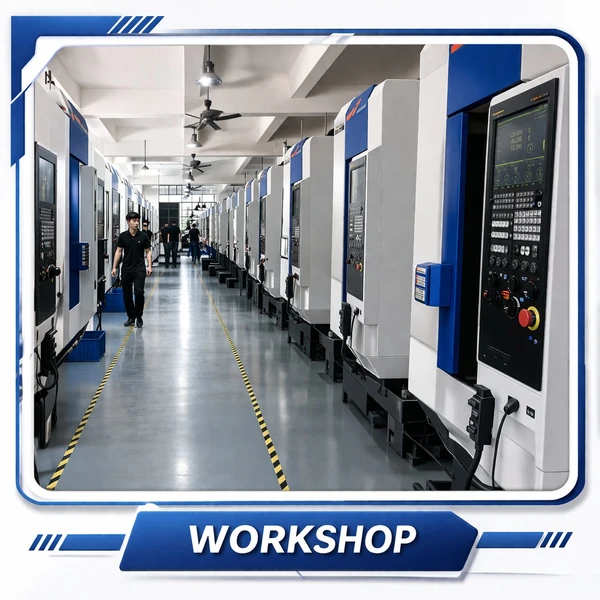
Production Facility
 |
 |
 |
 |
The Metallurgy Behind Field-Durable Worm Shafts and Wheels
Solving the brittle fracture problem requires understanding what actually changes when you switch from C45 induction hardening to 40Cr through-hardening. Induction hardening heats only the surface layer of the shaft — typically to a depth of 1.5 to 3.0 mm — and quenches it to martensite at 55–58 HRC. The core remains unhardened, soft, and relatively tough, but the transition zone between the two regions creates a local metallurgical discontinuity. Under bending loads at the thread root, stress concentrations develop at this boundary, and the high-carbon martensite in the case — which is hard but not ductile — does not redistribute stress by local yielding before fracture initiates.
Through-hardening with 40Cr eliminates this boundary. The entire shaft cross-section is heated and quenched to achieve uniform hardness, then tempered to 50–55 HRC at the surface with consistent hardness through the full section. There is no soft core, no hard shell, and no metallurgical discontinuity between them. Under the same impact bending load at the thread root, 40Cr through-hardened material redistributes stress by small-scale plastic deformation before fracture — absorbing the impact energy that would fracture a C45 induction-hardened shaft in the same condition. The tradeoff is a marginally lower peak surface hardness (50–55 HRC vs 55–58 HRC), which affects sliding wear resistance slightly but is entirely acceptable for the operating pressures at agricultural worm gear tooth contacts.
For the worm wheel, the choice between aluminum-iron bronze (ZCuAl10Fe3) and tin bronze (ZCuSn10Pb1) involves a direct strength-versus-wear-resistance tradeoff. Tin bronze has a tensile strength of approximately 250–280 MPa and forms a self-renewing tribological transfer layer at the mesh interface that gives exceptional anti-wear and anti-galling properties under continuous sliding. Aluminum-iron bronze has tensile strength of 550–600 MPa — more than double — and substantially better impact resistance, but slightly weaker anti-galling behavior under continuous high-speed sliding. For agricultural drives where the governing load event is an impact pulse from a stone obstruction rather than continuous high-speed operation, aluminum bronze is the correct specification. For continuous-duty applications like irrigation pivot gearboxes, tin bronze is preferred.
One critical note on lubricant compatibility: aluminum-iron bronze is chemically sensitive to extreme-pressure (EP) oil additives based on sulfur or chlorine compounds. Sulfur reacts with the copper and aluminum in the alloy, forming corrosive reaction products at the tooth surface that accelerate wear — sometimes faster than no lubrication at all. Specify mineral oil without EP additives, or PTFE-based and calcium sulfonate synthetic greases — all confirmed compatible with both bronze grades.
Engineering the Worm Drive for 10-Month Off-Season Storage
Off-season storage is an agricultural-specific design constraint that industrial worm gear engineering literature barely addresses. A worm gear housing sitting in an unheated barn from November to March in central Korea undergoes approximately 120 freeze-thaw cycles. The trapped moisture inside an inadequately sealed housing condenses on the worm shaft surface each morning when the temperature rises, then evaporates partially through the vent plug. Residual soil minerals and fertilizer residue in the condensate become concentrated on the shaft surface over successive cycles. By spring, the tooth surface of an untreated C45 worm shaft can carry a visible orange rust layer in the thread flanks — and, more critically, a thin film of corrosion product at the wheel mesh contact zone that acts as a fine abrasive at first startup.
Zinc phosphate treatment on the worm shaft addresses this mechanism at its root. The zinc phosphate layer is a microporous inorganic coating that retains lubricant at the shaft surface through capillary action, even as the bulk grease migrates away from the shaft surface over long storage periods. When condensation occurs and surface rust begins to develop on the thin lubricant film, the rust forms preferentially on the zinc phosphate oxide layer rather than on the steel substrate. This delays the point at which base metal corrosion reaches the tooth contact zone, typically by enough to survive a 10-month storage period followed by a clean engagement at first startup.
The lubricant specification for storage survival requires a synthetic base oil rather than a mineral base. Mineral oil greases show measurable oil bleed at temperatures above 60–70°C — which means that during summer storage (a barn roof can reach 50°C surface temperature in July, driving internal temperatures of 45–50°C with limited ventilation), the oil bleeds from the grease thickener and migrates to the lowest point in the housing. By November, the gear surfaces may have essentially no lubricant film remaining. Synthetic PAO-base NLGI 2 calcium sulfonate grease retains oil separation resistance to 80°C and above, and its pour point below -40°C ensures it does not harden to a point that prevents gear engagement at winter morning startup temperatures.
Equipment Replacement Reference
The brand names below are referenced for dimensional matching purposes only and do not imply any commercial or engineering endorsement relationship. All trademarks are the property of their respective owners.
| Equipment Brand | Applicable Equipment | Matching Basis |
|---|---|---|
| Kubota | Rice transplanters (SPU, NSU series), rotary tillers | Module and bore diameter matching; send part number or sample |
| LS Mtron (Korea) | Transplanter and spreader drive gearboxes | Korean metric module series — common sizes in stock |
| Iseki | Walking transplanters and power tillers | Module, tooth count, center distance confirmation required |
| Yanmar | Micro-tractor implement attachments | Module and face width matching; drawing or sample recommended |
| John Deere | Planter row unit drives, auger gearboxes | Module, bore, center distance from service manual dimensions |
Референце пројеката купаца
Rice Transplanter OEM — Jeonnam Province, South Korea · Q2 2023
Погон: Row spacing adjustment, M4, 30:1 ratio, Ø30 mm H7 bore with keyway
Seven C45 worm shaft fractures were reported from the same batch of 80 units during the first month of paddy planting season in a region with volcanic rock content in the soil. Fracture surface analysis confirmed brittle failure at the induction hardening transition zone — not tooth contact fatigue or ductile overload. The root cause was the impact pulse from a buried basalt fragment, not the rated transplanting torque. Material changed to 40Cr through-hardened. Result: zero fracture failures across 200 units in the following two full planting seasons. Warranty field service calls for this failure mode dropped by 94%.
“Korea Ever-Power identified the failure mode from the fracture surface description before we even sent the broken parts. The material recommendation was immediate and correct.” — Equipment Development Manager
Cassava Planting Machine Builder — Ho Chi Minh City Region, Vietnam · Q3 2024
Погон: Furrow opener depth adjustment, M5, 20:1 ratio, zinc phosphated C45 worm, ductile iron wheel
Equipment stored in open lean-to sheds during the October to April dry season (5 months). Previous supplier’s worm shafts showed heavy crevice corrosion in the thread flanks after storage, causing seizure at first startup and requiring shaft replacement before each growing season. Annual replacement parts cost for the dealer network was significant. Switched to zinc phosphate treated shafts with synthetic calcium sulfonate NLGI 2 grease fill. After one full dry season storage: all units started cleanly. Dealer network reported zero storage-corrosion warranty returns in the 12-month period following the switch. Annual replacement parts cost fell by 60% for worm shaft line items.
“We thought corrosion after storage was unavoidable. Korea Ever-Power treated it as an engineering problem and solved it with a material and lubricant change.”
Smart Greenhouse Equipment Startup — Gyeongbuk Province, South Korea · Q4 2024
Погон: Motorized growing rack lateral drive, M2, 40:1 ratio, SS316 worm shaft, tin bronze wheel — nutrient solution drip exposure
Multi-tier hydroponic strawberry growing racks exposed to continuous potassium nitrate and calcium chelate nutrient drip. Carbon steel worm shafts corroded within 8 weeks regardless of surface treatment. European stainless suppliers quoted 18-week delivery — the customer’s installation date was fixed. SS316 M2 DIN8 samples from Korea Ever-Power: 11 working days from drawing confirmation to delivery. After 12 months of continuous operation in the nutrient solution environment: no visible corrosion on shaft tooth surfaces. Startup expanded to 3 greenhouse sites using the same specification.
“Eleven working days to samples let us install on schedule. A European supplier would have delayed the entire project.”
Palm Harvest Equipment Supplier — East Kalimantan, Indonesia · Q1 2023
Погон: Harvesting pole height adjustment, M6, 40:1 ratio, aluminum-iron bronze wheel, Ø35 mm H7 bore
Equipment deployed during wet season involved frequent immersion in standing mud water. Bronze wheel corrosion and lubricant dilution caused drive failure within 3–4 weeks of wet season deployment. IP67 housing upgrade was specified in parallel with the gear component change, with a corrosion-resistant phosphate treatment added to the bronze wheel exposed surfaces. After one full wet season: bore and tooth measurements within original tolerance, no measurable corrosion on functional surfaces. Field replacement interval extended from 3–4 weeks to a planned annual overhaul cycle.
“The sealed housing and treated bronze combination solved a problem that had cost us significant field service labor every wet season.”
Standard Agricultural vs High-Durability Field Specification
| Фактор | Standard Off-the-Shelf Agricultural Worm Gear | Korea Ever-Power Field-Durable Specification |
|---|---|---|
| Shaft material (rocky soil) | C45 индукцијско каљено | 40Cr through-hardened — no brittle case-core transition |
| Wheel for impact duty | Tin bronze or grey iron | ZCuAl10Fe3 aluminum bronze — 2× tensile strength for stone impact |
| Storage corrosion protection | None or basic rust inhibitor spray | Zinc phosphate + synthetic grease fill — survives 10-month storage season |
| Спецификација мазива | Standard mineral NLGI 2 grease | Synthetic Ca-sulfonate, -40°C to +160°C — no bleed at summer operating temperature |
| Документација | Invoice only | Material cert, heat treatment record, batch hardness test report |
| Expected seasonal service cycles | 1 – 2 seasons before failure or replacement | 3 – 5 seasons with correct lubricant and annual inspection |

For agricultural applications requiring a complete sealed drive unit, matched worm gear pairs are available in IP65 and IP67-rated housings factory-filled with the synthetic grease specification described above. Compact enclosed пужни редуктори for transplanter, seeder, and irrigation system drives are available for direct mounting without housing modification. Visit wormwheelgear.top for the full agricultural worm gear component range.
Често постављана питања
Решите проблем са пољопривредним пужним зупчаником пре следеће сезоне садње
Пошаљите неисправан део, број дела или димензионалну скицу. Потврђујемо компатибилност и дајемо препоруку за материјал и цену у року од 24 сата. За сезонско планирање залиха код дилера, распитајте се о нашим дистрибутерским ценовним нивоима и програмима предсезонског снабдевања.
Уредник: Cxm