Practical Guide Series · C7 · Service Life

How to Double Your Worm Gear Service Life — The Six Levers Most Maintenance Teams Never Use

Same specification, same load, same environment. One drive replaced every 14 months. The neighboring drive on the same line: still original at 72 months. Six operational decisions separate them — and five of the six cost nothing to implement.

Six Practical LeversWith Calculated SavingsBefore and After Cases

worm gear service life extension maintenance

⚙ 韓国エバーパワーウォームギア株式会社 京畿道安山市 [email protected]

The 14-Month Drive and the 72-Month Drive — What Was Different

Two neighboring conveyor lines in a Korean automotive parts warehouse. Both use a 40:1 alloy steel worm gear set, M5, 40Cr shaft, ZCuSn10Pb1 tin bronze wheel. Both drives carry pallets on an 8-degree incline, three shifts per day. Line A replaced its worm wheel every 13-15 months — always from abrasive wear leading to excessive backlash. Line B was still running on its original gear set at 72 months when the plant went through an equipment audit. The maintenance records explained everything: the two lines had different supervisors, and the maintenance procedures were not standardized.

Line B had six practices that Line A did not: a running-in oil change at 100 hours; a filtered breather on the housing; correct non-EP lubricant (Line A had been using the same EP oil as the conveyor chain drives); PAO synthetic instead of mineral oil; a soft-start motor controller; and a magnetic drain plug checked at every oil change. None of these cost more than the value of one replacement wheel, and together they produced a service life 5x longer.

This guide quantifies the contribution of each practice, provides the implementation steps, and estimates the lifetime cost saving from each lever — to help maintenance managers build the business case for implementing them across all worm gear drives in their facility.

合金鋼ウォームとウォームギア
ウォームギア関連製品

The Six Service Life Levers — Implementation and Expected Impact

These six levers are listed in order of impact on worm gear service life. The first three produce the largest improvement. All six together account for the 5x difference observed between the best-maintained and worst-maintained drives in equivalent applications.

1
Running-In Protocol — The Oil Change You Cannot Skip

The single highest-impact maintenance action is one that happens only once per gear set installation: the oil change at 50-100 operating hours. During running-in, micro-asperities on the tooth flanks cold-work and conform — producing fine bronze wear particles suspended in the oil. These particles are 10-25 micrometres in size and too fine to settle by gravity or be caught by a standard oil fill strainer. They circulate continuously in the lubrication system and abrade both tooth flanks on every subsequent revolution.

Estimated Impact

Estimated impact: skipping the running-in oil change reduces service life by 30-50% through accelerated abrasive wear during the first 500-1,000 operating hours. The cost of the oil change: approximately one-fifth the cost of a replacement wheel.

Implementation

Implementation: fill with specified oil at installation; run at 30% load for 2 hours, 50% load for 8 hours; drain completely at 50-100 hours regardless of oil appearance; refill with fresh oil. Record the change date in the maintenance log as a separate entry.

2
Non-EP Lubricant — The Most Common Specification Error

EP (Extreme Pressure) additive gear oils are formulated for the rolling contact of helical and spiral bevel gears. They contain sulfur-based additives that react with copper in bronze worm wheels to form copper sulfide corrosion products. This corrosive attack on the tooth flank proceeds continuously from first fill, invisible to visual inspection until the damage is already severe.

Estimated Impact

Estimated impact: EP oil in a bronze-wheel worm drive reduces service life by 40-70% through combined corrosive and abrasive wear. The damage is irreversible — once EP attack has begun, the wheel life already consumed cannot be recovered by changing to correct oil.

Implementation

Implementation: confirm the lubricant on every worm gear drive. Specify non-EP worm gear oil or bronze-compatible industrial gear oil. Label the fill port clearly (red label: WORM GEAR OIL — NO EP ADDITIVES). Keep a separate drum for worm gear oil if the facility also uses EP oil for helical gear drives.

3
PAO Synthetic Oil — The Simplest Thermal Upgrade

Synthetic PAO (polyalphaolefin) oil has a viscosity index above 150, compared to 85-100 for mineral oil. This means PAO maintains higher viscosity at operating temperature than mineral oil of the same ISO VG grade. Higher operating viscosity means a thicker EHD film at the mesh contact, lower friction coefficient, lower operating temperature, and lower wear rate — simultaneously.

Estimated Impact

Estimated impact: switching from mineral to PAO typically reduces operating temperature by 8-15 degrees C and extends drain intervals by 1.5-2x. The combined effect of lower temperature and better film thickness extends wheel life by 20-40% in continuous-duty drives. PAO costs approximately 3x more than mineral oil per litre — easily recovered in the extended drain interval alone.

Implementation

Implementation: switch to PAO at the next scheduled oil change. No modification to the drive or housing required. Specify ISO VG grade appropriate to the operating temperature range — the same grade as mineral oil is typically correct for PAO in the same application.

4
Soft-Start Motor Control — Eliminating the Shock Load

Direct-on-line (DOL) motor starting produces a starting torque of 1.8-2.5x rated motor torque for typically 0.2-0.5 seconds. This torque pulse is transmitted directly to the worm shaft. For drives that start under load — inclined conveyors, hoists, material handling — the starting torque may be 2.5-3.5x the running torque. Worm gear fatigue life under cyclic torque loading follows the Woehler curve: life is proportional to approximately the inverse cube of stress amplitude. A 2.5x torque peak reduces fatigue life by approximately 15x compared to the same cycle at running torque.

Estimated Impact

Estimated impact: replacing DOL starting with soft-start motor control (reduces starting torque to 1.2-1.4x rated) extends fatigue life in the root fillet by 5-20x in high start-stop applications. For conveyor drives that start under full load multiple times per shift, this is the most impactful intervention after oil type correction.

Implementation

Implementation: install a soft-start electronic motor starter or VFD (variable frequency drive) for the worm gear drive motor. Program the ramp time to 3-5 seconds for the start sequence. This eliminates the torque impulse without mechanical changes to the gear set.

5
Sealed Housing and Filtered Breather — Contamination Prevention

Every worm gear housing breathes. As the housing temperature cycles between cold (ambient) and warm (operating), the internal air expands and contracts — drawing external air through any unsealed opening. Without a filtered breather, this air carries dust, grit, and moisture into the oil. A single 50-micrometre abrasive particle in a worm gear mesh acts as a three-body abrasive, scratching both the shaft thread and the wheel tooth face on every contact.

Estimated Impact

Estimated impact: contamination-related abrasive wear accounts for an estimated 20-35% of all premature worm gear failures in industrial environments. The investment in a 10-micrometre filtered breather is typically 200-500 Korean Won — less than 0.1% of the wheel replacement cost.

Implementation

Implementation: inspect the shaft seals at every oil change — a worn seal lip is the primary ingress path for liquid contamination. Install a 10-micrometre filtered breather on the housing vent port. Check the magnetic drain plug at every oil change and record the metallic particle count (small bronze-coloured paste: normal; large particles or metallic chunks: investigate).

6
Load Monitoring — Knowing When You Are Over-Driving the Gear

Gear wear rate accelerates as a power function of load: doubling the contact stress at the mesh approximately quadruples the specific wear rate. Many worm gear drives that fail prematurely are running above their rated torque — either because the application load has increased since installation (added weight, changed process), or because the original specification used an inadequate service factor.

Estimated Impact

Estimated impact: operation at 110% of rated torque reduces gear life by approximately 35% relative to operation at 100%. Operation at 130% of rated torque reduces life by approximately 75%. A motor current measurement during loaded operation provides a proxy for output torque — compare actual operating current to rated current and calculate whether the drive is operating within its rated capacity.

Implementation

Implementation: measure motor input current during normal loaded operation. Calculate approximate output torque: T_output = I_actual/I_rated x T_motor_rated x gear_ratio x efficiency. Compare to the gear set rated torque. If above 80%, investigate load reduction or specify a higher-rated replacement gear set. Document the result.


Expected Service Life by Specification and Maintenance Level

アプリケーションの種類 Material Spec Maintenance Level Expected Wheel Life Key Assumption
Standard conveyor C45 shaft + Sn10 bronze Poor: EP oil, no running-in oil change 8-14 months EP oil corrosion + running-in abrasion
Standard conveyor 40Cr shaft + Sn10 bronze Standard: non-EP mineral oil, change 2,000h 24-36 months Normal wear at rated load
Standard conveyor 40Cr shaft + Sn10 bronze Good: PAO oil, running-in change, filtered breather 48-72 months Clean lubrication, controlled wear rate
Standard conveyor SCM415 shaft + Sn10 bronze Good: PAO oil, all 6 levers implemented 72-96 months Maximum achievable with standard tin bronze
High-cycle packaging 40Cr shaft + Sn10 bronze Poor: DOL start, no running-in 4-8 months Root fillet fatigue from DOL torque peaks
High-cycle packaging SCM415 shaft + Sn10 bronze Good: soft-start, PAO, all levers 36-60 months Fatigue life optimized, wear controlled
Food processing SS316 shaft + Sn10 bronze Good: NSF H1 PAO, CIP compatible seals 36-60 months Corrosion eliminated, NSF H1 reduces scuffing resistance — monitor
Marine/offshore SS316 shaft + Al-iron bronze Good: marine PAO, FKM seals, all levers 60-120 months Corrosion eliminated, al-iron bronze for splash zone

Korea Ever-Power Production — Built for Long Service Life
ウォームギアワークショップ2 ウォームギアワークショップ3 ウォームギアワークショップ4
ウォームギアワークショップ5 ウォームギアワークショップ6 ウォームギアの梱包と出荷

Building the Business Case — Service Life Cost Calculation

Example: 20 Worm Gear Drives, 3-Shift Warehouse, 5-Year Period
Baseline (Line A practices)
Average wheel life14 months
Replacements per drive (5 years)~4.3
Wheel cost (incl. installation)KRW 650,000
Downtime cost per replacement38万ウォン
Total per drive (5 years)KRW 4,429,000
Total 20 drives (5 years): KRW 88,580,000
Optimised (Line B practices)
Average wheel life66 months (5.5 years)
Replacements per drive (5 years)~0.9
Wheel cost (incl. installation)KRW 650,000
Downtime cost per replacement38万ウォン
Total per drive (5 years)KRW 922,500
Total 20 drives (5 years): KRW 18,450,000
5-year saving from the 6 levers: KRW 70,130,000 across 20 drives  |  Implementation cost of all 6 levers: approximately KRW 4,000,000

Field Results

Four Service Life Extension Cases — Measured Before and After

Gyeonggi-do, Korea / Logistics Centre
EP Oil Replacement — 8-Month to 38-Month Wheel Life

状況: A logistics centre with 32 pallet conveyor corner drives was replacing worm wheels every 7-9 months. Oil analysis of the drain oil showed 2,800 ppm copper — a clear signature of EP sulfur attack on the bronze wheels. The maintenance team had been using the same ISO VG 460 EP gear oil for the worm drives as for the pallet chain lubricant.

解決: All 32 drives drained and refilled with non-EP ISO VG 460 mineral oil. Running-in oil change protocol introduced for all future replacements. Average wheel life post-change: 38 months across 12 complete cycles observed over the subsequent 4 years.

✓ Wheel life 4.6x longer / Annual replacement cost reduced by 78%
Changwon, Korea / Automotive Assembly
Soft-Start Introduction — Root Fillet Fatigue Eliminated

状況: An automotive assembly line ran packaging conveyors with DOL motor starts 8-12 times per hour per line. CMM analysis of failed wheels showed root fillet cracking — bending fatigue, not surface wear. The calculation confirmed: DOL start torque at 2.3x rated, producing bending stress at the root fillet 2.3x higher than running stress — and fatigue life proportional to 1/(2.3)^3 = approximately 8% of rated fatigue life.

解決: Soft-start electronic starters installed. Motor start torque limited to 1.25x rated. Bending stress at root fillet reduced to 1.25x running stress. Fatigue life improved by factor of (2.3/1.25)^3 = 12.5x. First wheel set still in service at 28 months post-installation.

✓ Fatigue life 12x improvement / Root fillet cracking eliminated
Busan Port, Korea / Container Terminal
Sealed Housing + Filtered Breather — Contamination Eliminated

状況: A container terminal’s deck-level conveyor worm gear drives were failing with abrasive wear patterns at 10-18 months. Oil analysis confirmed high iron and silica particle counts — airborne sand and grit from the port environment entering through unsealed housing vents. The housing vent ports had standard open breathers.

解決: 10-micrometre filtered breathers installed on all housing vent ports. Shaft seal inspection added to the quarterly maintenance schedule with immediate replacement if lip wear detected. After 36 months: zero premature failures attributable to abrasive contamination. Three drives still on original gear sets.

✓ Contamination failures eliminated / 36-month service life confirmed on 3 drives
Incheon, Korea / Cold Storage Facility
PAO Synthetic Oil — Cold-Start and Service Life Improvement

状況: A cold storage facility’s conveyor worm drives were experiencing two problems: excessive noise and high motor current at cold-start (warehouse at -5 degrees C), and shorter-than-expected service life. The mineral ISO VG 460 oil at -5 degrees C had viscosity approximately 2,800 cSt — generating viscous drag that overloaded the motor at startup. The high drag also produced shear heating in the mesh, cycling the oil between cold-viscous and warm-thin conditions that accelerated wear.

解決: ISO VG 460 mineral oil replaced with PAO ISO VG 220 (VI=155). At -5 degrees C, PAO 220 viscosity is approximately 560 cSt vs 2,800 cSt for mineral 460 — eliminating the cold-start overload. At operating temperature the PAO 220 provides adequate film thickness. Motor startup current returned to normal. Wheel life extended from 14 months to beyond 36 months at last inspection.

✓ Cold-start issue resolved / Service life at least 2.5x longer

韓国エバーパワー

Long-Life Worm Gear Products and the Documentation That Proves It
Long-Life Alloy Steel Worm Gear Set
40Cr or SCM415 / Documented Quality
Long-Life Alloy Steel Worm Gear Set
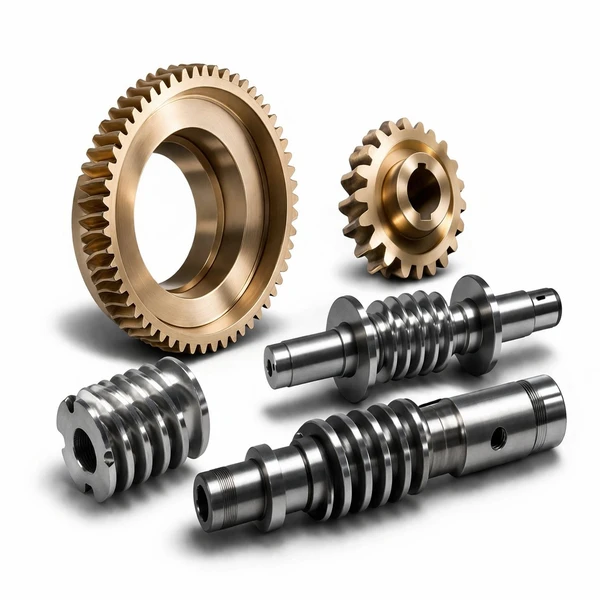
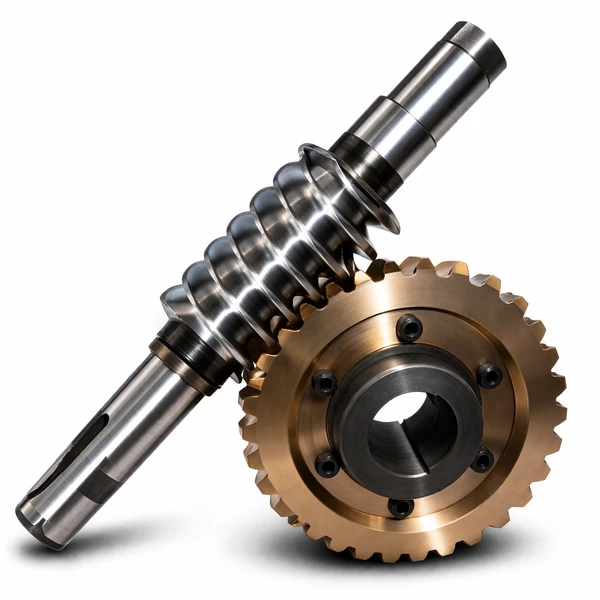
Long worm gear service life starts with documented material quality and verified contact geometry. Korea Ever-Power’s alloy steel worm gear sets ship with: material certificate to mill heat number confirming 40Cr composition (for D2 medium duty) or SCM415 composition and case depth record (for D3 heavy duty); CMM dimensional inspection confirming bore to H7 and lead error within the specified DIN class; and a contact pattern photograph confirming >=70% face width coverage — the key parameter for controlled wear rate. The contact pattern is tested at the assembly rig before shipment, not estimated from drawing geometry. A gear set with documented line contact will wear controllably and predictably. A gear set with undocumented point contact will wear in unpredictable bursts. The difference between 14-month and 72-month service life often comes down to whether the contact pattern was verified at shipment.

View / Request Specification

Precision Worm Wheel -- Service Life Optimised Replacement
Replacement Wheel / Profile-Matched / Documented
Precision Worm Wheel — Service Life Optimised Replacement
When replacing a worn worm wheel, the worm shaft condition determines what type of replacement wheel is needed. If the shaft thread flanks are unworn (surface finish and dimensions within original specification), a standard replacement wheel to the original specification is correct. If the shaft has measurable wear, the replacement wheel should be hobbed with a cutter profile matched to the actual worn shaft geometry — so the contact pattern on the new wheel starts at the correct load distribution rather than at a narrow contact that will wear rapidly to accommodate the geometry mismatch. Korea Ever-Power can hob a profile-matched replacement wheel from your shaft dimensions (provide module, lead, pitch diameter, and if possible, a worn shaft sample). Contact pattern verification on the replacement wheel is tested against the actual shaft before shipment.

View / Request Specification

Annual Maintenance Kit -- Worm Gear Drive
Maintenance Supply Program / Annual Kit
Annual Maintenance Kit — Worm Gear Drive
For facilities managing multiple worm gear drives, Korea Ever-Power offers an annual maintenance supply program: a pre-configured kit containing the replacement worm wheel (or set) for each drive in the facility’s inventory, shipped annually on a schedule that aligns with the planned maintenance interval. The kit includes: replacement worm wheel(s) or complete sets as required; 5 litres of specified non-EP oil (mineral or PAO as specified for each drive); magnetic drain plug if not currently installed; and a maintenance record sheet for each drive. Pre-configured annual kits eliminate the emergency procurement scenario — where a drive fails and the replacement part has a 4-week lead time while the production line is down. Contact Korea Ever-Power with your drive inventory list to receive a program proposal.

View / Request Specification

Service Life FAQ

Worm Gear Service Life — Questions from Maintenance Engineers

What is a realistic service life expectation for a worm wheel on a medium-duty industrial conveyor?+

Under correct specification and maintenance — non-EP lubricant, running-in oil change at 50-100 hours, filtered breather, correct load (below 80% rated torque) — a ZCuSn10Pb1 tin bronze wheel on a 40Cr shaft in medium-duty conveyor service should achieve 4-7 years before dimensional wear (increased backlash beyond acceptable limit) requires replacement. This assumes the drive is not overloaded, contamination is controlled, and lubricant is changed at 2,000-hour or annual intervals. Drives that achieve less than 2 years should be investigated for one of the six failure accelerators described in this guide — short service life is always traceable to a specific correctable cause.

How do I know if my worm gear drive is being overloaded?+

The most accessible indicator is motor current. Measure the motor input current during normal loaded operation using a clamp meter, and compare to the motor nameplate rated current. If actual operating current exceeds rated current, the drive is in overload. Note that nameplate current is the continuous rated current — short peaks above rated current (during starts, jams, or sudden load increases) are normal, but sustained operation above rated current is not. From motor current you can estimate output torque: T_output = (I_actual/I_rated) x T_motor_rated x gear_ratio x efficiency. If T_output exceeds the worm gear set’s rated output torque, the gear is overloaded. The remedy is either to reduce the load or to specify a larger module gear set.

Is there a simple inspection I can do at each oil change to assess the condition of the worm wheel without disassembly?+

Yes. At each oil change, collect a 100ml sample of the drain oil before filling. Inspect: colour (dark brown-black indicates overheating; green-black indicates EP oil or corrosive attack; milky white indicates water ingress). Allow the sample to settle for 2 hours and inspect the bottom for metallic sediment — bronze-coloured paste in small quantity is normal running-in wear product; large metallic chunks indicate abnormal wear. Check the magnetic drain plug for metallic debris — a thin bronze-coloured film is normal; a thick deposit of metallic particles is not. These three checks take 5 minutes and provide the earliest warning of accelerating wear before it becomes catastrophic failure.

Can switching to PAO synthetic oil cause seal leakage in existing drives?+

PAO synthetic oil has slightly different seal compatibility than mineral oil. Standard NBR (nitrile butadiene rubber) seals are compatible with PAO — no swelling or degradation occurs. The concern that sometimes arises is that PAO, being a cleaner solvent than mineral oil, can remove sludge deposits that had been sealing minor housing joint leaks. If a drive has never leaked with mineral oil but develops a slow weep after switching to PAO, the PAO has revealed a pre-existing leak path. The correct solution is to clean and reseal the leaking joint, not to revert to mineral oil.

We operate our factory during the week but the worm gear drives are idle over the weekends. Does this affect service life?+

Weekend shutdown affects service life through two mechanisms. First, lubricant film: during idle periods, the oil film on the tooth flanks drains away. The first few minutes of operation after a long idle period are in boundary lubrication — higher friction and wear until the film re-establishes. Second, moisture condensation: as the housing cools over the weekend, moisture can condense on internal surfaces if the housing is not sealed against the external atmosphere. Install filtered breathers and ensure shaft seals are in good condition to minimise moisture ingress during idle periods. Some facilities fill drives with a slightly higher viscosity oil if long idle periods are frequent, to maintain a thicker residual film on tooth surfaces during storage.

My maintenance interval is 2,000 hours. Should I switch to a longer interval if I use PAO synthetic oil?+

PAO synthetic oil typically allows extended drain intervals compared to mineral oil of the same ISO VG grade — up to 4,000-5,000 hours for continuously operating industrial drives at normal temperatures. However, the correct interval depends on operating conditions, not just oil type. For drives operating at high temperature (housing >65 degrees C), high contamination risk, or frequent thermal cycling, a 2,000-hour interval with PAO is appropriate regardless of the oil’s theoretical life. For clean, temperature-controlled indoor drives at moderate load, extending to 3,000 hours with PAO is reasonable. Conduct oil analysis at 2,000 hours on the first extended-interval change: if particle count is low and viscosity within 15% of fresh oil, extending to 3,000 hours is justified for that specific application.

Is there a benefit to using ZCuAl10Fe3 aluminum-iron bronze instead of ZCuSn10Pb1 tin bronze for longer service life?+

For service life under normal wear conditions, the correct answer is counterintuitive: ZCuSn10Pb1 tin bronze typically gives longer service life in standard conveyor and industrial applications than ZCuAl10Fe3 aluminum-iron bronze. This is because tin bronze’s lead phase provides boundary lubrication protection during start-stop cycles, protecting against the scuffing that initiates rapid wear. ZCuAl10Fe3 is superior in shock-loading applications (higher tensile strength, better bending fatigue resistance) but wears faster under continuous sliding without the boundary lubrication benefit of the lead phase. Specify ZCuAl10Fe3 when the failure mode is fracture or heavy shock loading — not to improve service life in standard wear applications.

Can I rebuild a worn worm gear drive by replacing only the wheel, keeping the original worm shaft?+

Yes, provided the shaft is assessed before reuse. Assess the shaft by: (1) measuring thread flank surface roughness with a portable profilometer — if Ra exceeds 1.6 um (standard) or 0.8 um (precision drives), the shaft flanks are worn and thread grinding is required before the new wheel is installed; (2) checking lead error with a CMM or pitch measurement — a worn shaft with increased lead error will produce poor contact on the new wheel; (3) checking shaft runout — bent or eccentric shafts damage new wheels rapidly. If the shaft passes all three checks, a standard replacement wheel is correct. If the shaft shows significant wear but is otherwise serviceable, a profile-matched replacement wheel (hobbed to the worn shaft geometry) provides better initial contact and longer life on the worn shaft than a standard-specification wheel.

Extend the Service Life of Your Worm Gear Drives

Describe your application and current wheel life. Korea Ever-Power will identify which of the six levers applies to your situation and recommend specification or maintenance changes that address the root cause — before the next replacement cycle begins.

編集者: Cxm