ウォームギアとは?完全技術ガイド
Most engineers can identify a worm gear on sight. Far fewer can explain why it self-locks, why it needs a bronze wheel against a hardened steel worm, or why its efficiency drops as the ratio rises. This guide builds worm gear understanding from first principles — starting with the geometry that makes everything else follow.
The Self-Locking Paradox — Why a Gear That Resists Motion Is Useful
A gear set that blocks rotation in one direction sounds like a design flaw. In most mechanical systems, resistance to motion is something engineers spend effort eliminating. But in applications ranging from manual hoists to solar trackers to surgical robot joints, a drive that actively prevents reverse rotation — without any external brake, without motor holding current, without springs or ratchets — is exactly what the design requires. A ウォームギアセット delivers this property as a geometric consequence, not as an added mechanism.
Understanding why requires understanding lead angle. And understanding lead angle requires starting with the basic geometry of how a worm thread engages a worm wheel. This guide builds that understanding from the component level up, covering the physics of self-locking, the reason for the bronze wheel material pairing, the contact mechanics that determine load capacity, and the efficiency trade-off that every engineer specifying a worm drive needs to account for in their motor sizing calculation.
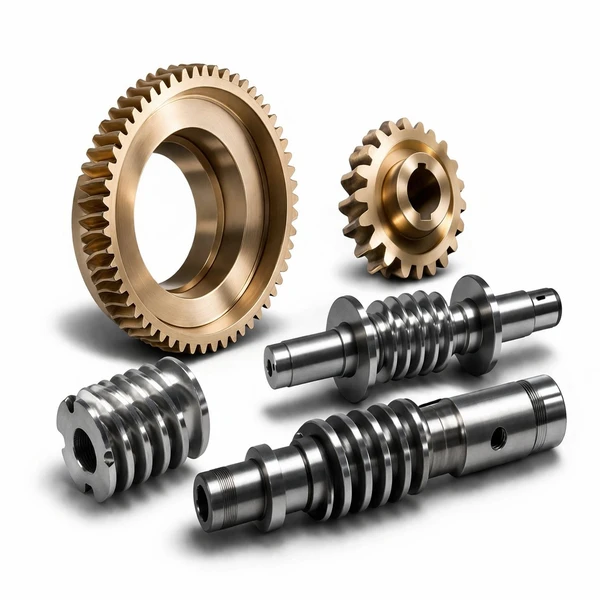
Technical Table
| パラメータ | 価値 |
|---|---|
| Model Number | M3, M4, M5, M8, M12 and custom modules |
| 材料 | Brass, C45 steel, Stainless steel, Copper, POM, Aluminum, Alloy and others |
| 表面処理 | Zinc plated, Nickel plated, Passivation, Oxidation, Anodization, Geomet, Dacromet, Black Oxide, Phosphatizing, Powder Coating, Electrophoresis |
| 標準 | ISO, DIN, ANSI, JIS, BS and Non-standard |
| 精度 | DIN6, DIN7, DIN8, DIN9 |
| Teeth Treatment | Hardened, Milled or Ground |
| 許容範囲 | 0.001 mm – 0.01 mm – 0.1 mm |
| Finish | Shot/sand blast, heat treatment, annealing, tempering, polishing, anodizing, zinc-plated |
| Items Packing | Plastic bag + Cartons or Wooden Packing |
| 支払い条件 | T/T, L/C |
| Production Lead Time | 20 business days (sample); 25 days (bulk) |
| 応用 | Automatic controlling machines, semiconductor industry, general industry machinery, medical equipment, solar energy equipment, machine tools, parking systems, high-speed rail and aviation transport equipment |
Anatomy of a Worm Gear Set — Components and Terminology
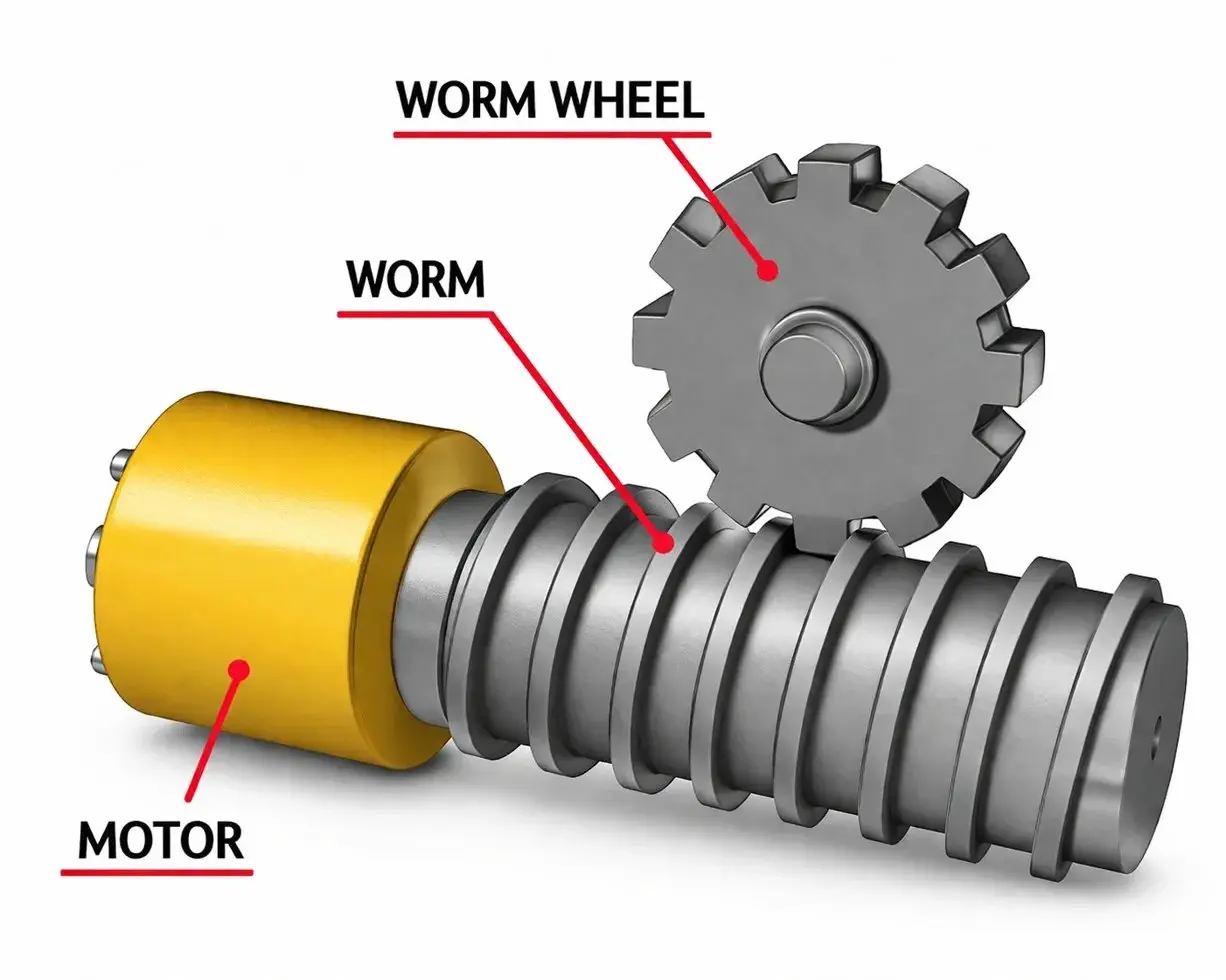
A ウォームギアセット consists of exactly two components. The worm is the driving element — a cylindrical shaft with one or more helical threads cut into its surface, resembling a large screw or threaded rod. The worm wheel (also called the worm gear, or simply the wheel) is the driven element — a gear wheel whose teeth are curved in a concave arc across the tooth face width to partially envelop the worm cylinder. The two shafts are oriented at 90 degrees to each other in the most common configuration, though other crossing angles are possible in specialized designs.
Key Terminology — What Each Term Actually Means
Module (m): The ratio of the pitch diameter to the tooth count. Determines the physical size of the teeth. Module 2 teeth are twice as large as module 1 teeth in all linear dimensions.
Number of starts (z1): How many separate helical thread paths are cut into the worm. A single-start worm has one continuous thread; a two-start worm has two threads running simultaneously around the cylinder. Starts directly determine the gear ratio — not the number of thread turns visible on the worm surface.
Number of teeth (z2): The tooth count on the worm wheel. Together with z1, this determines the gear ratio: i = z2 ÷ z1.
Lead: The axial distance the worm thread advances per complete rotation of the worm. Lead = axial pitch × number of starts. For a single-start worm, lead equals the axial pitch. For a two-start worm, lead is twice the axial pitch.
Lead angle (λ): The angle between the worm thread and a plane perpendicular to the worm axis. Calculated as: λ = arctan(lead ÷ (π × pitch diameter)). This angle is the single most important geometric parameter in a worm gear set — it determines efficiency, self-locking capability, and the contact mechanics at the mesh.
The Thread Geometry That Determines Everything Else
The lead angle is not just a number on a drawing — it is the parameter that physically connects gear ratio, self-locking behavior, and transmission efficiency into a single coherent system. Every other property of the worm gear drive follows from the lead angle, which is why understanding it is more useful than memorizing specifications.
Consider what happens at the mesh contact between the worm thread and the worm wheel tooth. The worm rotates and the thread surface slides across the wheel tooth surface. This is fundamentally sliding contact — not the rolling contact of spur, helical, or bevel gears. The direction of sliding is along the worm helix, at an angle to the direction of power transmission into the wheel. The component of the contact force that transmits torque to the wheel is determined by the cosine of the lead angle; the component that generates friction (and therefore heat) is determined by the lead angle and the friction coefficient of the material pair.
At a small lead angle (shallow helix — as found in high-ratio single-start worms), most of the contact force pushes the wheel tooth sideways into friction rather than driving it forward. This is why high-ratio worm drives have low efficiency — the geometry is inherently inefficient at translating input motion into output torque. At a large lead angle (steep helix — as found in low-ratio multi-start worms), a larger proportion of the contact force goes into useful torque transmission, and efficiency improves. A 10:1 single-start worm might achieve 80–88% efficiency; a 4:1 three-start worm might achieve 93–96% efficiency.
The Efficiency Formula — What the Math Actually Shows
Transmission efficiency η when the worm drives the wheel: η = tan(λ) ÷ tan(λ + ρ’), where ρ’ is the friction angle = arctan(μ ÷ cos α), μ is the friction coefficient, and α is the pressure angle (typically 20°). As λ decreases (higher ratio, shallower helix), the numerator shrinks faster than the denominator grows, and η approaches zero. This is not a deficiency of any particular manufacturer — it is a mathematical property of the worm gear geometry. Engineers who expect high efficiency from a high-ratio worm drive will always be disappointed; engineers who understand the formula will size their motors correctly from the start.
Self-Locking — The Physics Behind the Most Misunderstood Property
Self-locking occurs when the worm wheel cannot drive the worm — applying torque to the wheel output shaft produces friction at the mesh contact that exceeds the tangential force required to rotate the worm. The condition for self-locking is: lead angle λ less than friction angle ρ’. In formula terms: λ less than arctan(μ ÷ cos α).
For a typical steel worm against tin bronze wheel with oil lubrication, the friction coefficient μ is approximately 0.05–0.10. At a 20-degree pressure angle, ρ’ = arctan(0.07 ÷ cos 20°) ≈ 4.3 degrees. Any worm with a lead angle below approximately 4.3 degrees will self-lock under these lubrication conditions. A single-start worm at 40:1 ratio with a standard pitch cylinder diameter selection typically has a lead angle of 2–3 degrees — comfortably self-locking with oil lubrication.
Three practical implications follow from this physics that are often overlooked in specifications:
■ Self-locking depends on lubricant viscosity. As temperature rises, lubricant viscosity drops, the effective friction coefficient at the mesh decreases, and the friction angle decreases. A drive that reliably self-locks at 20°C with mineral oil may not self-lock at 75°C with a fully synthetic gear oil — the same drive, the same gear set, different operating conditions. For applications where self-locking is a safety requirement (hoists, solar trackers, positioning mechanisms that must hold load when the motor is off), the self-locking condition must be verified at the maximum operating temperature with the specific lubricant specified, not assumed from a generic nominal lead angle.
■ Multi-start worms are generally not self-locking. A two-start worm at 20:1 ratio has a lead angle approximately twice as large as a single-start worm at the same ratio. The larger lead angle may exceed the friction angle, eliminating self-locking. When self-locking is required, single-start worms with ratios above 15:1–20:1 are the standard specification. Below that ratio, or with multi-start worms, an external brake or holding mechanism may be needed.
■ “Self-locking” is not the same as “fail-safe.” Self-locking prevents rotation initiated from the output shaft under static load. It does not prevent rotation initiated by dynamic loads — vibration, shock impulse, or oscillating loads that momentarily reverse the force direction can cause a self-locking drive to creep over time. For critical safety applications, self-locking should be treated as a supplementary safety feature, not the primary load-holding mechanism.
Contact Mechanics — Why the Worm Wheel Tooth Curves Inward
The worm wheel tooth face is not flat across its width like a spur gear tooth. It is concave — curving inward in an arc that matches the worm’s pitch cylinder diameter. This curvature is produced by using a worm-profile hob (a cutting tool whose profile matches the worm thread geometry) to cut the wheel teeth. The result is that when the worm and wheel are assembled at the correct center distance, the contact between them is a line rather than a point.
This line contact is the key to the load capacity advantage of a properly manufactured worm gear set over a simple crossed helical gear arrangement (where a standard helical gear is paired with a worm, producing only point contact). Contact stress at the mesh is the contact force divided by the contact area. A line contact zone covering 15–30 mm of the tooth face width distributes the same force over an area 5 to 10 times larger than a point contact zone, reducing contact stress by the same factor. Lower contact stress means longer surface fatigue life, higher sustainable continuous torque, and better resistance to sudden overload.
The practical consequence for buyers: a worm wheel cut with a worm-profile hob is a fundamentally different product from one cut with a standard helical hob — even if the module, tooth count, bore diameter, and external dimensions are identical. The first has line contact and high load capacity; the second has point contact and low load capacity. There is no visual way to distinguish them from the outside. The only reliable check is the contact pattern test: assemble the worm and wheel at the correct center distance, roll under marking compound, and verify that the contact patch covers at least 60–70% of the tooth face width. Korea Ever-Power performs this test on all matched pairs and includes the contact pattern photograph in the shipment documentation.
Why Tin Bronze Wheel Against Hardened Steel Worm — The Tribological Reason
The standard material pairing for worm gear sets — hardened steel worm against tin bronze wheel — is not an arbitrary convention. It follows from the specific nature of the sliding contact at the worm mesh and the failure mode that this pairing prevents.
Sliding contact between two steel surfaces, even with lubrication, generates adhesive wear — a process where high spots on one surface weld momentarily to high spots on the other under the contact pressure and temperature, then tear apart as sliding continues. The torn fragments become abrasive particles in the oil film, accelerating wear exponentially. This process, called scuffing or galling, is the dominant failure mode when steel runs against steel at the sliding velocities typical of worm gear contacts (0.5–15 m/s).
Tin bronze (ZCuSn10Pb1) prevents this failure mode through a specific mechanism: under the combination of contact pressure and sliding at the mesh, the bronze surface forms a thin, self-renewing transfer layer of zinc-rich bronze on the hardened steel worm thread. This transfer layer acts as a sacrificial solid lubricant — it has a lower shear strength than either parent metal, so sliding preferentially occurs within the layer rather than causing adhesion between the base materials. The layer continuously replenishes from the bronze wheel surface as it is consumed. The result is a stable, low-wear sliding interface that can sustain millions of contact cycles without scuffing.
The worm shaft surface hardness requirement (55–62 HRC for production CNC-grade worms) relates to this mechanism: the harder the worm thread surface, the smoother the initial surface finish achievable after grinding, and the more completely the transfer layer forms during running-in rather than at rough high spots that generate abrasive particles. A soft or rough worm thread surface disrupts the transfer layer formation and leads to early adhesive wear failure, regardless of how good the bronze wheel material is.
 |
 |
 |
 |
Cylindrical vs Globoidal Worm Gears — When the Type Matters
Two fundamentally different worm geometries exist in production. The cylindrical worm (the most common type) has a worm shaft that is the same diameter along its entire useful length — the thread is cut into a constant-diameter cylinder. This type is straightforward to manufacture, easy to verify dimensionally, and can be made to DIN precision classes with standard grinding equipment. The vast majority of industrial worm gear sets — including everything in the Korea Ever-Power catalog — are cylindrical worm gear sets.

The globoidal worm (also called hourglass worm or Hindley worm) has a worm shaft that is narrower at the center than at the ends — the worm curves in the radial direction to wrap partially around the wheel. This curvature allows more wheel teeth to be in simultaneous contact with the worm at any instant, theoretically improving load capacity and efficiency. The practical disadvantages are substantial: the worm is significantly harder to manufacture to tight tolerances, harder to verify dimensionally, and cannot be adjusted axially to recover backlash the way a cylindrical worm can. Globoidal worms appear in specialty high-load applications such as slew drives for construction cranes and large military turrets, where the load density justification is strong enough to accept the manufacturing complexity.
For the overwhelming majority of industrial applications — CNC machine tool rotary axes, conveyor drives, solar trackers, agricultural machinery, packaging equipment, medical devices, and automotive actuators — the cylindrical worm is the correct specification. The globoidal type offers advantages only when the contact load per unit housing volume is so extreme that standard cylindrical worm design cannot achieve the required service life within the installation space constraint.
Common Terminology Errors — What People Say vs What They Mean
The terminology used for worm gear components is inconsistent across industries, regions, and engineering traditions. The table below clarifies the most common sources of confusion encountered in procurement discussions:
| What Is Said | What It Often Means | Clarification |
|---|---|---|
| “Worm gear” | Sometimes the worm shaft; sometimes the wheel; sometimes the matched set | “Worm gear set” or “worm and wheel” clarifies the complete pair; “worm” = the shaft; “worm wheel” = the gear |
| “Number of teeth on the worm” | Counting thread starts, not actual gear teeth | The worm has “starts” (1, 2, 3…) not conventional gear teeth; the wheel has teeth (z2) |
| “Gear ratio 40:1” | Could mean reduction or speed ratio depending on context | Specify “40:1 reduction” — worm input to wheel output. The worm always drives in standard operation. |
| “Module 4 worm gear” | Could be the worm shaft module, the wheel module, or both | For a matched set, worm axial module = wheel transverse module. Specifying “M4 matched set” is unambiguous. |
| “Self-locking worm gear” | Often assumed as inherent to all worm gears | Self-locking depends on lead angle being below friction angle — not guaranteed for all ratios, lubricants, and temperatures |
| “Right-angle gearbox” | Often used for worm gear reducers but also applies to bevel gear boxes | Specify “worm gear reducer” or “bevel gear reducer” to distinguish the transmission type |
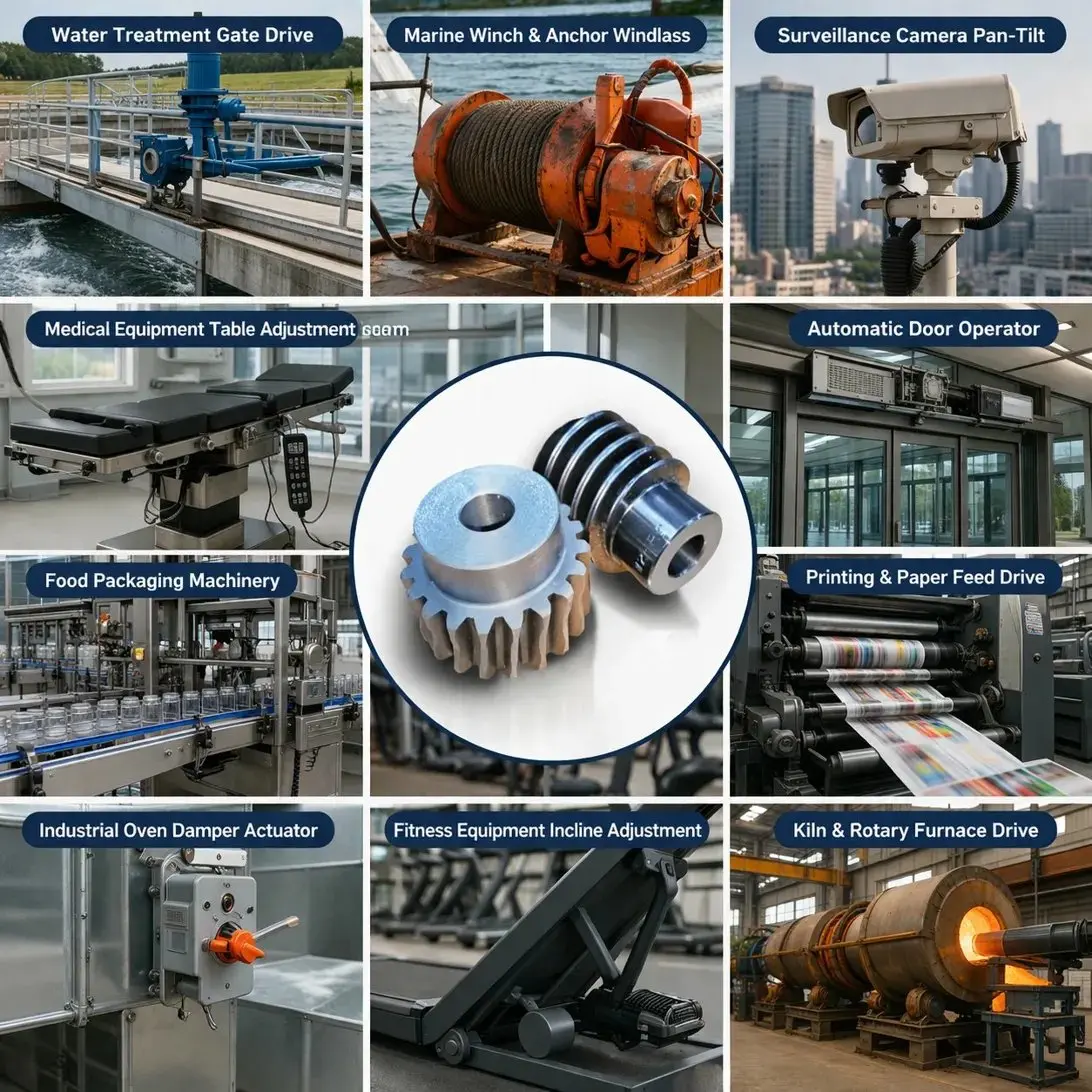
Where Worm Gear Drives Belong — and Where They Do Not
A worm gear drive is the correct mechanical solution when the application combines two or more of the following characteristics simultaneously: a right-angle shaft layout is required; a high reduction ratio is needed in a single stage; self-locking position holding without a separate brake is required; noise must be minimized relative to other gear types; and compact packaging at a high ratio is important.
When these conditions are absent — particularly when high power transmission efficiency is the primary requirement, when the shaft layout is parallel, or when a low ratio is needed — alternatives such as helical gears, planetary gearboxes, or bevel gear sets should be evaluated. The worm gear’s efficiency penalty (which can reach 30–40% of input power as heat at high ratios) is a real operating cost that must be accounted for in the total system energy budget and in the motor thermal load calculation.
For complete enclosed drive systems combining a worm gear set with a housing, bearings, seals, and a motor mounting flange, compact ウォームギア減速機 are available as ready-to-mount units. For bare gear components where the housing is part of the machine frame design, individual worm and wheel sets in the full range of modules, materials, and precision classes are available from Korea Ever-Power. 
よくある質問
Ready to Specify a Worm Gear Set for Your Application?
韓国エバーパワー社が製造 precision worm gear sets from M0.5 to M12 in brass, bronze, stainless steel, and alloy steel. Send your output torque, speed, ratio, and space envelope — we respond with a confirmed specification within one working day.
編集者: Cxm